
Ever open three tabs of power wheelchair buying guides and feel your eyes glaze over? I have. The specs, the jargon, the options — it can all blur together fast. But once you know how to translate those pages into personal decisions, everything changes. In this walkthrough, I will show you how to turn any buying guide into a simple, confident plan, so you can move through your day with more comfort, safety, and independence.
Along the way, I will point you to Go Wheelchairs, where expert advisors connect the dots between your life, your coverage, and the right chair. Go Wheelchairs is dedicated to providing reliable, motorized wheelchairs at fair prices and assisting customers with Medicare and other health insurance pathways, empowering individuals to move freely and independently. Ready to make those articles finally work for you?
Prerequisites and Tools
A little prep makes every buying guide easier to use. Think of this like pre-measuring before you hang a picture frame — five minutes now saves frustration later.
- Notebook or digital notes app for quick checklists and specs
- Measuring tape for doors, hallways, ramps, thresholds, and car trunks
- Current weight and height, plus preferred seat width and depth if known
- List of daily places and obstacles: tight kitchen turns, gravel driveway, bus steps, office elevator
- Any clinical recommendations from your clinician or therapist
- Insurance details: plan name, member number, and customer service phone
- If applicable, your physician’s order or notes about medical necessity
Step 1: Define Your Daily Life, Not Just the Chair
Start with your routine. Where do you go most days, and what surfaces do you cover? If you regularly navigate thick carpet, uneven sidewalks, or curb cuts, you will want different tires and suspension than someone who primarily moves between kitchen, den, and bedroom. Also look at storage and transportation: Does the chair need to fold to fit in a small car trunk, or can it be secured in a van?
Now map personal support needs. Do you need power tilt or recline for pressure relief (note: tilt/recline availability varies by model and seating system)? Are transfers easier with swing-away footrests or elevating leg rests (model-dependent)? Will a seat lift help you reach cabinets or maintain eye-level interactions at work? These answers turn vague preferences into concrete requirements.
- Comfort and posture: cushion type, lumbar support, power tilt and recline (model-dependent)
- Control preferences: right or left joystick; discuss alternative inputs (for example, head arrays or sip‑and‑puff) with your clinician and supplier to confirm availability and compatibility
- Capacity and size: user weight, preferred seat width, door clearance at home
- Transport: folding or quick-disassembly on some models (for example, Go Chair disassembles into pieces), removable or airline‑compliant batteries on travel models; verify vehicle tie‑down compatibility for the specific model
Step 2: Turn Features into Non-Negotiables Using Power Wheelchair Buying Guides
Most guides list dozens of features with numbers that seem abstract. Let’s anchor them to real outcomes. A small turning radius matters if you have a narrow galley kitchen or tight office cubicle. Ground clearance matters if your driveway has frost heaves or you face sidewalk cracks after rain. Battery range matters if you take long days out or commute by bus and train with few charging stops.
Use this table as your decoder ring. As you skim power wheelchair buying guides, jot down the specifications, then align them to your day-to-day outcomes and questions to ask a dealer or advisor.
| Feature | Why It Matters | Typical Spec to Watch | Questions to Ask |
|---|---|---|---|
| Turning radius | Helps in small kitchens, bathrooms, and elevators | About 20 to 27 inches for many mid-wheel designs | Can I complete a 180-degree turn in my hallway width? |
| Ground clearance | Prevents scraping on thresholds, ramps, and outdoor bumps | About 2 to 4 inches for standard models | Will this clear my porch threshold and driveway lip? |
| Battery range | Confidence for errands, workdays, and outings | Often 10 to 20 miles per charge depending on terrain | What is the realistic range with my weight and surfaces? |
| Weight capacity | Safety and component longevity | Standard: about 250 to 300 pounds; heavy-duty: about 350 to 600 pounds | How does capacity affect suspension and seat options? |
| Seating options | Pressure relief, posture, comfort over time | Power tilt and recline availability; seat lift travel | Which cushions and backrests pair best with these features? |
| Portability | Travel, stowing in cars, apartment living | Folding frame or quick-disassembly sections | Can I lift any components safely into my vehicle? |
Step 3: Choose a Drive Type That Fits Your Spaces
Drive configuration changes how a chair feels and turns. Rear-wheel, mid-wheel, and front-wheel each have strengths. If you have mostly indoor use and tight turns, mid-wheel is often the hero. If you split time between indoors and rougher outdoor surfaces, front-wheel or rear-wheel may feel smoother and track straighter. Your ideal pick depends on your rooms, your routes, and your comfort with how the chair pivots.
| Drive Type | Strengths | Ideal Use | Typical Turning Radius | Notes |
|---|---|---|---|---|
| Mid-wheel drive | Smallest turning circle, great maneuverability | Indoor spaces with narrow halls and tight kitchens | Often near 20 to 22 inches | May feel bumpier outdoors without upgraded suspension |
| Front-wheel drive | Stable curb approach, good outdoor traction | Mixed indoor and outdoor, gentle off-pavement paths | Often near 24 to 26 inches | Front caster path can feel different when turning |
| Rear-wheel drive | Predictable outdoor tracking at higher speeds | Outdoor-focused routes, longer straight-line travel | Often near 26 to 28 inches | Wider turns indoors; consider room layouts closely |
Here is a quick story. Maya, who works in a cozy bakery, tried a rear-wheel chair first and kept bumping a display by the register. After switching to a mid-wheel demo with a shorter turning radius, she could pivot neatly behind the counter and keep those croissants safe.
Step 4: Measure Your World So Specs Mean Something
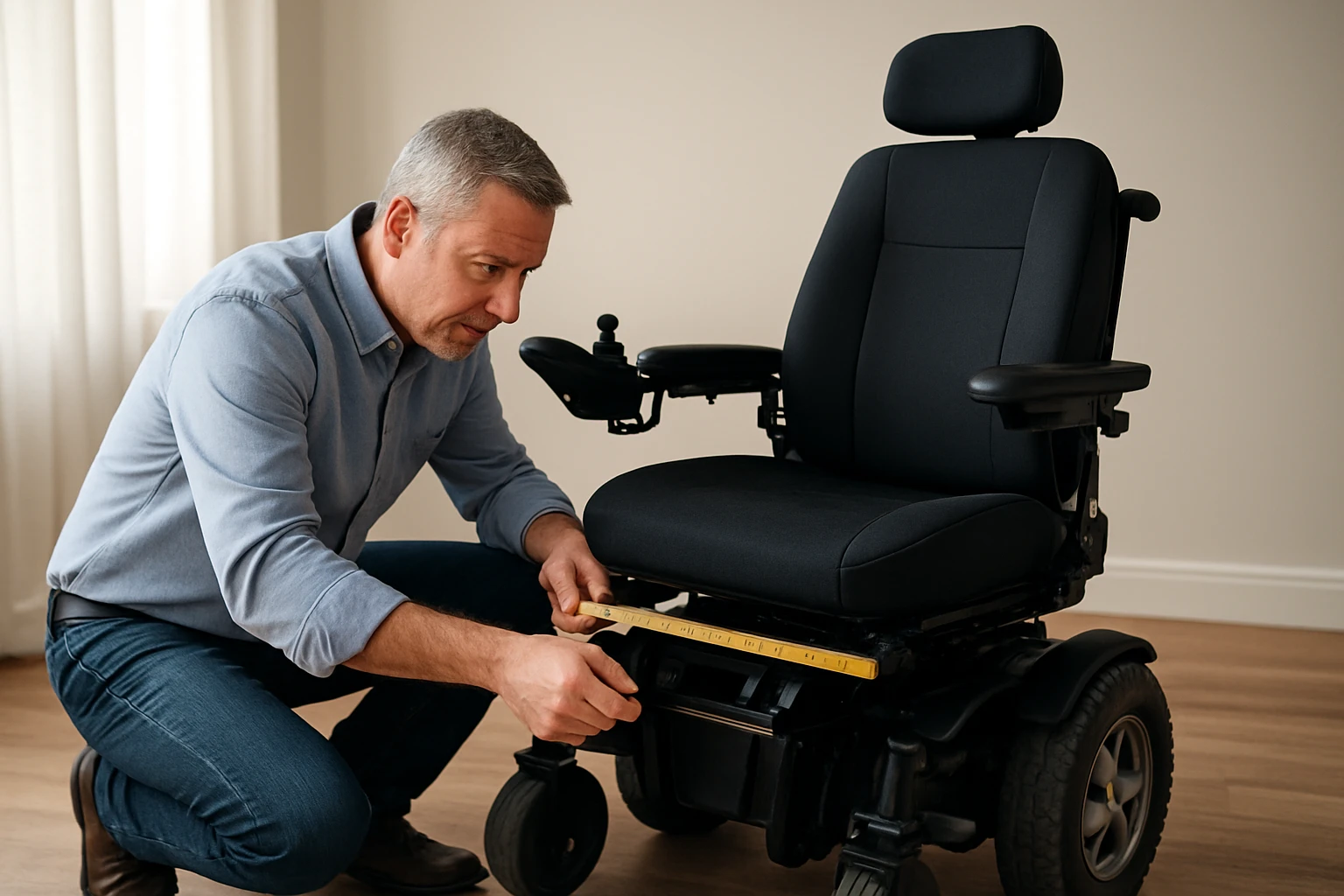
Numbers on a page only help if they match your real spaces. Walk through your routes with a measuring tape and note the tightest spots. Look at bathroom door width, hallway pinch points, elevator interior depth, and the rise and run of any ramps. Do not forget outdoor thresholds and the height of any vehicle tailgate or trunk you plan to use.
- Doors: Many interior doors run 28 to 32 inches clear. What is your narrowest?
- Hallways: Can you turn into rooms without backing up? Measure width at corners.
- Thresholds: Add up threshold height plus any metal strip or trim lip.
- Ramps: Note the steepest ramp you routinely climb and its surface material.
- Vehicle: Record opening height, trunk depth, and the lift you can handle safely.
| Measurement | Your Number | Target Spec | Pass or Needs Work |
|---|---|---|---|
| Narrowest door width | Chair overall width at least 1 to 2 inches less | ||
| Tightest hallway width | Turning radius compatible with 180-degree turn | ||
| Highest threshold | Ground clearance and front caster size to match | ||
| Vehicle opening height | Chair folded or disassembled height under limit |
Once you have your measurements, the phrases in buying guides suddenly speak your language. A turning radius is not just a number — it is whether you can swing into your bathroom without removing a towel rack.
Step 5: Build a Shortlist with Go Wheelchairs Comparison Tools
This is where momentum builds. Use the Go Wheelchairs resources hub to filter by what matters most: drive type, battery range, weight capacity, seat options, and portability. The hub includes buying guides, comparison tools, and travel tips, so you can filter smartly and also plan for life after purchase. Whether you need a standard setup for daily inside use or a heavy-duty platform for outdoor resilience, you will quickly narrow your choices.
Two quick examples from real shoppers: Ron needed high capacity and rugged tires to manage a sloped gravel drive, so he focused on heavy-duty models with reinforced suspension. Kim wanted to fly twice a year to see her grandkids, so she filtered for lightweight, foldable designs with airline-friendly battery options. Both found options in minutes with help from a Go Wheelchairs advisor.
| Model | Drive Type | Turning Radius | Range | Capacity | Portability | Notes |
|---|---|---|---|---|---|---|
| Shortlist A | Mid-wheel | 22 inches | 15 miles | 300 pounds | Non-folding | Excellent indoors; upgrade cushion |
| Shortlist B | Front-wheel | 25 inches | 18 miles | 350 pounds | Disassembles | Good curb handling |
| Shortlist C | Rear-wheel | 27 inches | 20 miles | 400 pounds | Non-folding | Smooth outdoors; larger footprint |
Tip: Keep your shortlist to three models at a time. If a fourth option tempts you, replace one instead of adding. Decision clarity rises when you compare apples to apples.
Step 6: Align Your Choice with Medicare or Insurance Coverage
Coverage can feel complicated, yet a simple checklist makes it manageable. Many plans follow guidance from the Centers for Medicare & Medicaid Services on power wheelchairs used in the home. That often includes a face-to-face evaluation with your clinician, documentation showing medical necessity, and a written order that specifies the type of wheelchair and key features. Plans differ, so confirm details with your insurer and lean on Go Wheelchairs for support with documentation and supplier coordination.
- Call your plan and ask what documentation is required for a power wheelchair used in the home.
- Schedule a face-to-face evaluation with your clinician and discuss why a power chair is necessary.
- Request a detailed written order listing diagnosis, chair type, and required features (noting some features, like tilt or elevating leg rests, may be model-dependent).
- Choose an in-network supplier. Go Wheelchairs can verify network status and help submit paperwork.
- Ask about prior authorization timelines and what to expect after approval.
| Coverage Step | What to Prepare | Who Helps | Timing Tip |
|---|---|---|---|
| Eligibility check | Policy number, plan details, home-use needs | You and insurer representative | Call early to confirm benefits |
| Clinical evaluation | Daily activities list, fall history, transfer needs | Clinician or therapist | Bring your measurements for context |
| Written order | Diagnosis, chair type, required features | Clinician | Ask for clarity on features to avoid delays |
| Supplier selection | In-network confirmation, preferred models | Go Wheelchairs advisor | Verify network before scheduling demo |
| Prior authorization | All documents submitted, contact info | Supplier and insurer | Track status weekly and note reference numbers |
If out-of-pocket costs apply, ask about payment plans, secondary insurance, and whether a Flexible Spending Account or Health Savings Account can help. Go Wheelchairs teams routinely guide shoppers through these steps, taking the sting out of paperwork so you can focus on mobility and comfort.
Step 7: Test Drive and Fit Like a Pro
No amount of reading beats a hands-on demo. Schedule a test drive for your two or three finalists. Bring your list of tight turns and tough surfaces to simulate real life. Try both right and left joystick positions. If standard controls are tiring or difficult, discuss alternative controls (such as head arrays or sip‑and‑puff) with your clinician and supplier to confirm compatibility and have a clinician present to fine‑tune settings.
Evaluate seating like you would a favorite chair at home. Sit for at least 20 minutes and check for hotspots at shoulders, hips, and tailbone. Cycle through tilt and recline if available to feel how your body loads and unloads pressure. If possible, try different cushions or backrests. Ask about seat lift travel and practice reaching shelves or having a conversation at eye level.
- Comfort check: pressure points, posture alignment, footplate height, armrest height
- Control check: response to small inputs, acceleration smoothness, stopping feel
- Environment check: turn through a doorway width like your narrowest at home
- Loading check: practice disassembly or folding and lifting any components you will handle
Step 8: Plan for Ownership — Maintenance, Travel, and Support

Owning a power chair is like owning a small, friendly vehicle. Batteries need regular charging, tires wear, and joysticks appreciate a soft cloth now and then. Ask about maintenance schedules, warranty coverage, and how to reach support quickly if something feels off. Go Wheelchairs provides personalized support, plus a resources hub with travel tips if you plan to fly or road-trip with your chair.
If air travel is in your future, speak with your airline well before departure. Some lithium-based batteries must be carried in the cabin, and gate-checking procedures vary. Print model and battery information and keep it with you. For road trips, consider a portable charger and a short ramp if your destinations have porch steps. Small preparations today mean fewer surprises tomorrow.
- Charge smart: top up nightly and avoid deep discharges when possible
- Keep a log: note range changes, strange noises, or error codes for service visits
- Spare plan: carry a basic tool kit and a tire repair plan for pneumatic tires
- Support: save Go Wheelchairs service contacts in your phone
Common Mistakes When Using Buying Guides
Even careful readers can get tripped up. Here are the pitfalls I see most, plus how to dodge them gracefully.
- Reading specs without measuring your space. Fix: Measure first, then filter guides by your actual numbers.
- Chasing the longest range when comfort is the real priority. Fix: Secure seating and posture, then fine-tune range.
- Underestimating outdoor terrain. Fix: Match ground clearance and tires to your roughest regular surface.
- Skipping a test drive. Fix: Insist on demos for finalists and bring your checklist.
- Ignoring coverage details until the last minute. Fix: Call your insurer early and use Go Wheelchairs for documentation guidance.
- Overlooking transport reality. Fix: Confirm foldability or component weights against your lifting ability and vehicle space.
- Assuming “one size fits all.” Fix: Personalize controls, seating, and accessories to your body and tasks.
Why Go Wheelchairs Fits This Journey
Buying guides are powerful, yet the magic happens when someone translates them into your life. That is where Go Wheelchairs shines. You will find a wide range of standard and heavy-duty motorized wheelchairs, plus lightweight, foldable designs when portability matters. Advisors help you compare models, understand seating and controls, and make sense of coverage criteria so you avoid delays and surprise costs.
The resources hub offers power wheelchair buying guides, side-by-side comparison tools, and practical travel tips. Whether you want the nimbleness of a mid-wheel option for tight apartments or the stability of a front-wheel or rear-wheel platform for outdoor routes, you will get personalized support and clear next steps. Individuals with mobility challenges often struggle to find affordable, dependable solutions that fit lifestyle and coverage needs; Go Wheelchairs addresses these challenges with variety, guidance, and insurance and Medicare assistance so you can move forward with confidence and independence.
Your Next Step
You now have a simple system to turn pages of specs into a chair that fits your spaces, your body, and your coverage.
Imagine the next 12 months with smoother turns at home, longer outings without range anxiety, and a seat that feels like it was built around you. That is the payoff for a little focused prep and a good partner.
What would change first if you used power wheelchair buying guides this way today?
Navigate Power Chair Choices with Go Wheelchairs
Explore our wide range of standard and heavy-duty motorized wheelchairs with personalized guidance and assistance with Medicare and insurance pathways, so you move forward confidently with reliable mobility that fits your life.