
If you have ever wrestled with a folding electric wheelchair frame in a parking lot while the rain is plotting against you, you are not alone. The good news is that folding or disassembly can be smooth, safe, and fast with the right steps. In a few minutes, you will know exactly how to prep, release, and compact your chair without pinched fingers, scuffed knuckles, or mystery latches — whether you are working with a folding‑frame model or a travel‑focused seat that disassembles into pieces for transport. And because Go Wheelchairs understands real-life mobility needs, you will also get pro tips on storage, transport, and how to access our free mobility consultation and insurance/Medicare assistance. Start a free consultation or learn more about our insurance support on the FAQs & insurance help page.
Before we dive in, a quick story. My neighbor Nina kept saying her chair was “stubborn,” but it turned out the frame lock was doing its job a little too well because she skipped one tiny release tab. Once she learned the sequence, her fold went from five frustrating minutes to under thirty seconds. That is what you are going to learn here: a simple, repeatable routine that works for many folding-frame portable power chairs. Note: some travel-focused models we sell, such as the Go Chair®, disassemble into multiple pieces rather than folding — follow the model-specific disassembly instructions for those chairs so you do not look for a non-existent folding latch.
Prerequisites and Tools
Every model is a bit different, so start by checking the user manual that came with your chair or the digital version on the manufacturer’s site. You do not need a toolbox to fold most chairs, but a short checklist keeps you safe and speeds things up. If you are loading the chair into a trunk, think ergonomics first: clear space, plan your handholds, and consider your lifting limits. If you use a travel model that disassembles (for example, the Go Chair® which separates into five pieces), follow the disassembly guidance and transport the lighter modules rather than trying to fold the frame. A little prep now saves a lot of strain later, especially for heavier, heavy-duty models designed to support larger weight capacities.
- Read the quick-start or folding section of your manual for your exact latch locations and sequence.
- Clear a 5 by 5 foot area so you can move freely without bumping walls, doors, or bumpers.
- Gloves with light grip to avoid slips and protect against pinch points.
- Soft strap or Velcro tie to secure the folded chair if your model does not auto-latch.
- Protective mat or towel if folding on rough ground or near a car bumper.
- Optional: A folding ramp for vehicle loading if lifting is difficult or you use a heavier unit.
Not sure what you are working with? This cheat sheet can help you identify your mechanism and plan the right move.
| Folding Mechanism | Where You See It | How It Works | What To Do | Pros | Watch-outs |
|---|---|---|---|---|---|
| Center cross-brace scissor | Under seat, X-shaped arms | Seat pushes down to expand, pull up to collapse | Lift seat strap or center handle firmly | Fast, intuitive | Mind finger pinch zones at hinges |
| Twin side latches | Low on left and right frame rails | Both latches release before fold | Flip both locks, then compress frame | Secure feel, sturdy ride | Easy to forget one latch and force it |
| Backrest release with seat hinge | Latch behind backrest plus seat handle | Back folds first, then seat collapses | Fold backrest, then pull seat strap | Slim folded profile | Check joystick cable slack before folding |
| One-pull top handle | Handle behind seat or on backrest | Single pull syncs multiple locks | Pull in one motion, guide wheels together | Very quick fold | Requires full power-off before use |
| Disassembly (piece-separable travel models) | Travel products like the Go Chair® and some compact models | Chair separates into modules (seat, battery, frame, footrests, wheels) | Follow model-specific disassembly sequence; remove and secure battery where applicable; lift pieces individually | Very light pieces for trunk or air travel; feather-touch disassembly | Do not search for folding latches if your model disassembles; keep batteries handled per airline/TSA rules |
Step 1: Power Down and Prepare the Chair
Start by turning the chair completely off at the controller. If your model uses a key, remove it. Unplug any charger and stow the cord so it will not snag. If your chair has a horn, lights, or a USB (Universal Serial Bus) port on the joystick, make sure all accessories are off. Folding while powered can stress the controller or jostle the joystick unexpectedly, so always cut power first and give the system five seconds to fully sleep. Where applicable, and especially before disassembling a travel model, remove or secure batteries following your model’s instructions — see Step 2 and your manual for battery removal guidance.
Next, remove or secure accessories. Detach the seat cushion if it is loose, fold or remove cup holders, and unplug any phone mounts or oxygen attachments you have added. Swing footrests up and in, or remove them if your model uses quick-release pegs. Finally, lock the parking brakes if your chair has manual wheel locks, or set the drive motors to engage rather than freewheel. Keeping the chair still while you fold or disassemble makes everything simpler and safer.
Step 2: Manage the Battery Safely
Lithium battery packs are designed to be handled, but you want to treat them with care. Confirm the chair is off, then check whether your battery is user-removable. If it is, release the latch and lift the pack straight up using the molded handle, keeping fingers clear of contacts. Store the pack upright in a safe spot. If your battery is fixed, skip removal and simply verify the power indicator is dark. Either way, never force a tight connector. If a latch resists, recheck the release button or tab before applying more pressure.
Weight planning matters too. Many folding chairs weigh 40 to 70 pounds (lbs) without the battery, and the pack can add another 4 to 10 pounds (lbs). Removing the pack reduces lift weight and can make trunk loading easier. Traveling by air or public transit? Place the battery’s watt-hour (Wh) rating sticker where it is easy to see, and keep the manual handy. While policies vary by carrier, presenting clear information about your mobility battery saves time and prevents gate-side confusion. Go Wheelchairs also offers travel and battery documentation support and pre-flight checklists — contact our team if you need help with airline rules or battery documentation.
Step 3: Stow the Touchpoints and Set a Stable Base
Before you compress the frame, take thirty seconds to protect the parts you touch most. Fold armrests up if they articulate, lower the backrest if your model supports it, and ensure the joystick cable has slack. Tuck the joystick inward to avoid bumps. If your footplate folds, secure it so it will not catch on the floor as the frame moves together. Small adjustments now prevent scuffs and keep everything aligned when the frame closes.
Set a stable base by centering the chair on a flat surface. If you are in a tight hallway or beside a car, angle the chair so you can pull straight up on the seat or fold handle without twisting your back. Ask for a second set of hands if you have shoulder limitations or are working with a larger, heavy-duty model. Go Wheelchairs customers often tell us that this one prep step is the difference between a smooth fold and a wrestling match, especially in winter coats or rain gear.
Step 4: Release and Fold the Folding Electric Wheelchair Frame
Now you are ready for the main move. Identify your release points from the table above or your manual. Commonly, there is a seat strap at the center seam or a top handle behind the backrest. With feet clear and one hand steadying the back, pull the strap or handle upward in a strong, continuous motion. You will feel the center cross-brace move and the wheels draw closer together. Keep lifting until the frame reaches its natural stop or the auto-latch clicks.
If your chair has twin side locks, release them first, then lift. For models with a backrest-first fold, flip the backrest latch and fold the back down toward the seat before pulling the seat strap. Do not tug sideways or bounce the frame; slow, even pressure protects hinges and keeps fingers safe. If your model disassembles rather than folds (for example, the Go Chair®), follow the disassembly sequence instead of the folding steps above — remove batteries if required and carry the lighter pieces separately. Think of it like closing a quality suitcase: the mechanism wants to help you if you move with it, not against it.
Step 5: Secure the Fold and Protect the Joystick
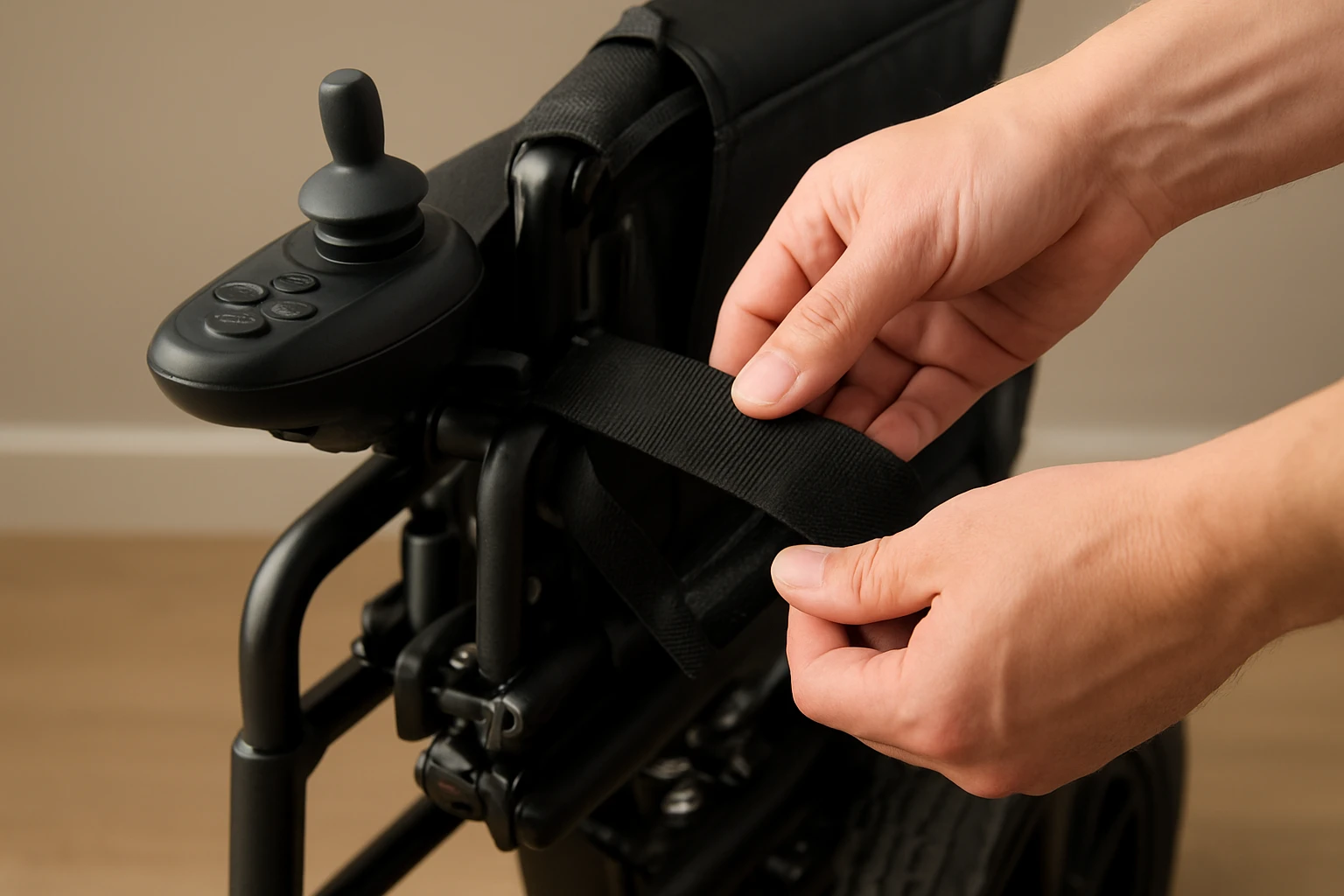
With the frame fully compressed, engage any transport latch or safety clip. Some chairs auto-lock when folded, while others rely on a small hook-and-eye or magnetic clip. If your chair does not auto-lock, use your strap to keep it snug. A secured fold prevents the frame from blooming open as you lift, which can startle you or strain your wrists. Give the chair a gentle shake; if it stays compact, you are set to move it.
Next, tend to the joystick. If it sits proud of the armrest when folded, position a soft towel between the joystick and the frame or rotate the control inward if your model allows. This avoids accidental knocks that could misalign the joystick or scratch the display. Protecting the joystick is one of those tiny five-second habits that pays off for years, especially when you are sliding the chair into a trunk beside a stroller, luggage, or groceries.
Step 6: Lift, Load, or Roll with Good Body Mechanics
When it is time to move your folded chair, use the built-in carry handle if available and keep the load close to your body. Bend at the knees, not the waist, and lift with your legs. If your chair has small transport wheels when folded, roll it instead of lifting when possible. Loading into a car? Position the folded frame vertically just inside the trunk lip, then pivot the base in rather than dead-lifting the entire weight. This swivel move protects your back and reduces the chance of scraping the bumper.
Different vehicles call for different tactics. Use this quick guide to choose your move and stay safe.
| Vehicle or Situation | Best Loading Method | Notes and Tips |
|---|---|---|
| Sedan trunk | Vertical pivot into trunk | Place a towel on the bumper, remove battery to reduce weight |
| Hatchback or SUV | Roll up ramp or two-person lift | Secure with a strap to prevent sliding on turns |
| Ride share or taxi | Driver assists one end, you guide | Communicate latch location and folded weight up front |
| Public transit | Stay folded and roll where allowed | Mind peak hours; keep joystick protected from bumps |
| Air travel gate-check | Fold, label, remove battery if required | Keep watt-hour (Wh) rating visible and manual handy |
Real-world example: James, a Go Wheelchairs customer using a heavy-duty model, keeps a compact ramp in his hatchback so he can roll the folded chair in solo. He logs fewer lifts, avoids back strain, and is on the road faster. Little adjustments like these make daily independence feel lighter.
Step 7: Unfold, Reconnect, and Run a Quick Safety Check
To set up again, reverse the process. Place the folded chair on a flat surface with the transport latch facing you. Release the latch, then press down gently on the seat until the frame opens and the cross-brace locks into place. Raise the backrest if you folded it, swing footrests out, and return armrests to your preferred position. If you removed the battery, drop it straight into the bay until you feel the latch click, then give it a light tug to confirm it is secure.
Power on and run a two-minute safety check. Verify the joystick boots normally, the horn and speed controls respond, and the freewheel levers are in drive. Take a slow test roll forward and back to confirm everything tracks straight. If something feels off, power down and recheck the latch and battery connections. A calm reset is faster than troubleshooting on the move, and it protects your investment in the long term.
Pro Tips from Go Wheelchairs Experts
Customers tell us the fold gets effortless with a rhythm and a few thoughtful habits. First, choose a consistent fold order and repeat it every time. Muscle memory beats guesswork, especially in crowded spaces. Second, log your folded dimensions in your phone. Knowing that your chair folds to, say, 27 by 14 by 30 inches helps you choose rental cars, hotel rooms, and storage spaces without surprise. Third, if your home has tight doorways, stage a folding zone by the most-used exit with a small shelf for gloves and straps, so you never scramble at the last minute.
If you are in the market for a new chair, Go Wheelchairs can talk through how different mechanisms affect your daily routine. Our lineup includes lightweight, travel‑focused models (some fold, and some — like the Go Chair® — disassemble into multiple pieces) as well as a wide range of standard and heavy-duty motorized wheelchairs for users who prioritize stability, capacity, or outdoor range. We also offer personalized support and guidance, plus help with Medicare and other health insurance coverage — start a consultation or use our wheelchair recommendation quiz to find models that match your vehicle, storage, and travel needs. With our resources hub, you can compare models, read buying guides, and grab travel tips to make sure the fold or disassembly fits your lifestyle, not the other way around.
What to Check Before and After Folding
Make this quick inspection part of your routine. It is the difference between confident travel and last-second drama. Before folding, ensure the charger is disconnected, accessories are secured, and freewheel levers are in the correct position per your manual. During the fold, keep fingers out of hinge lines and use a steady pull. After folding, confirm the transport latch is engaged and the joystick is protected. When unfolding, double-check the battery latch and run a short rolling test before tackling ramps, curbs, or uneven sidewalks.
| Checkpoint | Quick Pass | What Can Go Wrong | Fix |
|---|---|---|---|
| Power off | Controller lights are dark | Controller strain, beeps, or errors | Hold power button to shut down fully |
| Battery status | Removed or latched securely | Loose connection, intermittent power | Re-seat until the latch clicks |
| Latch engagement | Folded lock or strap secured | Chair opens during lifting | Engage lock, add strap for backup |
| Joystick safety | Rotated inward or padded | Scratches, accidental knocks | Use towel or rotate mount inward |
| Cable slack | Wires not taut or pinched | Pinched cable, control errors | Re-route with gentle slack |
Common Mistakes to Avoid

Everyone goofs occasionally, but these are the big ones that cost time or repairs. Keep them in your rearview and you will save money and stress.
- Forcing a stuck fold without finding the missed latch. If it resists, you probably skipped a release step.
- Folding while powered on. The controller can wake the motors or flag errors if jostled.
- Lifting from the joystick or armrest alone. Those parts are not designed for full-frame weight.
- Letting cables go taut across a hinge. Pinched wires are a common and avoidable repair.
- Skipping the transport latch. A bloom-open fold mid-lift can twist wrists or ding your car.
- Underestimating weight. Use a second person, a ramp, or remove the battery to stay within safe lift limits.
- Storing a damp chair folded. Moisture plus enclosed spaces can encourage corrosion. Dry first, then store.
How Go Wheelchairs Makes Folding Life Easier
Folding is not just a trick; it is a lifestyle advantage if the chair matches your day-to-day. That is where Go Wheelchairs shines. We help you compare mechanisms and real-world folded or disassembled sizes, then align your choice with your vehicle, home storage, and strength preferences. Our range includes travel designs that fold or disassemble (like the Go Chair®), plus standard and heavy-duty frames built for durability that still pack down efficiently when appropriate. Whether you prioritize airline-friendly batteries, extended outdoor range, or compact trunk fit, we help you map features to your routine.
Coverage matters too. Individuals seeking reliable mobility solutions often need clear guidance on Medicare or other health insurance coverage, documentation, and timelines. Our team walks you through the paperwork step by step, coordinates with your clinician when needed, and helps you understand what is considered medically necessary under your plan. Meanwhile, our resources hub offers buying guides, comparison tools, and travel tips, so you can practice folds or disassembly steps, plan routes, and hit the road with confidence. In short, we bridge the gap between budget, coverage, and daily independence — contact our insurance team or start a consultation for personalized help.
Troubleshooting a Tricky Fold
If your chair will not collapse after you have released the usual latches, pause and run a simple diagnostic. First, check for an accessory or footplate blocking the frame. Then verify both side locks are fully open; many require a complete flip, not just a nudge. Next, confirm the seat seam is centered. On scissor-style frames, an off-center pull can bind the mechanism. If the chair still resists, place one foot lightly against a wheel to stabilize and pull the seat strap straight up with both hands. No luck? It is time to consult the manual or call support before forcing it.
Persistent issues may point to a worn hinge bushing or a bent latch. That is fixable and usually inexpensive, but you want a qualified technician to take a look. Go Wheelchairs support can help you identify the part, order replacements, or point you to a trusted service partner. We can also recommend models whose folding mechanism or disassembly sequence better suits your grip strength or shoulder range of motion. When the fold or disassembly feels natural, you will use it more, protect your chair, and travel with less friction.
Safety, Specs, and Smart Storage
Let us finish with three power tips that protect your chair and your time. First, know your numbers: folded or disassembled dimensions, total weight without battery, and battery watt-hours (Wh). Jot them down or save them in your phone. Those numbers solve half of your travel puzzles in advance. Second, store the chair in a cool, dry place with the battery charged to about 50 to 60 percent if you are not using it for several weeks. Lithium cells like moderate charge levels during rest. Third, plan a micro-maintenance routine: a quick monthly wipe, hinge check, and latch test keeps everything moving smoothly.
| Spec to Track | Why It Matters | Typical Range | Tip |
|---|---|---|---|
| Folded size | Fits trunks, closets, hotel rooms | 24 to 32 in tall, 12 to 18 in wide | Measure your trunk opening, not just trunk depth |
| Chair weight minus battery | Determines safe solo lift vs two-person lift | 40 to 70 pounds (lbs) | Remove battery to reduce lift weight when needed |
| Battery weight | Impacts carry comfort and airline rules | 4 to 10 pounds (lbs) | Use a small tote with handle for easy carry |
| Battery watt-hours (Wh) | Travel and safety documentation | Often under 300 watt-hours (Wh) | Keep a photo of the label on your phone |
Confident Folding, Every Time
You now have a simple routine to power down, release, compress, and secure your chair so a folding electric wheelchair frame feels effortless rather than awkward. For travel‑focused models that disassemble, follow the manufacturer’s disassembly steps and carry the lighter modules to your vehicle. Imagine your next trip: you pull up, fold or disassemble in seconds, slide the chair or its modules into the trunk with a clean pivot, and get on with your day. In the next 12 months, that habit puts hundreds of minutes back into your life while sparing your back, your bumper, and your budget.
What small upgrade would make your fold even smoother right now: a lighter frame, a quick-latch joystick mount, or a right-fit ramp that matches your car and your routine?
Make Folding Simple with Go Wheelchairs
Explore a wide range of standard and heavy-duty motorized wheelchairs with personal guidance and Medicare or insurance help, so you move confidently and independently.