
Are lightweight folding electric wheelchairs airline safe? The short answer is yes, with the right prep and a chair that meets airline and battery rules. Think of it like packing a suitcase with a few extra checks: the same destination, just a smarter route to get there. When you know what flight crews look for, you can breeze through the gate and focus on the fun part of travel.
I still remember helping a close friend fly to her niece’s graduation with a compact travel chair. We learned quickly that a tiny detail like a battery label can make or break a smooth handoff at the jet bridge. Since then, I have kept a simple checklist that reduces anxiety and wins smiles from agents.
Along the way, Go Wheelchairs has become a go-to guide for many travelers. With a wide range of standard and heavy-duty motorized wheelchairs, lightweight foldable designs, and real human advice on insurance and Medicare coverage, the team helps you match your lifestyle, paperwork, and budget. And yes, we will answer the million-dollar question again: Are lightweight folding electric wheelchairs airline safe?
#1 Are lightweight folding electric wheelchairs airline safe? Battery rules, simplified
What it is: Airlines follow safety rules for mobility-aid batteries, especially lithium-ion packs. Most carriers align with IATA (International Air Transport Association (IATA)) and FAA (Federal Aviation Administration (FAA)) guidance, which typically allows lithium-ion batteries up to 300 Wh (watt-hours (Wh)) per battery, or two batteries up to 160 Wh (watt-hours (Wh)) each. Non-spillable sealed lead-acid and gel batteries are also permitted with terminal protection. The formula to estimate watt-hours is simple: Wh (watt-hours (Wh)) = V (volts (V)) × Ah (amp-hours (Ah)).
Why it matters: Battery compliance is the first thing agents and ramp teams check, because it is the backbone of airline safety for powered wheelchairs. Clear labels, covered terminals, and a secure battery mount speed things up at the gate. If your battery is removable, you will likely carry it in the cabin with protected contacts. If it is integrated and meets design standards, it may stay installed with the power isolated.
Quick example: A common travel battery is 24 V (volts (V)) × 10 Ah (amp-hours (Ah)) = 240 Wh (watt-hours (Wh)). That is within typical airline limits and usually allowed as installed or carried on, depending on the design. Go Wheelchairs provides spec sheets and user manuals, and can help customers locate manufacturer documentation (for example, UN 38.3 test summaries) when those documents are available; airlines set their own policies about which documents they require.
| Battery Type | Typical Rule | Carry-On or Checked | Notes |
|---|---|---|---|
| Lithium-ion (single battery up to 300 Wh (watt-hours (Wh))) | Allowed when protected; usually limit is 300 Wh (watt-hours (Wh)) | Installed or removable; spares in cabin | Labels must show Wh (watt-hours (Wh)); terminals protected; UN 38.3 (United Nations (UN) Manual of Tests and Criteria Section 38.3) recommended |
| Two lithium-ion batteries (each up to 160 Wh (watt-hours (Wh))) | Allowed; often two spares permitted | Spares in cabin only | Each battery individually protected from short-circuit |
| Non-spillable sealed lead-acid or gel | Allowed when terminals protected | Usually can stay installed | Marking “Non-spillable” helps; secure mounting is key |
| Spillable/wet lead-acid | Allowed with restrictions | Often removed and packed upright | Rare in modern travel chairs |
Tip: Always confirm your airline’s latest policy. Carriers implement IATA (International Air Transport Association (IATA)) and FAA (Federal Aviation Administration (FAA)) guidance in slightly different ways.
#2 Folding size, weight, and where your chair rides
What it is: Lightweight folding power chairs collapse to a compact footprint. Most travel frames fold like a baby stroller and weigh 30 to 60 pounds (lbs) or 13 to 27 kilograms (kg), making them easy to maneuver to the jet bridge. Once tagged at the gate, your chair is typically carried down to the cargo hold and rides upright in a protected spot.
Watch This Helpful Video
To help you better understand Are lightweight folding electric wheelchairs airline safe?, we’ve included this informative video from MaviGadget. It provides valuable insights and visual demonstrations that complement the written content.
Why it matters: Smaller folded dimensions make it easier for ramp crews to safely lift and position your device. On regional aircraft with smaller cargo doors, a compact chair can be the difference between loading smoothly or needing extra time. Under the Air Carrier Access Act (ACAA (Air Carrier Access Act)), airlines must accept mobility devices when space and safety permit, and they should prioritize careful handling.
Quick example: If your folded width is under 15 inches and weight under 55 pounds (lbs), most agents will smile when they see it. Travelers from the Go Wheelchairs community often add a simple laminated card with fold steps zip-tied to the frame; crews appreciate the clarity and it speeds handoff.
#3 Airline paperwork that speeds you through security
What it is: A small packet of documents can cut your time at the counter by half. Include a battery spec sheet with Wh (watt-hours (Wh)), an owner’s manual page that describes how to fold and disconnect power, and manufacturer documentation such as UN 38.3 (United Nations (UN) Manual of Tests and Criteria Section 38.3) test summaries when available. Some airlines invite notice 48 hours ahead for mobility aids so their system flags your booking.
Why it matters: Agents handle hundreds of scenarios per day. When you hand over a neat, one-page summary, you reduce uncertainty and avoid supervisor callbacks. It is also useful during connections if different teams handle your chair. Go Wheelchairs can help you assemble this packet and provide plain-language battery summaries; they can also assist in locating manufacturer documentation when available. Airlines ultimately determine which documents they accept, so it’s wise to confirm requirements with your carrier.
Quick example: I once watched a ramp lead scan a battery label for a traveler, then point to the matching Wh (watt-hours (Wh)) on a printed spec page. Approval took 30 seconds. The traveler made preboarding with time to spare and kept their cushion with them, exactly as planned.
| When | What to Share | Why It Helps |
|---|---|---|
| 72 to 48 hours preflight | Notify special assistance of wheelchair type, folded size, and battery Wh (watt-hours (Wh)) | File is flagged; ground team prepared with straps and space |
| Check-in | Show battery spec sheet, UN 38.3 (United Nations (UN) Manual of Tests and Criteria Section 38.3) letter, and folding steps | Agent validates safety quickly and tags device correctly |
| Gate | Repeat battery Wh (watt-hours (Wh)), demonstrate isolation switch, hand over joystick | Ramp crew confident and careful with your device |
#4 Gate-check and preboarding: hand-off like a pro

What it is: Gate-checking means you roll your chair to the aircraft door, transfer to the aisle chair or your seat, and the crew moves your wheelchair to the hold. You get it back at the jet bridge on arrival. Preboarding allows extra time to do this without pressure, and you can brief the ramp team on the safest lift points.
Why it matters: A calm, clear handoff prevents damage. Most airline teams are careful but time-pressed. Show how your chair folds, where to lift, and how to isolate or remove the battery. Under DOT (Department of Transportation (DOT)) guidance and the Air Carrier Access Act (ACAA (Air Carrier Access Act)), you can request a Complaint Resolution Official (CRO (Complaint Resolution Official)) if you need help asserting your rights.
Quick example: Before boarding, I label three spots with painter’s tape that read “Lift Here,” “Battery Switch,” and “Folds This Way.” It takes two minutes and earns instant buy-in from crews. Go Wheelchairs’ resource hub offers printable gate-check tags and a one-page folding diagram template that many readers customize.
- Remove joystick and store it in your carry-on.
- Keep your seat cushion with you to protect skin integrity.
- Collapse the frame fully and secure with a strap or Velcro.
- Turn off master power and engage the isolation switch.
- Attach your contact info and destination city to the frame.
#5 Protection, repairs, and your rights if something goes wrong
What it is: Airlines are responsible for repairing or replacing mobility devices damaged in transit when the device was accepted for transport, per DOT (Department of Transportation (DOT)) enforcement under the Air Carrier Access Act (ACAA (Air Carrier Access Act)). Recent DOT (Department of Transportation (DOT)) reports show about a 1.3 percent mishandling rate for wheelchairs and scooters across U.S. carriers, which is better than it was a few years ago but still not zero.
Why it matters: Knowing the playbook keeps you in control if something happens. Document your chair with photos at the gate, get a damage report before leaving the airport, and keep receipts for rentals or repairs. Airlines should provide a loaner if needed. If a dispute arises, ask for the CRO (Complaint Resolution Official (CRO)) at the station, and follow up with a DOT (Department of Transportation (DOT)) disability complaint online.
Quick example: One Go Wheelchairs customer landed to find a bent footplate. The airline logged the issue immediately, approved a local repair, and reimbursed within two weeks. Because the traveler had before-and-after photos and a clear invoice, the process was painless.
#6 Domestic vs international nuances you should know
What it is: Rules harmonize globally but are not identical. IATA (International Air Transport Association (IATA)) guidance is the baseline many airlines follow, while U.S. carriers also operate under FAA (Federal Aviation Administration (FAA)) and DOT (Department of Transportation (DOT)) rules. In Europe, the European Union (EU) Regulation 1107/2006 sets assistance duties for carriers and airports. Code shares add another twist, because the operating carrier’s policy applies.
Why it matters: A chair cleared on a domestic route may face different battery or packing expectations abroad. Connection times should be longer on international tickets to allow careful handling. If your itinerary includes multiple carriers, send your battery details to each one and carry a universal set of documents in English plus your destination language if possible.
Quick example: For a U.S. to Europe trip, a traveler with a 252 Wh (watt-hours (Wh)) lithium-ion battery emailed both carriers and attached the UN 38.3 (United Nations (UN) Manual of Tests and Criteria Section 38.3) letter. Both confirmed carriage, and ground teams on each side followed the same folding diagram. Easy handoffs on both legs.
#7 Design features that make a chair truly travel-ready
What it is: Some features make flying smoother: quick-release batteries with covered contacts, an isolation switch labeled clearly, a frame that locks in the folded position, recessed motors and wiring, and removable arms or joystick. Water and dust resistance ratings help in rain on the ramp, and tie-down points guide safe lifting.
Why it matters: Flight crews are experts at moving bags, not necessarily at the intricacies of powered mobility. A chair designed with airline mode in mind reduces the chance of damage and speeds boarding. Lightweight folding models from Go Wheelchairs emphasize these details and include spec sheets that speak the airline’s language.
Quick example: A traveler chose a Go Wheelchairs compact model with a 240 Wh (watt-hours (Wh)) battery, a single toggle isolation switch, and a center carry handle. Ramp agents could lift from the handle and never touched the wheels or armrests. The chair arrived in perfect shape, twice in one week.
| Feature | Airline Benefit | Traveler Benefit |
|---|---|---|
| Quick-release, labeled battery | Faster verification of Wh (watt-hours (Wh)) and safer handling | Smoother security checks and fewer delays |
| Fold-lock mechanism | Easier stowage in cargo hold | Less chance of unfolding during transit |
| Recessed cabling and joystick removal | Fewer snag points when lifting | Protects controls and wiring |
| Tie-down/lift points labeled | Clear, safe lift locations | Peace of mind at handoff |
How to choose the right option
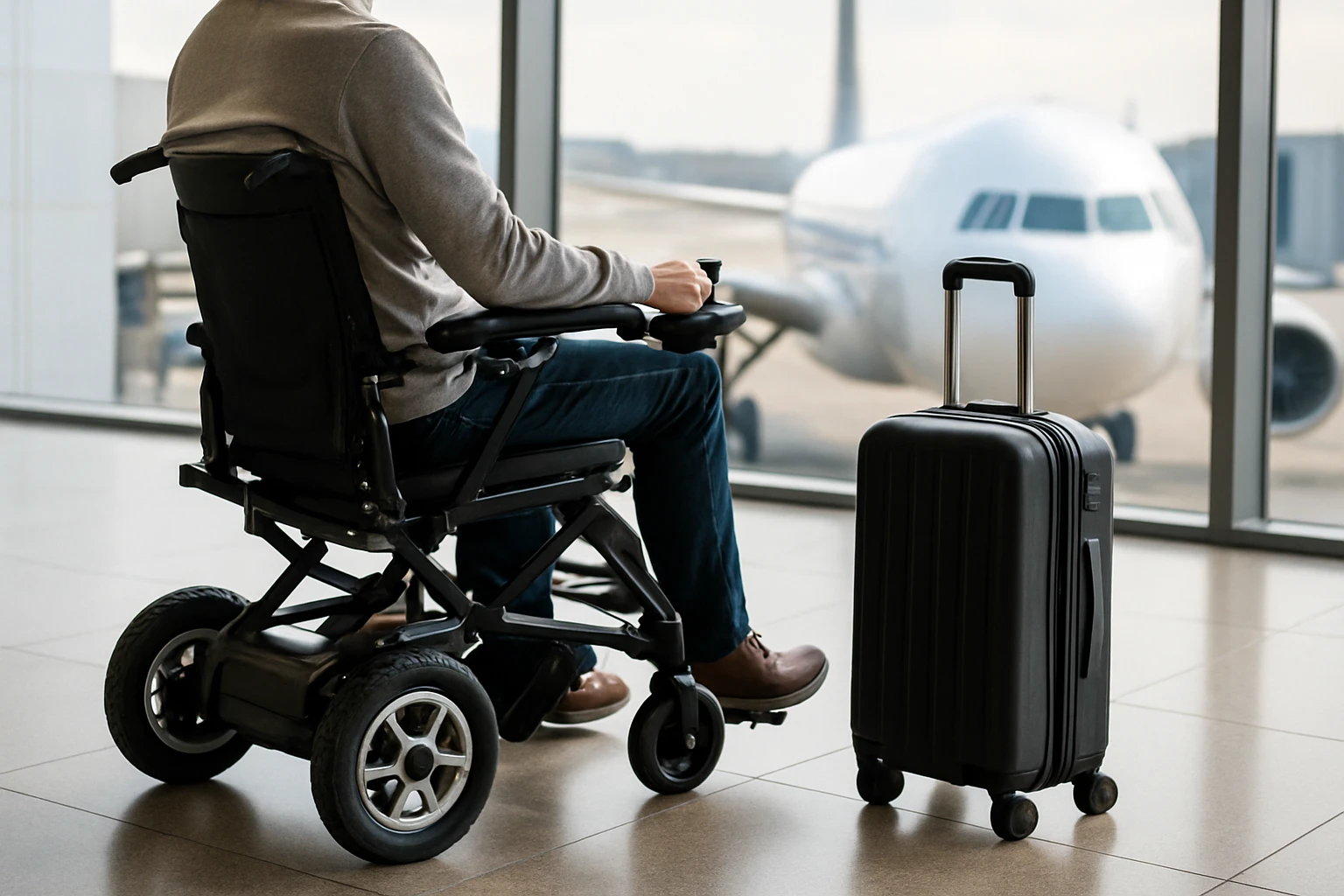
Choosing a travel-ready power chair becomes simple when you map your needs to features. Start with battery rules, then match frame design and support. The framework below keeps decisions clear and focused.
- Confirm battery compliance. Aim for 160 to 300 Wh (watt-hours (Wh)) total for broad airline acceptance. Ensure the label shows Wh (watt-hours (Wh)) or that volts and amp-hours are printed so you can calculate.
- Measure your storage spaces. Note folded width, depth, and height at home, and share those with the airline if flying regional aircraft.
- Prioritize independence at the destination. If you will roll miles, consider a slightly larger battery within rules. If you will hop in ride-hail often, ultra-compact may win.
- Plan the handoff. Choose chairs with obvious lift points, removable joystick, and a hard-wearing travel cover.
- Budget smart with coverage help. Ask Go Wheelchairs about insurance and Medicare options, so your ideal chair fits both lifestyle and coverage needs.
| Trip Priority | Recommended Features | Why It Works |
|---|---|---|
| Shortest airport time | Integrated 200 to 300 Wh (watt-hours (Wh)) battery, fold-lock, labeled switches | Faster checks and minimal disassembly |
| Lightest lift for crews | Frame under 40 pounds (lbs), center handle, removable joystick | Simplifies safe loading, protects controls |
| Longest range days | Up to 300 Wh (watt-hours (Wh)) lithium-ion, efficient motors, spare within rules | More hours between charges without breaking limits |
| Mixed terrain touring | Suspension, puncture-resistant tires, sealed wiring | Reliable performance in variable weather |
Go Wheelchairs can walk you through this framework in a quick call. The team’s wide range of standard and heavy-duty motorized wheelchairs means you can compare compact travel frames with more robust options for everyday use, then pick the setup that travels beautifully and lives well at home. Personalized guidance and the resource hub’s buying guides, comparison tools, and travel tips keep you confident from checkout to check-in.
#8 Bonus: Packing hacks that make airline safety effortless
What it is: Smart packing is more than clothes. A small toolkit, tape labels, and a travel note for crews transform the experience. Keep a spare joystick knob, a short Velcro strap, zip ties, and a lightweight cover in your carry-on. Add a page that says, “This chair folds; lift here,” with arrows.
Why it matters: These details prevent rushed decisions when boarding starts. They also show respect for the crew’s time and expertise, which usually earns the same respect back for your equipment. Extra straps or a soft cover add protection against scuffs without adding bulk or violating any rules.
Quick example: A traveler taped a square of bright paper over the battery switch with the words “Power Isolated.” The ramp team thanked him at deplaning because it saved them a phone call to the gate. Seconds saved add up to less stress for everyone.
#9 Real-world support: how Go Wheelchairs smooths every step
What it is: Beyond products, Go Wheelchairs offers a people-first pathway to travel. The team helps verify your battery’s Wh (watt-hours (Wh)), can assist in locating manufacturer documentation such as UN 38.3 (United Nations (UN) Manual of Tests and Criteria Section 38.3) summaries when available, and drafts a one-page gate brief in plain language. They also guide you on Medicare and insurance options, so you are not forced to choose between safety, comfort, and affordability.
Why it matters: Individuals with mobility challenges often struggle to find affordable, dependable wheelchair solutions that fit lifestyle and coverage needs. With personalized support, you can get the right chair, the right paperwork, and the right expectations long before packing. That is how stress drops and confidence rises.
Quick example: A customer needed a heavy-duty motorized wheelchair for daily life and a lightweight folding travel chair for trips. Go Wheelchairs helped him secure coverage for the primary device and choose a travel model with a 240 Wh (watt-hours (Wh)) battery that passed airline checks. He now rotates between both, no compromises.
How to choose the right option
Still deciding between a few chairs? Try this five-minute filter. First, confirm the battery’s Wh (watt-hours (Wh)) is printed or easily calculated. Second, fold it yourself and time the process. Third, look for lift points and quick-disconnects. Fourth, weigh the frame. Fifth, call your airline once to validate you have what they need. If any step feels uncertain, ask Go Wheelchairs to review your shortlist with you.
Finally, ask a traveler’s question: Will this chair make my life easier in the airport and at the destination? If the answer is not an immediate yes, keep exploring. The right match is out there, and it is worth finding.
Final thoughts
Airline safety for lightweight folding electric wheelchairs comes down to the right battery, clear labels, and a confident handoff plan. Imagine your next trip where preboarding is relaxed, the crew already knows your chair’s moves, and you roll off the plane smiling because everything just worked. Are lightweight folding electric wheelchairs airline safe when you prepare this way? Absolutely, and your future self will thank you.
Travel Further With Go Wheelchairs
Get a wide range of standard and heavy-duty motorized wheelchairs, plus personalized help and insurance or Medicare guidance to move forward with confidence and independence.