Medicare Documentation for Power Wheelchairs: Templates & Approval Triggers to Get Covered
You deserve mobility that matches your life, not a maze of paperwork. Still, far too many people are denied simply because a few critical details are missing or buried in the chart. This guide breaks down medicare documentation for power wheelchairs in plain language, then hands you six physician-ready templates and the specific “approval triggers” that reviewers look for. At Go Wheelchairs, we see every day how the right words, in the right places, turn a stressful process into a confident yes, and we’re going to walk you through that playbook step by step.
Medicare Documentation for Power Wheelchairs: What Matters Most
If you have never tried to decode coverage rules, the terminology can feel intimidating, but the underlying idea is simple: paint a clear, clinical picture that proves medical necessity inside the home. Reviewers want to see that a power wheelchair is required for mobility-related activities of daily living such as bathing, toileting, and feeding, and that simpler options would not work. They expect a recent face-to-face examination that documents specific functional limitations, not just diagnoses, and a narrative that explains why a cane, walker, or manual wheelchair would be unsafe, insufficient, or impractical. When that story is explicit, consistent, and tied to your home layout and daily tasks, approvals rise and delays drop.
Industry reviews suggest that many initial denials stem from vague notes like “patient needs power chair,” which say what but not why. Strong documentation connects symptoms to function, function to daily tasks, and daily tasks to safety and independence within your home. It also confirms that you can operate the device safely, or that a caregiver can assist, and that your home has adequate access or a plan to ensure it does. With the right framework, your physician can capture all of this in one visit, and your equipment supplier can help coordinate a home assessment or provide guidance that ties the whole story together.
| Document | Who Completes | Timing | What Reviewers Look For |
|---|---|---|---|
| Face-to-face clinical examination note | Treating physician | Typically within 6 months of order | Functional limits tied to in-home activities, objective findings, prognosis, safety risks, and why lesser devices fail |
| Detailed written order | Treating physician | After exam, before delivery | Type of device, features, accessories, and clinical justification for each item |
| Home mobility assessment | Clinician or assessor | Before prior authorization | Door widths, flooring, ramp needs, turning radius, safe operation plan |
| Trial and failure of lower-level devices | Physician or therapist | During assessment phase | Why cane, walker, or manual wheelchair is unsafe, inefficient, or not feasible |
| Safety and training plan | Therapist (supplier provides setup guidance) | Before delivery | Ability to operate joystick or alternative control, caregiver support if needed |
| Functional goals | Physician with patient input | At time of exam | Specific goals like reaching the bathroom safely or preparing meals independently |
6 Physician-Ready Templates You Can Use Today
Print these, paste them into your electronic health record, or read them aloud while your physician documents the visit. Each template uses everyday language that aligns with coverage reviewers’ expectations. Keep the tone factual and specific, and avoid general phrases like “patient cannot walk.” Instead, quantify distances, describe safety risks, and connect the dots from clinical findings to activity limitations in the home. Small changes in wording make a big difference in how your need is understood.
Watch This Helpful Video
To help you better understand medicare documentation for power wheelchairs, we’ve included this informative video from WPS Government Services – Medicare. It provides valuable insights and visual demonstrations that complement the written content.
Template 1: Face-to-Face Exam Note — Functional Mobility in the Home
[Patient Name], [Age], presents with [primary condition] resulting in [describe weakness, spasticity, dyspnea, pain, balance loss]. On exam, strength is [X/5] in [limbs]; gait is limited to [distance] with [device] and requires [rest breaks or assistance]. Within the home, the patient is unable to safely perform mobility-related activities of daily living such as [list ADLs] due to [fatigue, falls risk, pain, impaired coordination], despite trial of [cane, walker, manual wheelchair], which caused [falls, shoulder strain, inability to propel effectively]. Given these limitations, a power wheelchair is medically necessary to enable safe, timely performance of in-home tasks and to reduce fall risk, caregiver burden, and hospitalization risk.
Template 2: Trial and Failure of Lesser Devices
The patient trialed alternative mobility options with the following outcomes: Cane — insufficient support; patient veered and required wall contact after [distance]. Walker — caused [pain or instability]; patient needed [assist] after [distance] and could not transport the walker into smaller rooms. Manual wheelchair — patient unable to propel functional distances due to [upper extremity weakness, cardiopulmonary limitations, severe pain], leading to dependence for basic tasks. Based on safety, endurance, and efficiency, these devices do not meet the patient’s in-home mobility needs.
Template 3: In-Home Need and Layout
The medical necessity is for use inside the home. The patient must traverse [distance] from bedroom to bathroom and negotiate [thresholds or turns]. Doorway widths are [measurements]; flooring is [carpet, wood, tile]. A power wheelchair with [turning radius specification] allows access to bathroom and kitchen workspaces safely, without prolonged standing or risk of falls. The patient and caregiver confirm adequate space for operation and storage, or will implement [ramp, doorway widening] prior to delivery.
Template 4: Power Wheelchair and Features Justification
A standard power wheelchair is required to meet baseline mobility. Due to [weight, terrain between rooms, frequent transfers, posture needs], additional features are necessary: Heavy-duty frame for user weight of [lbs/kg] and durability; captain’s seat with adjustable armrests for skin protection and posture; elevating leg rests or power tilt to manage edema and pain; joystick on [dominant side] for control; battery range suitable for in-home use over [hours] with planned charging. Each feature is medically necessary to ensure safe, effective performance of in-home activities.
Template 5: Detailed Written Order Script
Order: Power wheelchair, standard or heavy-duty as clinically indicated, with [seat width x depth], [battery type], [footplate/legrest], [armrests], [cushion type], and [back support]. Rationale: Required for in-home mobility given inability to ambulate or self-propel safely. Accessories are medically necessary to maintain skin integrity, manage edema, support posture, ensure safe transfers, and permit operation within the patient’s home. Duration: Lifetime. Supplier to help coordinate home evaluation and provide setup guidance and training.
Template 6: Safety, Training, and Caregiver Support
The patient demonstrated the ability to operate a joystick with [right/left] hand, sustaining attention and safely navigating simulated doorways and turns. Caregiver [name] is present [hours/day] to assist with transfers and charging. A training plan includes: initial setup, control adjustments, safe turning and backing, charging routine, and emergency stop procedures. With training and caregiver support as outlined, the device can be operated safely in the home.
Approval Triggers That Turn “Maybe” Into “Approved”
Think of approval triggers as the phrases and facts that light up a reviewer’s checklist. They prove medical necessity by linking your diagnosis to functional limits, then to specific activities in your home that cannot be done safely with lower-level devices. They also confirm that a power wheelchair can actually be used where you live and that you or your caregiver can operate it safely. When these elements are explicit, the request aligns with policy language and the decision becomes simple.
| Trigger | Sample Wording That Works | Where It Lives | Common Pitfall |
|---|---|---|---|
| In-home medical necessity | “Needs powered mobility to reach bathroom and kitchen safely; standing beyond 30 seconds causes knee buckling.” | Physician exam note intro | Talking about community distance rather than home tasks |
| Trial and failure of lesser devices | “Walker trial led to two near-falls after 20 feet; manual wheelchair not feasible due to bilateral shoulder pain.” | Assessment section | Listing devices without results or distances |
| Objective findings | “Hip flexion 3/5; oxygen saturation drops to 89 percent after 25 feet; requires seated rest.” | Physical exam and vitals | Only stating diagnosis without functional impact |
| Home accessibility and safety | “Doorways 32 inches; hard flooring; plan for small threshold ramp at entry.” | Home assessment | No layout details or training plan |
| Ability to operate | “Demonstrated safe joystick control; caregiver assists with transfers and charging.” | Safety and training plan | Assuming ability without documentation |
| Feature-level justification | “Heavy-duty frame required for user weight and durability; elevating leg rests to manage edema.” | Order and justification | Listing features without medical reasons |
From Exam to Delivery: Timeline, Prior Authorization, and Follow-Through

Good documentation is a story with a beginning, middle, and end, and every chapter has a date. Start with a recent face-to-face examination that documents functional limits tied to in-home tasks. Next, secure a detailed written order that spells out the device and each medically necessary feature, then arrange or coordinate a home assessment that shows the chair will actually work in your space. Finally, submit for any required prior authorization, respond promptly to requests for more information, and schedule delivery with training on day one.
- Week 1: Physician visit and comprehensive exam note using Template 1 and Template 2.
- Week 1 to 2: Clinician or assessor performs home assessment; supplier helps coordinate or documents findings using Template 3.
- Week 2: Physician completes detailed written order using Template 5.
- Week 2 to 3: Assemble packet with safety plan and feature justification using Templates 4 and 6.
- Week 3 to 5: Submit prior authorization where required; answer reviewer questions quickly.
- Week 5 to 8: Delivery, fitting, and training; confirm that the chair performs as documented in the home.
| Step | Primary Owner | Backup Partner | Tip for Speed |
|---|---|---|---|
| Exam and narrative | Physician | Therapist | Bring this guide and your completed symptom diary |
| Home assessment | Clinician or assessor | Caregiver | Measure doorways and list obstacles before the visit |
| Order and justification | Physician | Supplier | Justify each feature with a medical reason |
| Prior authorization | Supplier | Physician | Respond to questions within 24 to 48 hours |
| Delivery and training | Supplier | Therapist | Schedule caregiver to attend training |
Avoid These Red Flags and Denials
Reviewers are not trying to say no; they are trying to confirm medical necessity. The fastest way to derail a request is to make them guess. When reasons are implied instead of stated, denials follow even for people who truly qualify. Use this quick list of red flags to tighten your packet before it goes anywhere.
- Vague statements without metrics, such as “cannot walk far,” instead of “needs to rest after 15 feet due to knee buckling and shortness of breath.”
- Talking only about outdoor needs like shopping or community distances rather than mobility inside the home.
- No documented trial and failure of cane, walker, or manual wheelchair, or no reason those devices are unsafe or ineffective.
- Missing home layout details such as doorway widths, flooring type, or plan for a small ramp at the entry.
- Listing features without clinical reasons, like “elevating leg rests” without “to manage edema and pain that limit sitting tolerance.”
- Silence on safety: no notation about operating a joystick, vision and cognition, or caregiver involvement.
Fixes are straightforward. Add distances and times, connect limitations to specific in-home tasks, document why lesser devices failed, measure your space, and tie every feature to a medical purpose. The tweaks take minutes and save weeks.
How Go Wheelchairs Helps You Win Coverage and Choose Confidently
At Go Wheelchairs, we combine the clinical playbook you just read with real-world product fit, because great documentation only matters if the chair fits your life. Our team supports you and your physician with examples, checklists, and the six templates above, then helps you select from a wide range of standard and heavy-duty motorized wheelchairs that work in real homes. If you need a lightweight, foldable wheelchair for travel days, we have options; if you need a heavy-duty power base with posture support and long battery life, we have that too. Most importantly, we walk with you through insurance and Medicare assistance so the paperwork and the product both feel seamless.
People come to us worried that coverage will force them into a one-size-fits-all solution. It will not. We match your clinical needs with the right features, show exactly how those features support safe in-home function, and provide a clear plan for training and caregiver support. Our resources hub includes buying guides, comparison tools, and travel tips so you make confident decisions today and six months from now, after daily life teaches you what really matters.
Here is a quick example. A customer with severe osteoarthritis and cardiopulmonary limits could propel a manual chair for only 20 feet before chest tightness set in, and a walker created two near-falls in a week. We worked with the physician to document in-home needs and trial outcomes using Templates 1 through 3, justified heavy-duty construction and elevating leg rests with Template 4, and coordinated a home assessment that confirmed doorway clearance. The request was approved on the first pass, and the chair now turns from bedroom to bathroom without a risky pivot or pause.
Quick Prep Checklist You Can Bring to Your Visit
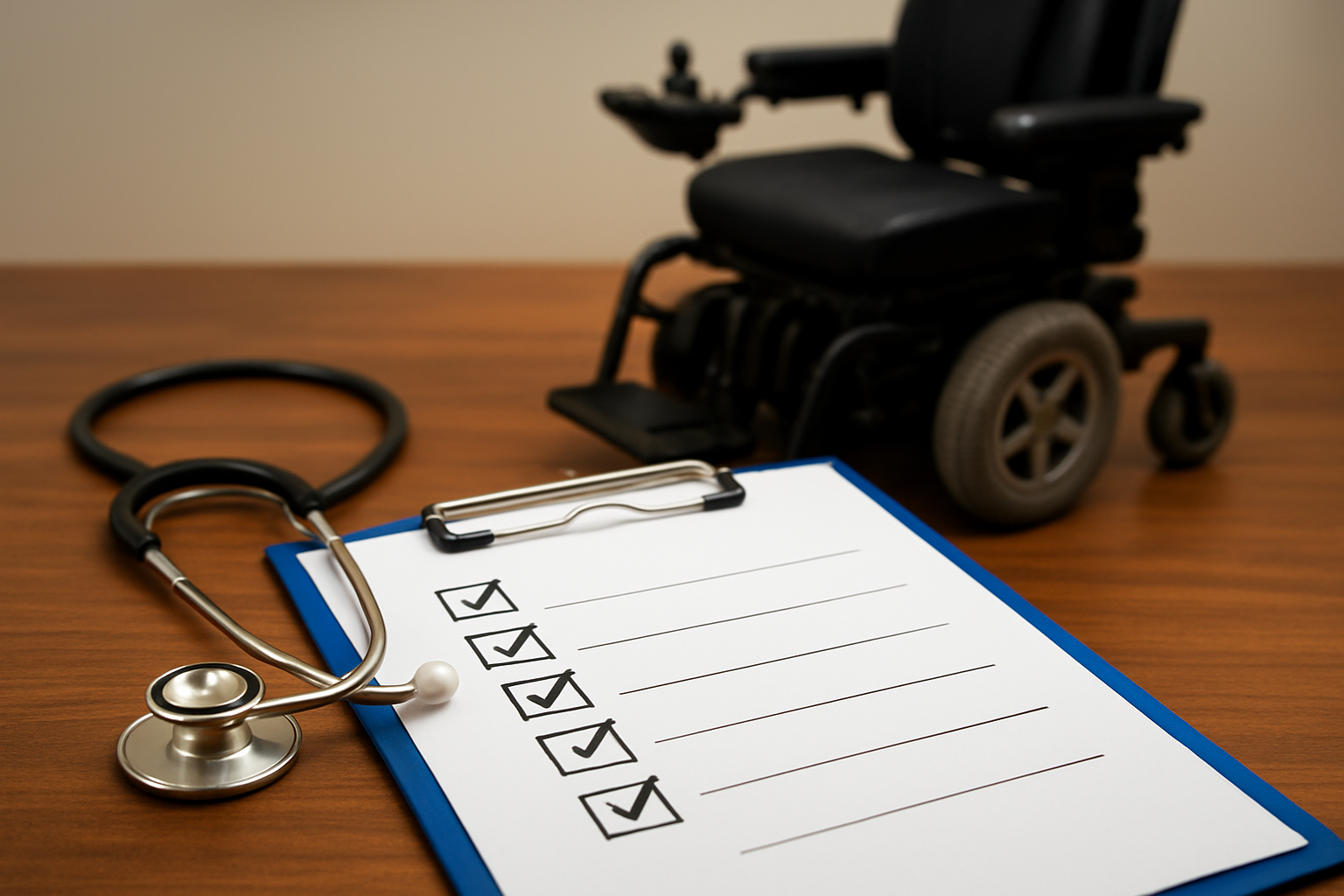
Want to make your appointment ridiculously productive? Bring this one-page checklist and you will leave with stronger notes than 90 percent of requests out there. Small details like doorway width or exact distances are gold for reviewers because they paint a vivid, verifiable picture. Use this list to gather what your physician needs before the pen hits the paper.
- Three-day diary of how far you can walk or self-propel before you must stop, including symptoms and rest time.
- List of activities inside your home that you cannot do safely or efficiently without powered mobility.
- Measurements: doorway widths, hallway turns, flooring types, and any thresholds or steps.
- Results of trying a cane, a walker, and a manual wheelchair, including distance, time, pain, or near-falls.
- Names and availability of caregivers who assist with transfers, charging, or daily tasks.
- Your goals: get to the bathroom in time, prepare simple meals, reduce falls, or decrease caregiver strain.
Note: Coverage rules and terminology evolve. This guide is for educational purposes and supports a collaborative conversation with your physician and your insurance plan.
Why This Works: The Reviewer’s Perspective
When reviewers open a request, they scan for four things in order: medical necessity inside the home, trial and failure of lesser devices, objective findings, and safety plus feasibility. If your packet answers all four clearly and consistently, their job becomes easy and your answer becomes timely. Industry data shared in audits and supplier reviews show that a significant share of delays arise not from ineligibility but from missing links between diagnosis, function, and home use. You can control those links with the templates and triggers in this article and by partnering with a supplier who understands both documentation and design.
Go Wheelchairs exists for exactly that intersection. We maintain a wide range of standard and heavy-duty motorized wheelchairs, plus lightweight foldable designs for travel, because life is not one-size-fits-all. Our team offers personalized support and guidance and hands-on help with insurance and Medicare questions, and our resources hub stays current so you always have the latest buying guides, comparison tools, and travel tips. If you are tired of feeling stuck between confusing forms and equipment that does not fit, we are here to move you forward with clarity and confidence.
Recap of the Six Templates: Face-to-face exam note, trial and failure of lesser devices, in-home need and layout, feature-level justification, detailed written order script, and safety plus training plan. Use them together for a cohesive story that demonstrates need, feasibility, and safety in your home.
Pro Tips:
- Use numbers for distances, times, doorway widths, and battery range; reviewers love specifics.
- Tie every feature to a medical reason in one sentence so nothing looks like preference or convenience.
- Confirm a caregiver plan on paper even if you rarely need it; it reassures reviewers about safety.
- Keep copies of everything in one folder so follow-up questions are easy to answer.
Next-Level Considerations: Accessories, Seating, and Future Needs
Many people focus on the base power wheelchair but forget that seating and accessories are often where comfort, safety, and skin protection happen. If edema limits knee flexion, elevating leg rests are not a luxury; they are a medical need that allows you to sit long enough to prepare a meal or get to the bathroom without pain. If posture or skin integrity is fragile, a clinical cushion and adjustable back support can prevent pressure injuries and reduce hospitalizations, which insurers respect when the rationale is clearly written. Think ahead about transfers, doorway turns, and charging habits so your setup works day one and year one without a constant scramble.
Go Wheelchairs will help you road-test those plans. We map your daily routines against the chair’s turning radius, seating angles, and control options, then document exactly how each choice supports safe, independent living inside your home. That is how we minimize surprises after delivery and keep your documentation airtight if anyone asks questions later. A little foresight goes a long way in both comfort and coverage.
Everything you need to get covered is now in your hands.
Imagine cruising smoothly from bedroom to bathroom, your documentation sailing through on the first pass, and your chair fitting your space like it was built for it. What would become possible for you once your medicare documentation for power wheelchairs is this clear?
Additional Resources
Explore these authoritative resources to dive deeper into medicare documentation for power wheelchairs.
Streamline Medicare Power Wheelchair Coverage with Go Wheelchairs
Access a wide range of standard and heavy-duty motorized wheelchairs and personalized Medicare documentation guidance so you move forward with confidence and independence.