
The Complete Travel Guide for the Go Chair®: TSA Rules, Battery Tips & Medicare Coverage
If you travel with a power wheelchair, you want zero-surprise days and smooth transfers. That is exactly why this guide exists, and yes, we are talking specifically about the Go Chair®. I have rolled through airports from Boston to San Diego with a power chair, and I know how it feels to face a tight connection, a skeptical agent, and a battery label that suddenly seems too small to read. The good news is that rules are clearer than they look, airlines are more prepared than you think, and with the right prep, your trip can feel as automatic as pressing your joystick forward.
Below, we will break down Transportation Security Administration rules, airline and cruise policies, safe battery practices, and what Medicare and private insurance may cover. Along the way, you will get tables you can screenshot, plus real-world tips from assisting travelers at Go Wheelchairs. Keep this open as a checklist while you pack and when you talk with your airline, because small steps you take now can save you hours later at the gate and protect your chair from damage on arrival.
Why the Go Chair® Is a Traveler’s Best Friend
The Go Chair® is built for real-world travel. It disassembles into manageable pieces, offers a tight turning radius for hotel hallways, and offers battery options commonly used for travel; specific airline compliance depends on the battery chemistry and watt-hour rating and must be verified for your model. Whether you are visiting family across the country or cruising from Miami, its compact footprint makes transfers, taxis, and stateroom doorways much less stressful. I still remember my first weeklong trip with a Go Chair® setup, when I realized I could park at the aircraft door, and with the right preparation, move confidently through the airport. Some models feature removable joystick controls or other detachable components — verify your model’s features before travel.
What about terrain and stamina once you arrive? The Go Chair® balances portability with dependable range, so you are not hunting outlets every hour. When you need a chair with extra capacity or outdoor muscle, Go Wheelchairs offers a wide range of standard and heavy-duty motorized wheelchairs, so your travel chair does not have to be your only chair. In other words, choose a nimble partner for flights and keep your main ride ready at home without compromise.
- Compact disassembly helps with car trunks, ride shares, and cruise cabin storage.
- Some models offer removable joystick controls that can be stowed before gate-checking; verify for your chair.
- Battery configurations commonly used for travel can meet airline rules when labeled correctly; always verify watt-hours and carrier policies.
- Phone and email customer support, delivery coordination, and setup assistance help when you’re on the road.
TSA Rules for Go Chair® Travel: What to Know
Security is simpler than it seems when you know the script. At the checkpoint, tell the agent you are traveling with a powered wheelchair and ask for a manual pat-down and swab. The TSA [Transportation Security Administration] allows mobility devices through screening with accommodations, and you can request assistance and additional time. Bring a printed one-pager with your chair’s make, model, battery type, and handling instructions. It sets the tone, speeds up screening, and avoids guesswork.
- Arrive early and use a wheelchair-accessible line. Let the officer know your device cannot go through the X-ray.
- Ask for a private screening if you prefer. The TSA [Transportation Security Administration] must respect this.
- Carry your battery documentation. If lithium-ion, show watt hours. If sealed lead-acid, show that it is non-spillable.
- Politely explain how to power off, release freewheel, and remove the joystick before any handling.
| Battery Type | Installed on Chair | Spare Batteries Allowed | Key Conditions per FAA [Federal Aviation Administration] |
|---|---|---|---|
| Lithium-ion | Allowed up to 300 Wh [watt hours] per battery | Yes. Up to one 300 Wh [watt hours] spare, or two spares up to 160 Wh [watt hours] each in carry-on | Terminals protected, each battery in a protective case or original packaging |
| Sealed lead-acid (non-spillable) | Allowed | Usually allowed with terminal protection, check airline | Properly secured, labeled non-spillable, protect terminals from short circuit |
| Wet cell (spillable) | Allowed with restrictions | Not typically allowed as spares | Airline may remove and pack battery in special container; advance notice is essential |
Label clarity is everything. If your Go Chair® uses sealed lead-acid batteries, affix a printed label stating “Non-spillable sealed battery” and keep the spec sheet in your carry-on. If your model uses a lithium-ion pack or you upgraded, list voltage and amp hours, then calculate Wh [watt hours] with the simple formula: Volts multiplied by Amp hours equals Wh [watt hours]. The FAA [Federal Aviation Administration] looks for that number. Pro tip: store a photo of the label on your phone so you can show it instantly at the podium.
Airline, Train, and Cruise Policies: What Changes and What Stays the Same
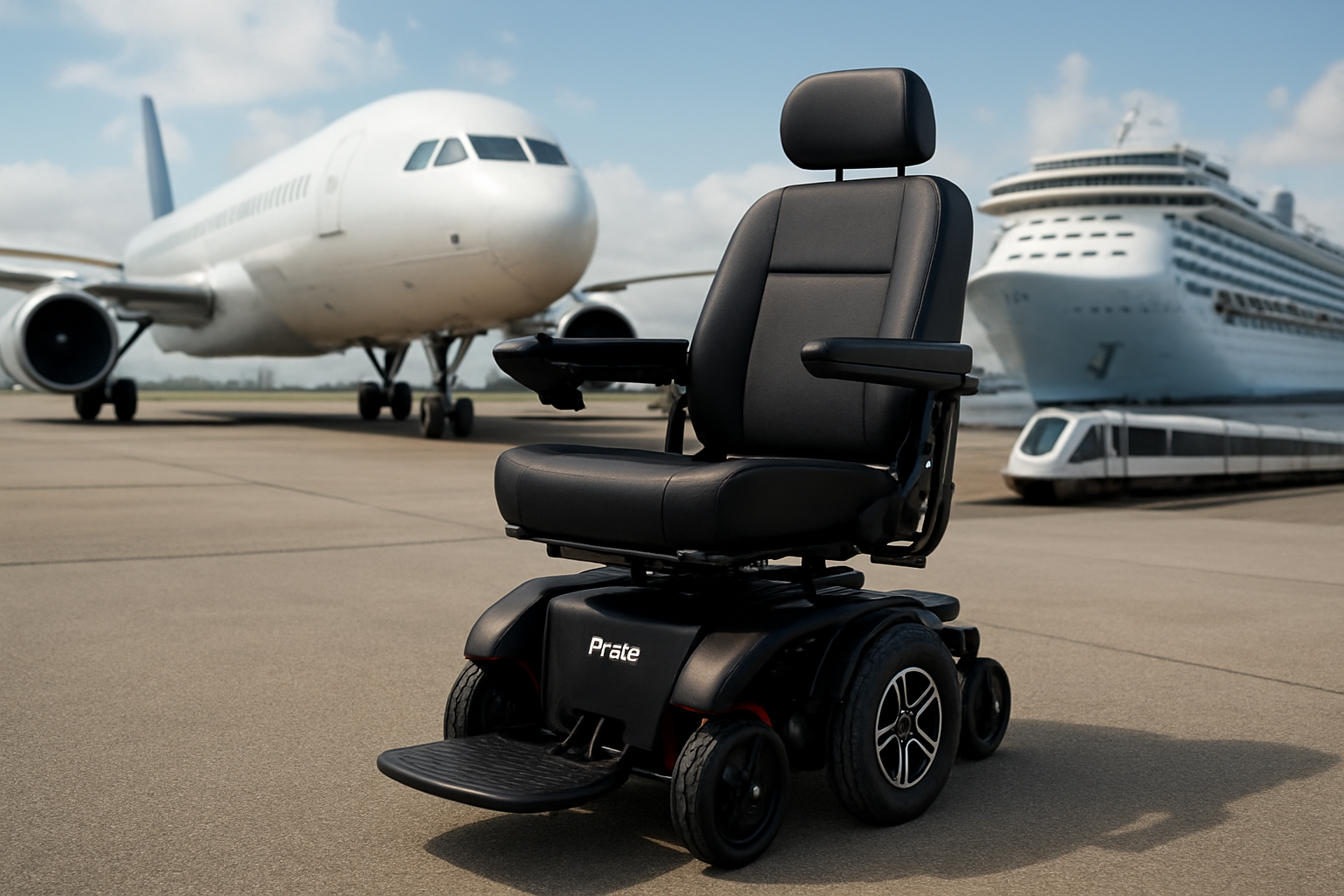
Airlines follow FAA [Federal Aviation Administration] rules, but each carrier layers on its own procedures. Most require notice that you are traveling with a powered wheelchair, ask for battery details, and encourage you to arrive early for preboarding. Trains in the United States covered by the Americans with Disabilities Act are generally straightforward, and cruise lines often have dedicated staff at the pier to assist and tag your device. The biggest variation is who handles the chair at the aircraft door and how they secure it in cargo.
| When | Action | Your Note |
|---|---|---|
| 30 to 14 days out | Notify airline of a powered wheelchair and battery type; request preboarding | Save confirmation emails and agent names |
| 72 to 48 hours out | Print handling card with power-off steps and joystick removal | Attach with a zip tie to the chair frame |
| 24 hours out | Charge batteries fully and photograph the chair from all sides | Photos help if damage claims are needed |
| At the airport | Ask for a gate-check tag and supervise stowage if possible | Remove joystick, cushion, and battery documentation to carry-on |
Concerned about damage rates? The Department of Transportation [Department of Transportation] monthly reports show that roughly 1.3 to 1.6 percent of wheelchairs and scooters checked by United States airlines are reported mishandled in a typical month. That number is trending in the right direction, but the best protection is preparation. Fold or remove what you can, lock the freewheel levers, use foam or a towel to cushion the joystick base, and give ramp agents your handling card with a smile. People are far more careful when they know the owner is watching and they have clear instructions in hand.
- At boarding, ask for a gate delivery tag so your chair comes up at the aircraft door on arrival.
- Remove the joystick and keep it in a padded tote; it is the most vulnerable part.
- Use painter’s tape over loose connectors and quick-release points to prevent snags.
- After landing, test driving and turning radius before leaving the gate area.
Battery Tips, Charging, and Maintenance On the Road
Air travel is demanding on batteries because devices get powered off, moved, and sometimes stored in cold cargo holds. The fix is to control what you can control. Charge fully overnight, then stop charging a bit before you leave so your charger cools and goes into a safe pack. If you travel internationally, bring a dual-voltage charger or a voltage converter for regions that do not use 110 volts, plus the correct plug adapter. If you ever need to calculate Wh [watt hours] for your battery, just multiply voltage by amp hours. For example, a 24 volt system using two 12 volt, 12 amp hour modules totals about 288 Wh [watt hours].
- Never pack loose batteries with metal tools or coins. Use terminal covers or individual cases.
- Keep your charger and a small extension cord in your personal item so they never get gate-checked.
- Store batteries between 40 percent and 60 percent if you will not use the chair for more than two weeks.
- In hot climates, avoid leaving your chair in a closed car where heat can reduce battery lifespan.
If your Go Chair® uses sealed lead-acid packs, remember they like regular, full charges. Quick ten-minute top-offs do not help much, while nightly full charges do. For lithium-ion, partial charges are fine, but try not to store at 100 percent for long periods. Either way, your joystick display is a good guide, but voltage can dip faster on hills or carpet, so plan a charging window during lunch or before dinner. When in doubt, ask your hotel for a ground-floor room near outlets, and bring a small surge-protected power strip for safe, tidy charging.
Medicare Coverage, Insurance, and Documentation
Let us talk budgets and benefits. Medicare Part B may cover a power wheelchair as durable medical equipment, when medically necessary for use in the home. That can include the Go Chair® if your clinician documents your need and you meet coverage criteria. A face-to-face exam, detailed written order, and proof that a cane, walker, or manual chair is not sufficient are typically required. Private insurance plans often follow similar standards, though paperwork and prior authorization requirements vary by carrier. The CMS [Centers for Medicare & Medicaid Services] rules can feel dense, but they are manageable with an organized checklist and a partner who speaks the language.
| Requirement | What It Means | Your Action | How Go Wheelchairs Helps |
|---|---|---|---|
| Medical necessity | Power chair needed for basic home activities | Discuss daily tasks you cannot do with your clinician | Templates for visit notes that capture needed details |
| Face-to-face exam | Clinical visit within a defined time window | Schedule promptly and save the visit summary | Reminders and coordination with your clinic |
| Detailed order | Model, accessories, and medical rationale | Confirm measurements and options | We prepare a clean order set for signature |
| Prior authorization | Some plans require approval before delivery | Share your insurance card and plan details | We submit and track the authorization for you |
Go Wheelchairs specializes in navigating Medicare and insurance for powered chairs, so you are not learning acronyms while recovering from an appointment. We verify benefits, estimate out-of-pocket costs, collect the right documents the first time, and coordinate delivery. If travel is a priority, we will help you weigh the Go Chair® against lightweight folding options or heavier-duty models, then create a setup that fits your home, your lifestyle, and your coverage.
Real-World Packing Checklist, Dimensions, and Quick-Reference Tables
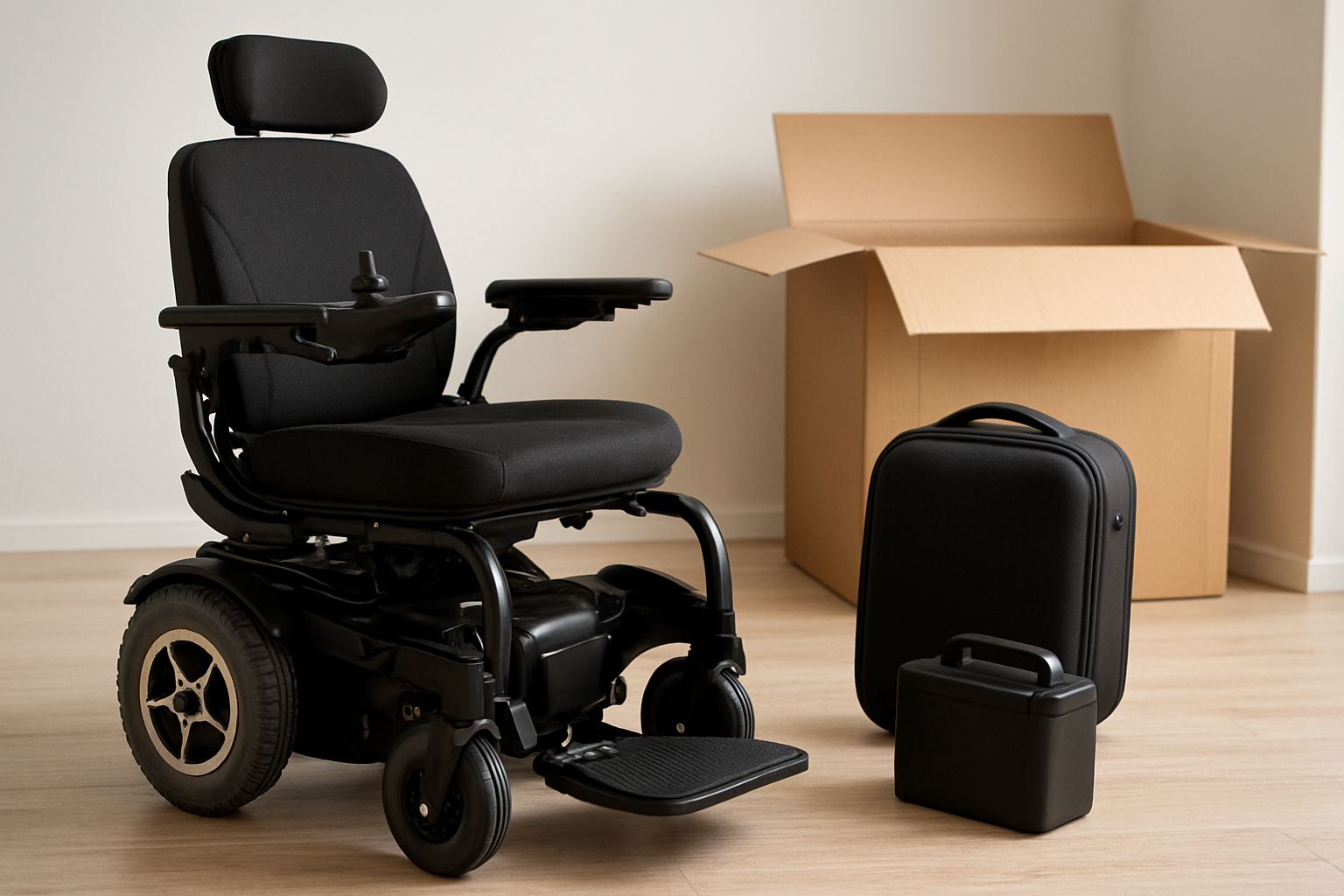
Let me share a quick story. Maria wanted to visit her granddaughter but dreaded the idea of gate-checking an electric wheelchair. She printed a one-page handling guide, zip-tied it to the chair, and moved her joystick and cushion to a backpack before boarding. On arrival, the ramp agent read the instructions, locked freewheel levers, and Maria rolled off the jet bridge without a hiccup. Confidence is not magic; it is a repeatable process you can pack with you.
| Spec | Typical Value | Travel Note |
|---|---|---|
| Overall width | About 22 to 23 inches | Fits many aircraft aisles only with aisle chairs; use preboarding |
| Turning radius | About 25 to 26 inches | Great for hotel rooms and cruise cabin corridors |
| Heaviest piece after disassembly | Roughly 30 to 36 pounds | Comfortable for many caregivers to lift into a car trunk |
| Battery type | Usually sealed lead-acid, non-spillable | Bring printed label and spec sheet to the airport |
| Weight capacity | Commonly 300 pounds | Verify for your exact model and year |
- Handling card: power-off steps, freewheel instructions, joystick removal, and your contact info.
- Protective bag or case: for joystick, charger, and small tools.
- Zip ties, painter’s tape, and a microfiber cloth: quick fixes and safe covers for connectors.
- Printed copies: airline confirmation, battery specs, doctor’s note if you prefer, and chair serial number.
How Go Wheelchairs Helps You Travel Confidently
Choosing the right device for travel is about trade-offs, and an expert partner makes those choices easier. Go Wheelchairs offers a wide range of standard and heavy-duty motorized wheelchairs, plus lightweight, foldable wheelchair designs for flights, trains, and cruises. Our team listens to how you live, maps your daily routes, and then recommends a chair that fits your budget, your back, and your doorway. If you need insurance or Medicare help, we handle the paperwork and keep you updated at every step, so you know exactly where things stand.
- Personalized guidance: fit assessments, test drives where available, and honest trade-off discussions.
- Insurance and Medicare assistance: benefit checks, documentation support, and prior authorization tracking.
- Resources hub: buying guides, comparison tools, travel tips, checklists, and policy explainers in plain English.
- Trusted brands: options from travel-ready chairs to bariatric models without overpaying for features you do not need.
Here is a final example. James needed heavy-duty stability at home and a nimble chair for weekend trips. We paired a robust daily driver with a travel-ready Go Chair® and created a simple packing routine with labeled zip-top bags for his joystick and charger. He now boards earlier, tags his chair at the jet bridge, and spends less time explaining and more time enjoying the journey. That is the power of the right equipment and a plan built for you.
Airline Forms, Damage Claims, and Smart Scripts You Can Use
Even with the best preparation, things happen. If your chair is damaged, ask to complete a damage report before you leave the arrival area, take time-stamped photos, and request a loaner if needed. The Department of Transportation [Department of Transportation] requires airlines to repair or replace a wheelchair damaged in transit. Keep a tiny folder in your bag with your chair’s serial number, a parts list, and your preferred service dealer. When you speak to an agent, a calm script helps you get what you need without friction.
- “I rely on this device for mobility. Let us complete the damage report now and arrange a loaner so I can continue my trip.”
- “Here are my photos from departure and arrival. This is my handling card showing how the chair should be stowed.”
- “Please note the joystick and armrest damage on the form, and include my dealer’s contact for repair coordination.”
Before your next trip, consider contacting TSA Cares [Transportation Security Administration Cares] for personalized assistance through security. While policies evolve, the FAA [Federal Aviation Administration] and Department of Transportation [Department of Transportation] maintain stable rules around batteries and damage responsibilities. Save their pages offline or as bookmarks, and do a five-minute review the night before you fly. That small ritual can turn uncertainty into a predictable, stress-light routine you carry from airport to airport.
Quick recap of the core checklist you can screenshot:
- Tell your airline about your powered wheelchair and battery type at least 72 hours in advance.
- Print a handling card, attach it to your chair, and carry battery specs and photos.
- Remove and carry the joystick and cushion; protect terminals; ask for gate delivery.
- On arrival, inspect immediately and file any necessary reports before leaving the gate area.
Finally, remember that equipment choice is personal. Some travelers prefer the classic Go Chair® disassembly for car trunks, while others want a folding power chair for international trains. If you are unsure, Go Wheelchairs will talk through door widths, vehicle lifts, battery preferences, and your coverage options to design a setup that just works wherever you roam.
Traveler’s note: Product dimensions and airline policies can change by model year and carrier. Always confirm with your airline and review the FAA [Federal Aviation Administration] and TSA [Transportation Security Administration] guidance before departure.
Your journey should feel as open as your map. With clear rules, better prep, and a right-fit chair, you can go farther with less fuss, whether it is a weekend getaway or a long-haul adventure.
Promise: You learned exactly how to navigate airport security, protect your chair, manage batteries, and leverage coverage to make travel simpler. Imagine boarding next time with a calm checklist, a tagged chair, and total confidence chatting with the gate agent. Where will your Go Chair® take you next?
Additional Resources
Explore these authoritative resources to dive deeper into pride mobility pride go chair travel power.
Travel-Ready Confidence with Go Wheelchairs
Explore the Go Chair® and a wide range of standard and heavy-duty motorized wheelchairs, expert guidance, and Medicare assistance to move forward with confidence and independence.