
Power Wheelchair Buying Guide for First Time Users: Fit, Controls, Weight Capacity & Medicare-Friendly Tips
If you are just starting your search, this power wheelchair buying guide for first time users is designed to turn overwhelm into clarity. I still remember helping a friend test drive their first motorized wheelchair; a hallway that seemed roomy suddenly felt like a tightrope until we found a chair that actually fit their dimensions and daily life. That moment taught me something simple but powerful: the right power chair is less about flashy features and more about a thoughtful match between your body, your spaces, and your goals. As you read, you will learn how to size a chair correctly, choose controls that feel natural, verify weight capacity, and navigate Medicare and other insurance like a pro, with Go Wheelchairs walking beside you at every step.
Power Wheelchair Buying Guide for First Time Users: Start Here
Let us begin with outcomes you can feel: independence, confidence, and comfort. Before you look at models, write down where you plan to use your chair most, how long you typically sit each day, and what “freedom” looks like for you. Do you need tight indoor maneuvering, curb-climbing for sidewalks, or a foldable design for travel? Will you bring a service animal, oxygen tank, laptop bag, or groceries along? These details guide everything from turning radius to suspension to battery range. Next, consider funding. Many first-time buyers qualify for coverage through Medicare and other health insurance when medical necessity is documented. Go Wheelchairs can help translate requirements from the Centers for Medicare & Medicaid Services (CMS [Centers for Medicare & Medicaid Services]) and other insurers into a simple task list, then match you with a chair that fits both your life and your budget.
- Define where you will ride: apartment hallways, office corridors, parks, public transit, or all of the above.
- List must-have features: compact turning, outdoor stability, seat elevation (available on some models), adjustable or high-back seating, or lightweight, foldable transport.
- Note health essentials: posture needs, pressure relief, or alternative controls if hand strength is limited.
- Plan the numbers: monthly budget, possible copays, and whether you will pursue Medicare or other insurance coverage.
How to Get the Right Fit: Measurements, Seating, and Posture
Fit is everything. A power chair that is one inch too wide can snag door frames, and a seat that is one inch too deep can cause slouching and discomfort. Measure with a soft tape while seated on a firm surface. For seat width, measure the widest point of your hips or thighs and add about one inch for clothing and movement. For seat depth, measure from the back of your hip to the back of the knee and subtract roughly one to two inches so your calves are free and circulation stays happy. Seat-to-floor height should allow your feet to rest comfortably on footplates while keeping knees and hips at roughly ninety degrees. Back height, armrest height, and cushion selection influence posture and pressure distribution, which is why many folks work with a physical therapist or occupational therapist during this step. If you do not have one, Go Wheelchairs can help you connect with a seating specialist and coordinate demos or recommend cushions to try before you decide.
Watch This Helpful Video
To help you better understand power wheelchair buying guide for first time users, we’ve included this informative video from Mobility Scooters Direct. It provides valuable insights and visual demonstrations that complement the written content.
- Bring your doorway widths; Americans with Disabilities Act (ADA [Americans with Disabilities Act]) clear width is typically 32 inches at minimum, but many homes have 28 to 30 inches.
- Account for winter jackets and layered clothing that can change fit by an inch or more.
- Consider growth or weight fluctuation; a small seat width adjustment now can prevent a replacement later.
| Dimension | How to Measure | Why It Matters | Typical Range |
|---|---|---|---|
| Seat Width | Widest hip or thigh point plus about one inch | Prevents hip pressure and rubbing against armrests | 16 to 22 inches for most adults |
| Seat Depth | Back of hip to back of knee minus one to two inches | Supports thighs without pressing on calves | 16 to 20 inches common |
| Seat-to-Floor Height | From seat surface to floor with footplates in place | Ensures efficient foot support, transfers, and table clearance | 18 to 20 inches typical |
| Back Height | From seat to under shoulder blade or higher if needed | Stability for trunk and head; accommodates recline functions | 18 to 24 inches or higher with headrests |
| Armrest Height | Elbow at 90 degrees from seat surface | Reduces neck and shoulder strain | 7 to 10 inches above seat |
| Footplate Clearance | From floor to underside of footplate | Prevents scraping on thresholds and ramps | 2 to 3 inches |
Controls and Drive Systems: Test What Feels Natural
Think of controls like your steering wheel. The standard joystick is highly customizable, with sensitivity and speed profiles the technician can tweak to your comfort. If hand function is limited, alternative inputs such as head arrays, sip-and-puff systems, or chin controls can open the door to confident mobility. Drive system also shapes the ride. Mid-wheel drive chairs pivot almost in place, making tight turns feel easy. Front-wheel drive chairs climb obstacles smoothly and track well outdoors. Rear-wheel drive chairs often offer higher top speeds and a stable, straight-line feel over longer distances. A quick showroom spin is helpful, but a real-world test in your hallway, elevator, and neighborhood is even better. Go Wheelchairs can walk you through setup of multiple drive profiles, so you can switch between “indoor precision” and “outdoor cruise” at the push of a button.
| Drive Type | Approx. Turning Radius | Ride Feel | Best For | Notes |
|---|---|---|---|---|
| Mid-wheel Drive | About 20 to 22 inches | Pivots near center; very nimble indoors | Small apartments, tight office spaces | Six-wheel contact improves stability; watch curb approaches |
| Front-wheel Drive | About 24 to 26 inches | Strong obstacle climbing and traction | Mixed indoor/outdoor use, uneven sidewalks | Slightly larger indoor footprint than mid-wheel |
| Rear-wheel Drive | About 26 to 28 inches | Stable at higher speeds, smooth tracking | Outdoor distance, ramps, and gentle hills | Wider turning can challenge narrow hallways |
Weight Capacity, Terrain, and Battery Range: Match Chair to Life
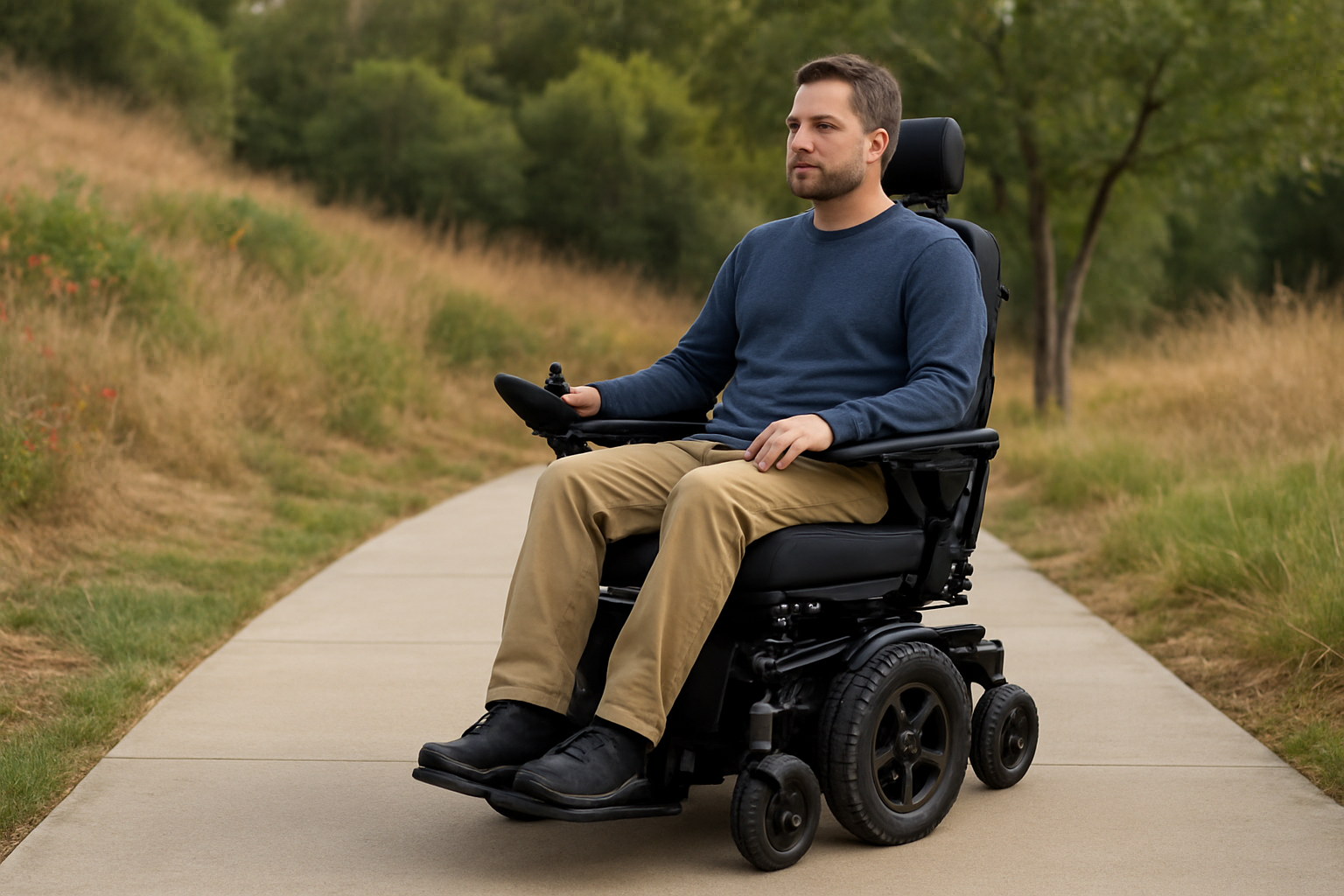
Capacity is not just about your body weight; include the weight of accessories, bags, medical equipment, and anything you carry regularly. For safety and performance, choose a chair with at least a 15 percent margin above your typical total load. Standard power chairs often support up to 300 pounds, while heavy-duty models can support 400 to 500 pounds or more, with sturdier frames and wider seats. Terrain matters too. Indoor-focused users generally benefit from lighter frames and tight turning, while outdoor travelers may prioritize suspension, wheel size, and motors tuned for hills. Battery range varies by model and conditions; manufacturer ranges assume ideal scenarios. Real-world range depends on speed, incline, temperature, and payload. Industry surveys suggest most first-time users are comfortable with 10 to 18 miles per charge, while heavy-duty riders often target 12 to 22 miles for peace of mind.
| Capacity Tier | User Weight Range | Typical Seat Width | Advertised Range per Charge | Real-world Considerations |
|---|---|---|---|---|
| Standard | Up to about 300 pounds | 16 to 20 inches | 10 to 18 miles | Best on smooth floors and level sidewalks; compact turning |
| Heavy-duty | About 300 to 450 pounds | 20 to 24 inches | 12 to 22 miles | Stronger motors, enhanced suspension; handles cracks and curbs |
| Very heavy-duty | About 450 to 600 pounds | 22 to 26 inches | 10 to 20 miles | Wide footprint; confirm doorway clearance and ramp ratings |
Medicare-Friendly Steps: Documentation, Coverage, and Costs
Good news: with the right paperwork and supplier, many power wheelchairs qualify as durable medical equipment (DME [durable medical equipment]) when they are medically necessary for home mobility. Under Medicare Part B, after the annual deductible is met, Medicare typically pays 80 percent of the approved amount if the supplier accepts assignment, and you pay the remaining 20 percent. The path is structured but doable: a face-to-face exam with your prescriber, a detailed written order, documentation proving that a power chair is required for safe mobility in your home, and selection of a participating supplier. The Centers for Medicare & Medicaid Services (CMS [Centers for Medicare & Medicaid Services]) can require prior authorization for some models, and timelines vary by state. Go Wheelchairs helps you gather the right documentation, coordinate with your clinician, and confirm supplier participation so there are no surprises at delivery.
| Coverage Step | Who Is Involved | Key Document | Tip to Avoid Delays |
|---|---|---|---|
| Face-to-face evaluation | Prescriber, you, and often a seating clinician | Clinical notes on home mobility needs | Describe home barriers, distances, and daily tasks in detail |
| Medical necessity | Prescriber and therapist | Letter of medical necessity | Include why a manual chair or scooter will not meet needs |
| Detailed written order | Prescriber | Prescription with chair features | Spell out seat size, drive type, cushions, and accessories |
| Prior authorization | Insurer and supplier | Authorization confirmation | Check requirements before ordering; timelines can vary |
| Supplier selection | You and supplier | Assignment acceptance record | Verify the supplier accepts assignment to limit out-of-pocket costs |
| Delivery and fitting | Supplier technician | Delivery ticket and setup notes | Test in your home; request programming tweaks and training |
- Document pain points with specifics: number of transfers per day, distances between rooms, and any falls or near-falls.
- Ask your prescriber to include why a cane, walker, manual chair, or scooter is not sufficient inside your home.
- Keep copies of all notes and orders; Go Wheelchairs can help organize and submit them to reduce back-and-forth.
Try, Compare, Decide with Go Wheelchairs
Chairs feel different once they meet your life. Bring your tightest turn, steepest ramp, and bumpiest threshold into the evaluation by measuring and describing them. If you commute or travel, try a lightweight, foldable power wheelchair to see how it fits in car trunks or rides on transit. If you need robust outdoor performance or higher weight capacity, roll a heavy-duty model over real cracks and grass to judge stability. A recent Go Wheelchairs customer, a high school coach balancing gym floors and weekend fields, compared mid-wheel and front-wheel drive, then chose front-wheel for traction and a cushioned backrest for long days. With Go Wheelchairs, you get a partner that provides a wide range of standard and heavy-duty motorized wheelchairs, practical demos where possible, personalized programming, and clear guidance on Medicare and other insurance, all backed by a resources hub full of buying guides, comparison tools, and travel tips.
- Ask for two speed profiles: a slow indoor mode with gentle acceleration and a faster outdoor mode with smoother coasting.
- Check ramp compatibility at home; verify ramp weight rating and width against chair weight and overall width.
- Confirm service and support: what adjustments are covered, and how quickly a technician can respond if something feels off.
Quick Reality Checks and Pro Tips

A few small checks prevent big headaches. Measure your narrowest doorway and the tightest turn between rooms; compare those numbers to the chair’s overall width and turning radius. If you plan to travel, confirm airline or public transit rules and bring your charger and a protective joystick cover. Consider battery type and charging habits: lithium-ion batteries generally offer lighter weight and quicker charging, while other chemistries can be heavier but cost less upfront. According to industry data, most power wheelchairs last five to seven years with proper maintenance, and regular tire checks, joystick inspections, and battery care can extend that lifespan. Finally, build your circle: a prescriber who listens, a seating clinician who understands posture, and a supplier who supports you after delivery. Go Wheelchairs prides itself on being that last piece, offering ongoing support long after the sale.
- Create a three-minute “daily route” you can test during your demo: bed to bathroom, bathroom to kitchen, and out the door.
- Bring a backpack with your typical load so weight and balance mimic your real day.
- Set a comfort threshold: if you cannot sit comfortably for at least two hours during testing, revisit fit or cushioning.
How Go Wheelchairs Helps You Move Forward
Individuals with mobility challenges often struggle to find an affordable, dependable solution that fits both their lifestyle and coverage needs. Go Wheelchairs addresses this head-on with a wide range of standard and heavy-duty motorized wheelchairs, lightweight, foldable options for travel, and a team that offers personalized support at every step. From your first conversation, we map your spaces, clarify your goals, help your clinician document medical necessity, and coordinate insurance and Medicare details so your purchase makes sense both clinically and financially. Our resources hub features practical buying guides, comparison tools, and travel tips to accelerate your learning, while our guidance after delivery ensures your chair is tuned to you. The result is simple: you get a chair that fits, controls that feel natural, capacity that handles your life, and coverage that keeps costs predictable.
Your next move is straightforward: gather measurements, list your must-haves, and schedule a fit and drive consultation. Whether you are choosing a compact indoor expert or a heavy-duty outdoor partner, we will help you compare options side by side and program profiles you can live with. If you are pursuing Medicare or other insurance, we will walk you through documentation requirements and supplier participation so you know what to expect. When everything aligns, the chair will feel like an extension of you, and your days will expand to meet your ambitions. If you want a steady co-pilot, Go Wheelchairs is ready.
Closing Thoughts
Pick the chair that fits your body, your spaces, and your goals, then let smart coverage and support do the heavy lifting. In the next 12 months, expect lighter batteries, smarter controls, and more flexible coverage pathways that reward clear documentation and trustworthy suppliers. What would your everyday life feel like if every room, curb, and errand became comfortably reachable again? If you want a roadmap you can return to any time, bookmark this power wheelchair buying guide for first time users.
Additional Resources
Explore these authoritative resources to dive deeper into power wheelchair buying guide for first time users.
Choose Confidently with Go Wheelchairs
Explore a wide range of standard and heavy-duty motorized wheelchairs with personal Medicare guidance so you move forward with confidence and independence.