Mobility Device Travel Regulations Explained: An Airport Checklist for Power Wheelchairs, Batteries & Insurance Docs
If you have ever felt overwhelmed trying to decode mobility device travel regulations right before a flight, you are absolutely not alone. Between power wheelchair batteries, check-in scripts, and insurance documents, the details can feel like a moving target. The good news is that once you know who sets the rules and what airport staff actually look for, the process gets much simpler. Think of this guide as your friendly preflight co-pilot, keeping you one step ahead from the curb to your seat.
My first time assisting a friend with a power chair, we learned the hard way that a missing battery label can stall boarding. After that, we traveled with a one-page spec sheet taped under the seat, and everything changed. Agents smiled, questions got answered fast, and the chair rolled down the jet bridge with confidence. That is the kind of trip you deserve every time.
Below, we break down the key rules, demystify battery limits, and give you a ready-to-use airport checklist for power wheelchairs, batteries, and insurance documents. Along the way, you will see how Go Wheelchairs supports travelers with the right equipment, personalized guidance on coverage, and a practical Resources Hub packed with buying guides, comparison tools, and travel tips you can use today.
Mobility Device Travel Regulations: What Really Matters at the Airport
Let us start with who does what, because understanding the roles behind the rules is half the battle. In the United States, the Air Carrier Access Act protects your right to fly with your mobility device. The United States Department of Transportation publishes the Airline Passengers with Disabilities Bill of Rights to make those protections clear in plain language. Meanwhile, the Federal Aviation Administration focuses on safety standards for batteries and hazardous materials, and the Transportation Security Administration handles security screening at the checkpoint.
This can sound complicated on paper, yet the practical takeaway is surprisingly straightforward. Airlines must accept mobility devices, including motorized wheelchairs, as checked baggage and provide assistance during boarding and deplaning. Airline staff may ask questions to verify battery type and safe handling steps, but they should not require you to disassemble your chair beyond what safety demands. Your game plan is to show you know your device, have the right paperwork handy, and can direct staff to the cut-off switch and any travel mode.
| Who | Role | What It Means For You |
|---|---|---|
| Air Carrier Access Act | Protects your right to travel with assistive devices | Airlines must accept your wheelchair and provide assistance |
| United States Department of Transportation | Publishes the Airline Passengers with Disabilities Bill of Rights and monitors mishandling | Use these rights if you face barriers or device damage |
| Federal Aviation Administration | Sets safety standards for batteries and hazardous materials | Follow battery limits, terminal protection, and packaging guidance |
| Transportation Security Administration | Conducts security screening at the checkpoint and gate | Expect inspection but request chair-friendly procedures and assistance |
| Airline | Implements procedures, aircraft stowage, and staff training | Notify at least 48 hours ahead about your device and needs |
Here is a stat to keep in your back pocket when you talk to gate staff. According to public reports from the United States Department of Transportation, U.S. carriers mishandle roughly one to two percent of mobility devices each month, which adds up to well over ten thousand units each year. That is why labeling, instructions, and photos are not just nice-to-haves; they are your best insurance against preventable damage and delays.
Power Wheelchair Battery Rules Explained: Watt-hours, Switches, and Safe Packing
Batteries are where most of the confusion lives, so let us make it crystal clear. Airlines and regulators care about two things: the chemistry of the battery and the energy capacity. Lithium-ion batteries are typically subject to specific Watt-hour limits. Sealed lead acid and other non-spillable types have different handling rules. What you need is the battery type, capacity, and simple instructions that show staff how to disconnect or secure the power.
Watch This Helpful Video
To help you better understand mobility device travel regulations, we’ve included this informative video from Chelsea Bear – Living With Cerebral Palsy . It provides valuable insights and visual demonstrations that complement the written content.
If your chair uses Lithium-ion power modules, check the label for the Watt-hour rating. As a general reference in many airline policies, a mobility device with an installed Lithium-ion battery up to 300 Watt-hours is accepted, and you may bring one spare up to 300 Watt-hours or two spares up to 160 Watt-hours each. If your chair uses two installed Lithium-ion modules, each usually must be 160 Watt-hours or less. Airlines may vary, so confirm at booking and again 48 hours before departure.
| Battery Type | Typical Use | Common Airline Acceptance | Limits to Know | How To Prepare |
|---|---|---|---|---|
| Lithium-ion | Modern power chairs and scooters | Accepted when installed securely; spares usually in carry-on, not checked | Often up to 300 Watt-hours per installed battery; two spares up to 160 Watt-hours each | Label capacity, protect terminals, switch off, and secure against activation |
| Sealed lead acid (non-spillable) | Many standard and heavy-duty power chairs | Accepted installed; may require terminals protected; spares allowed per airline policy | Check airline-specific dimensions and weight handling limits | Disconnect power, cover terminals, and provide handling instructions |
| Spillable (wet) batteries | Less common in modern mobility devices | Accepted with extra packaging and upright handling requirements | Airlines may limit routing or aircraft type; advance notice required | Provide leakproof container and clear handling instructions if applicable |
A simple rule of thumb helps: if the battery can be removed easily and safely, carry spares in the cabin with terminals protected and each module in a separate protective pouch. If the battery stays installed, ensure the chair has a clearly marked power cutoff and that the joystick is protected from accidental activation. Bring a one-page battery sheet that lists chemistry, Watt-hours, and any manufacturer guidance. Most crews appreciate clarity more than anything else.
The Airport Checklist: From Home to Gate to Aircraft Hold
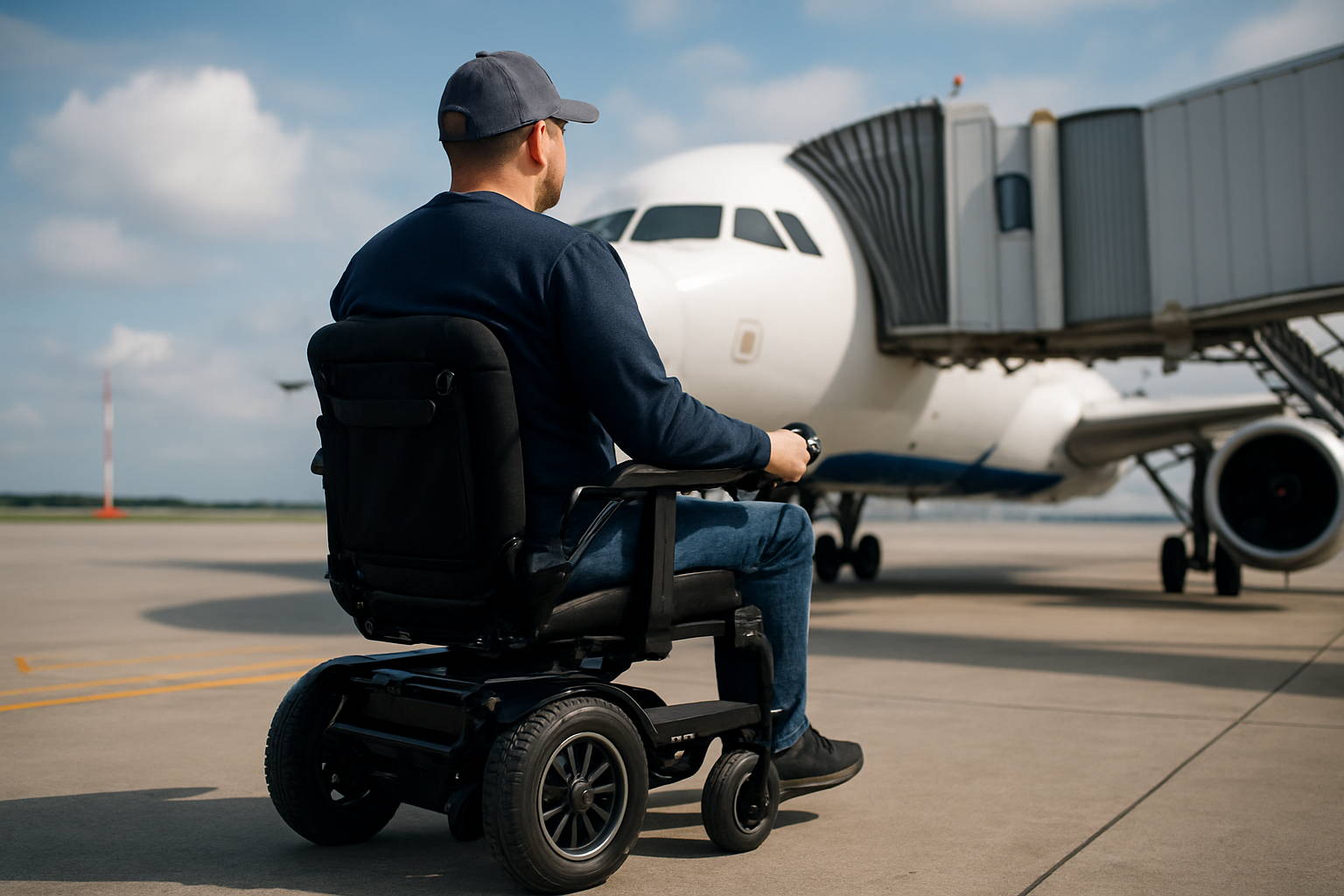
Checklists keep you calm and on schedule, especially on busy travel mornings. Aim to do a quick timeline from 72 hours before departure to your arrival at baggage claim. The most important moments are the phone call to the airline to pre-notify them, your check-in desk conversation, and the handoff at the gate. If you do those three well, the rest tends to fall into place.
| When | What To Do | Why It Matters |
|---|---|---|
| 72–48 hours before | Call the airline’s disability or special assistance desk and provide device dimensions, weight, battery type, and Watt-hours | Ensures the aircraft can accommodate your chair and staff are briefed |
| 24 hours before | Print or save your battery spec sheet, the device manual page on “transport,” and a one-page handling card | Speeds up check-in and gate conversations |
| Morning of flight | Photograph the chair from all sides and remove loose accessories into a labeled tote | Creates a condition record and prevents loss |
| At check-in | Request gate-check, pre-boarding, and loading instructions review; confirm you will transfer via aisle chair if needed | Sets expectations and protects your priority assistance rights |
| At the gate | Walk the agent through power cutoff, freewheel mode, and how to lift or secure the chair | Reduces risk of damage during loading and unloading |
| Upon arrival | Inspect the chair before leaving the jet bridge; report damage immediately | Enables on-the-spot fixes and stronger claim documentation |
Here is a concise, speak-it-out-loud script you can use at the counter and gate: “Hi, I am traveling with a powered wheelchair. The battery is Lithium-ion, 252 Watt-hours, installed and secured. Here is the handling card showing the power cutoff and freewheel mode. I would like to gate-check the chair and pre-board to guide the handoff.” Short, confident, and complete.
- Bring a small roll of painter’s tape to secure joystick covers without residue.
- Attach a bright tag with your name, mobile number, and destination airport code.
- Carry a compact tool kit if your chair manufacturer recommends one for removal of the joystick or headrest.
- Ask crew to avoid laying the chair on its side unless required by safety or space constraints.
Documents and Insurance: What To Carry and How To Use It
Paperwork is your fast pass. Airline staff are trained, but a clear document set can shave ten minutes off every conversation. Keep digital copies on your phone and a slim paper folder in your carry-on. If you ever need to file a damage claim, having these on hand turns a stressful moment into a solvable task.
| Document | What It Proves | Where To Store |
|---|---|---|
| Battery spec sheet and capacity label photo | Battery chemistry, Watt-hours, and airline acceptance guidance | Printed sheet in folder; photo in phone gallery |
| One-page handling card | Power cutoff location, freewheel instructions, and lift points | Laminated copy zip-tied to frame; spare in folder |
| Device manual transport page | Manufacturer directions for safe stowage | Printed copy or bookmarked PDF on your phone |
| Proof of ownership and serial number | Establishes value and identification if lost or damaged | Photo of serial plate; purchase receipt in cloud storage |
| Health insurance and Medicare documents | Covers repair or replacement pathways after damage | Carry-on folder and secure digital backup |
| Airline damage claim form template | Speeds up reporting at baggage service | Pre-filled with your device info for quick edits |
For extra peace of mind, many travelers carry a short letter from a clinician stating the chair is medically necessary and must travel with you. It is not always required, but it can help when an agent is new to mobility devices. If you need support gathering documentation, Go Wheelchairs offers personalized guidance and checklists, including help aligning Medicare coverage details with your travel plan so you are not scrambling last minute.
Protecting Your Chair: Prep, Handoffs, and Damage Claims

The best protection starts with a five-minute prep routine. Secure or remove anything that could snag, snap, or pop off during loading. That usually means headrest, side guards, cushions, cup holders, and the joystick cover if your model allows it. Add a firm note on your handling card that the chair should remain upright and never used as a baggage cart.
At the gate handoff, take 60 seconds to demonstrate freewheel mode and the power cutoff. Show staff where to lift if a lift point exists, and where not to lift if parts are cosmetic. Ask if the chair will be stowed in the cargo hold or in a special closet on certain aircraft types. For regional jets with narrow holds, clarifying this early helps everyone plan the safest route.
- Photograph the chair as you hand it over and again at the jet bridge on arrival.
- If something looks off, report it before leaving the gate area; it is much easier to fix quickly.
- Use calm, specific language: “The right footplate hinge is bent; here is a photo from this morning.”
- Ask for an immediate repair plan, a loaner if needed, and a written acknowledgment of the issue.
If a claim is necessary, request the airline’s written process and reference your rights under the Air Carrier Access Act and the Airline Passengers with Disabilities Bill of Rights. Keep receipts for any urgent fixes, and follow up with the airline in writing within the timeline they provide. If you need additional support, the United States Department of Transportation accepts disability-related complaints, and your health insurance or Medicare benefits may help with repair or replacement depending on policy terms.
How Go Wheelchairs Sets You Up for Smooth Travel
Travel goes smoother when your chair is selected and set up with airports in mind. Go Wheelchairs offers a wide range of standard and heavy-duty motorized wheelchairs, including lightweight, foldable designs that fit tighter aircraft spaces and simplify gate-check handoffs. Many models feature modular Lithium-ion battery options, with capacities that align with common airline Watt-hour limits and clear labeling that airports appreciate.
But gear is only the start. Go Wheelchairs provides personalized support and guidance that helps you match chair features with your lifestyle and coverage needs. If you are navigating Medicare or another health insurance plan, the team can help you understand documentation, prior authorizations, and what travel-related accessories may be covered. That kind of clarity means fewer surprises when you are trying to enjoy a trip.
Need to compare models quickly? The Go Wheelchairs Resources Hub includes buying guides, comparison tools, and travel tips designed to make decision-making faster and less stressful. You will find side-by-side specs, airline-aligned battery notes, and practical checklists you can print the night before you fly. It is a one-stop place to research, plan, and pack with confidence.
- Travel-smart features: foldable frames, modular batteries, and protective joystick covers.
- Insurance know-how: help aligning Medicare paperwork with your purchase and travel needs.
- Real support: a team that will talk you through airline calls and documentation prep.
Real-World Scenarios and Time-Saving Tips
Let us turn policy into practice with two quick trips. On a short domestic hop, a traveler with a foldable power chair and two 160 Watt-hour Lithium-ion modules gate-checks the chair and carries a spare battery in the cabin. With a printed handling card and early pre-boarding, boarding takes no extra time. On arrival, a quick inspection at the jet bridge confirms everything is intact, and the trip continues without drama.
On a longer international route, another traveler phones the airline’s special assistance desk 72 hours in advance with chair dimensions, weight, and battery details. They request pre-boarding and confirm the aircraft has space to keep the chair upright in the hold. They bring a clinician’s note, their insurance information, and a pre-filled claim template just in case. That little bit of prep is the difference between anxiety and a smooth transfer between connections.
| Scenario | Key Moves | Outcome |
|---|---|---|
| Domestic, narrow-body aircraft | Two 160 Watt-hour modules; gate-handled; pre-boarding; handling card | On-time boarding; safe stowage; quick inspection at arrival |
| International, wide-body aircraft | 72-hour pre-notice; dimensions provided; clinician letter; claim template ready | Coordinated loading; confidence at connections; fast issue resolution if needed |
A few efficiency wins add up. Save a photo album on your phone titled “Wheelchair Travel” with battery labels, serial number, and chair photos. Keep a zip pouch with spare zip ties, painter’s tape, and a thin plastic cover for rainy tarmac moments. And if you are between models, ask Go Wheelchairs which chairs are most airline-friendly for the routes you fly most often.
One last pro tip: when you arrive at the gate, introduce yourself and show the handling card before staff get busy with general boarding. You will be amazed how much smoother things go when you set the tone early with practical, respectful guidance. It turns a potential bottleneck into a high-five moment for the whole crew.
Ready to turn all of this knowledge into an easy travel day? This playbook gives you the map: know the rules, show your documents, and guide the handoff like a pro. With the right chair, a clear battery label, and a simple handling card, you are already ahead of the curve. And with Go Wheelchairs in your corner, you have support before, during, and after every flight.
Travel eases when expertise meets preparation. In the next 12 months, more airlines will refresh training and refine stowage options as traveler feedback and safety data improve. What small step will you take this week to feel more confident navigating mobility device travel regulations on your next trip?
Additional Resources
Explore these authoritative resources to dive deeper into mobility device travel regulations.
Navigate Mobility Device Travel Regulations with Go Wheelchairs
Use Go Wheelchairs’ Resources Hub for buying guides, comparison tools, and travel tips, plus personalized support and Medicare coverage guidance so you move forward with confidence and independence.