
Can I Fly with a Power Wheelchair and a Lithium Battery? 9-Step Preflight Checklist for Medicare & Insurance Travelers
If you are wondering can i fly with a power wheelchair and a lithium battery, the short answer is yes, with the right prep and paperwork. Airlines carry mobility devices every day, and the rules are more straightforward than they seem once you break them down. The key is knowing your battery’s watt-hour rating, telling the airline exactly what you are bringing, and setting your chair up so ground crews can move it safely. I still remember my first trip with a friend’s power chair; we were nervous at the ticket counter, then relieved at the gate when the agent pulled up the policy and walked us through the tag. Confidence grows fast when your plan is clear.
That is where a little guidance goes a long way. Go Wheelchairs is dedicated to providing reliable, motorized wheelchairs at fair prices and offering assistance with Medicare and other health insurance paperwork, empowering individuals to move freely and independently. If you have ever felt stuck between airline rules and insurance forms, you are not alone. Go Wheelchairs addresses these challenges by offering a variety of motorized wheelchairs, personalized support, and help preparing insurance or Medicare documentation and approvals, ensuring customers can move forward with confidence and independence. In this guide, you will get plain-English rules, a 9-step preflight checklist, and practical tips we use with customers who travel often. Ready to take the guesswork out of flying with your chair?
Can I Fly with a Power Wheelchair and a Lithium Battery? Real Talk and Quick Wins
Here is the practical reality. Under the Air Carrier Access Act, airlines must accept mobility devices, including power wheelchairs, and the battery rules are set by the FAA (Federal Aviation Administration) and IATA (International Air Transport Association). Lithium-ion batteries are allowed with watt-hour limits, and sealed lead-acid batteries are allowed with safeguards against leaks and short circuits. The airline will either let your battery stay installed or ask you to remove it and carry it aboard, which depends on whether the chair is designed for battery removal. If you know your battery type and rating, arrive early, and attach handling instructions to your chair, you will make life easier for the gate agent, the ramp crew, and yourself.
One more reason to prepare well: mishandling of mobility devices does occur during travel, and clear handling steps and protective measures reduce that risk. Add a laminated tag that explains how to switch your chair to freewheel mode, how to disconnect the joystick, and where safe lift points are located. It sounds simple, but this is the difference between your chair rolling off the jet bridge intact or needing repairs at baggage claim. Preparation is protective gear for your travel day.
| Battery Type | Typical Rating | Installed Battery in Checked Device | Removable Battery | Spare Batteries in Carry-On | Notes |
|---|---|---|---|---|---|
| Lithium-ion | Varied; model-dependent (commonly measured in the hundreds of Wh) | Allowed with protections and airline approval; rules vary by carrier | Often must be removed and carried in cabin or handled per airline rules | Subject to airline and regulatory limits; carriers may require approval for higher‑capacity spares and spares are typically not permitted in checked baggage | Terminals must be covered; use original case or tape |
| Sealed lead-acid or AGM | Rated in Ah (amp-hours); convertible to Wh if voltage is known | Allowed when secured against damage and short circuit | Removed only if the device requires it | Not typically carried as loose spares | Non-spillable models are preferred for air travel |
Finding your watt-hours: If the label shows only V (volts) and Ah (amp-hours), use Wh (watt-hours) = V (volts) × Ah (amp-hours). Example: 24 V (volts) × 12 Ah (amp-hours) = 288 Wh (watt-hours).
Know the Rules: Batteries, Airline Policies, and Documentation
Policies share the same backbone worldwide because airlines align with FAA (Federal Aviation Administration) and IATA (International Air Transport Association) guidance, but each carrier adds its own forms and timelines. Most airlines want your device dimensions, weight, battery type, and watt-hours in advance. Some require that your lithium battery be removable and placed in a protective bag for carry-on, especially if your chair folds. All require terminals to be protected against short circuits. If your battery is safe to remain installed, your chair usually goes to the cargo hold at the jet bridge and returns to you at the aircraft door upon arrival.
Watch This Helpful Video
To help you better understand can i fly with a power wheelchair and a lithium battery, we’ve included this informative video from 10 Tampa Bay. It provides valuable insights and visual demonstrations that complement the written content.
Documentation smooths the path. Print your battery’s SDS (Safety Data Sheet) or MSDS (Material Safety Data Sheet), the chair manual page that explains how to disconnect power, and the airline’s mobility aid policy. Having a one-page “handling card” taped to your chair is golden. It should show how to set freewheel mode, where to lift, what parts are removable, and your contact number. Go Wheelchairs includes printable templates in our Resources Hub so you can fill in your exact model details, plus we can help you find the SDS (Safety Data Sheet) for your battery if it is not obvious on the label.
| Item | What to Share | Where to Find It |
|---|---|---|
| Chair make and model | Brand and full model name | Purchase paperwork or frame label |
| Dimensions and weight | Length × width × height, total weight | User manual or a quick tape measure |
| Battery type | Lithium-ion or sealed lead-acid | Battery label or spec sheet |
| Watt-hours | Exact Wh (watt-hours) rating | Battery label or Wh (watt-hours) = V (volts) × Ah (amp-hours) |
| Disconnection steps | Freewheel, joystick removal, power isolation | Manual excerpt or handling card |
- Helpful tip: Call the airline’s special assistance line 48 to 72 hours in advance to add a mobility aid note and request preboarding.
- Accessibility extra: TSA (Transportation Security Administration) Cares can arrange assistance through security when you call ahead.
Can I Fly with a Power Wheelchair and a Lithium Battery? Your 9-Step Preflight Checklist
- Confirm your battery specs. Snap photos of the battery label. If needed, calculate Wh (watt-hours) using V (volts) × Ah (amp-hours). Print or save the SDS (Safety Data Sheet).
- Tell the airline early. At booking or at least 48 hours prior, give dimensions, weight, battery type, and Wh (watt-hours). Ask for gate-check return at the aircraft door.
- Prepare a handling card. Show freewheel location, lift points, power isolation, joystick removal, and your phone number. Laminate it or place it in a clear pouch.
- Protect critical parts. Remove the joystick if your model allows, wrap with bubble material, and pack in your carry-on. Tape loose connectors and cover battery terminals.
- Bring a mini toolkit. Include a hex set, small adjustable wrench, zip ties, painter’s tape, and spare fuses. Tools must comply with TSA (Transportation Security Administration) rules.
- Document everything. Print the airline policy page and your battery SDS (Safety Data Sheet). Keep a copy of your DME (durable medical equipment) prescription or letter of medical necessity.
- Request the right airport services. Ask for preboarding, an aisle chair if needed, and an agent to meet you at the gate for the mobility handoff.
- Arrive early and communicate. Be at the counter 2 to 3 hours ahead for domestic flights. Politely ask the gate agent to brief the ramp lead about your chair.
- Inspect on arrival. Before leaving the jet bridge, check your chair. If anything is damaged, file a report immediately with the airline and document photos for insurance.
Packing, Handoffs, and In-Flight Tips: What Actually Works
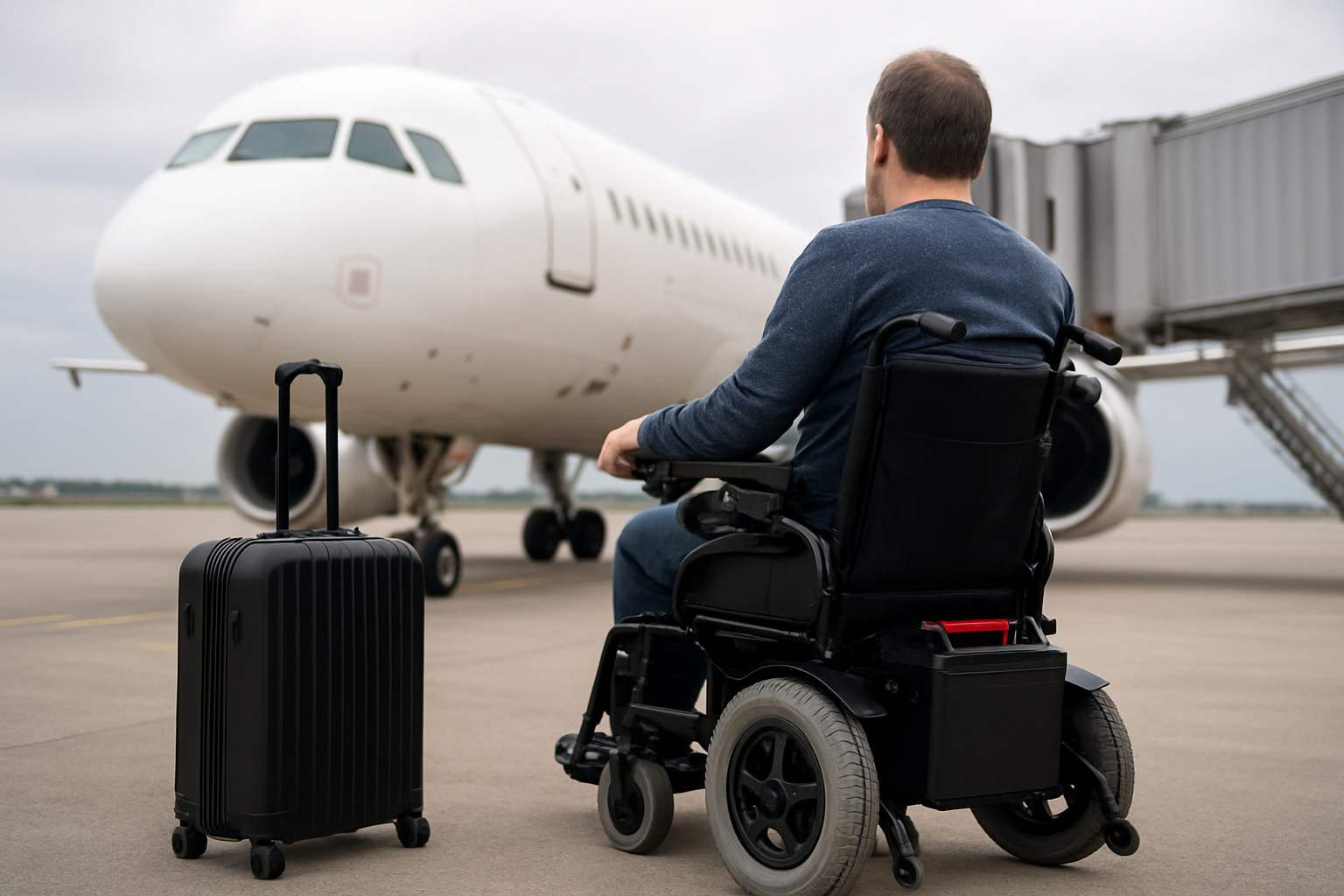
Think of your wheelchair like a precision instrument with a simple travel kit. Use painter’s tape to label lift points and the freewheel levers, and zip tie anything that can swing or snag. I coach customers to pack a “ready bag” with spare joystick gimbals if removable, the charger, a copy of the SDS (Safety Data Sheet), and a trash bag to cover the seat cushion against rain on the ramp. When you meet the ramp crew, point to the handling card and, if needed, offer a 20-second walkthrough. Most crew members appreciate the clarity, and you will feel calmer because everyone is on the same page.
Security and boarding get easier with practice. Call TSA (Transportation Security Administration) Cares ahead of time to flag your screening; tell them you cannot transfer or you need a manual pat-down. Preboarding lets you settle early and verify your chair is tagged to return at the aircraft door, not the baggage carousel. Keep medications and critical parts in your carry-on. During the flight, conserve energy with pressure relief stretches and hydration. Little rituals like that help you arrive ready to roll rather than worn down by the process.
- At security: tell officers if your chair cannot be powered off, and show the SDS (Safety Data Sheet) if asked.
- At the gate: ask for a gate-check tag marked Return to Jet Bridge, and take photos of your chair before handoff.
- In flight: keep your charger, a thin cushion, and any catheter or medical supplies in reach.
Coverage, Costs, and Claims: Medicare and Insurance Essentials
Let us talk money and coverage, because planning saves headaches later. For many people, power wheelchairs are covered as DME (durable medical equipment) when they are medically necessary at home. Travel accessories, like protective cases or spare lithium batteries, are often not covered by Medicare or private plans unless deemed medically necessary, which varies by plan and documentation. If the airline damages your chair, they are generally responsible for repair or replacement under consumer protection rules, and reporting the damage before leaving the airport speeds everything up. Keep the incident number, photos, and follow-up emails in one folder.
Before you fly, check whether your plan requires prior authorization for repairs or if it uses specific HCPCS (Healthcare Common Procedure Coding System) codes for replacement parts. If you need a loaner chair while yours is in repair after a flight incident, ask your plan about temporary equipment and limits. Go Wheelchairs can help translate coverage language and prep the paperwork. We routinely coach customers through claims, from gathering invoices to finding authorized repair shops, so that transportation hiccups do not turn into long downtimes at home.
| Scenario | Medicare | Private Insurance | Airline | Traveler | Notes |
|---|---|---|---|---|---|
| Airline damages chair | Typically not primary | May cover secondary after airline | Primary for repair or replacement | Keep receipts for incidentals | Report at airport with photos and a written claim |
| Loaner chair during repairs | Sometimes covered | Varies by plan | Occasional goodwill solutions | Possible copays | Ask your plan about temporary DME (durable medical equipment) |
| Spare lithium battery | Rarely covered | Plan-dependent | Not covered | Out of pocket | Bring receipt and SDS (Safety Data Sheet) for airline |
| Protective travel bag or cover | Usually not covered | Varies by plan | Not covered | Out of pocket | Useful in rain and on busy ramps |
Choosing the Right Power Chair for Flying: Travel, Standard, or Heavy-Duty
Not every power chair is built with airports in mind, and that is okay. The right fit depends on your body, your routine, and your routes. Frequent flyers often prefer lightweight, foldable chairs with airline-friendly removable lithium batteries. Others need the stability and seating features of standard or heavy-duty motorized wheelchairs, then travel comfortably by checking the chair at the gate with a clear handling plan. Go Wheelchairs carries all three categories and helps you weigh tradeoffs using real-world travel scenarios, not just spec sheets. If Medicare or your insurer covers your current chair, we help you explore travel options that do not jeopardize your coverage.
Here is a simple way to compare your options at a glance. If you are unsure where to start, our team can walk you through battery choices, seat widths, suspension, and transport needs. We can also connect the dots between your clinical requirements and the airline’s rules, so you are not forced to choose between comfort at home and practicality on the road.
| Category | Typical Weight | Battery Setup | Airline Fit | Use Case | Offered by Go Wheelchairs |
|---|---|---|---|---|---|
| Lightweight, foldable | 45 to 70 lb | Removable lithium battery within airline-acceptable limits (check carrier) | Easiest to carry on battery and gate-check frame | Frequent flyers, tight connections, compact cars | Yes, with guidance on battery SDS (Safety Data Sheet) |
| Standard motorized | 120 to 200 lb | Lithium or sealed lead-acid, often installed | Gate-check with handling card and preboarding | Daily comfort, posture support, mixed travel | Yes, wide range of models and seating options |
| Heavy-duty motorized | 200 lb and up | Higher capacity battery, often installed | Gate-check with clear lift points and ramp briefing | Higher weight capacity, outdoor durability | Yes, heavy-duty lineup with travel planning help |
Quick case study: Maya, who uses a standard mid-wheel drive chair, flew from Denver to Orlando with a 288 Wh (watt-hours) battery. Go Wheelchairs helped her print a handling card and compute Wh (watt-hours) from V (volts) × Ah (amp-hours). She removed her joystick at the gate, taped the freewheel instructions to the backrest, and asked the agent to brief the ramp lead. Her chair came up to the jet bridge at landing without a scratch, and the report she carried stayed nicely unused in her backpack. Preparation made the difference.
Pro Tips That Save the Day When Things Go Sideways

Even a flawless plan can meet turbulence. If your inbound aircraft changes, reconfirm gate-return of your chair with the agent and ask them to radio the ramp. If a crewmember tries to send your chair to baggage claim, calmly show the gate-check tag and request a supervisor. If a damage incident occurs, take photos, get names, and submit the report before leaving the airport. Then call your supplier and your insurer with the claim number so repairs and authorizations can move in parallel rather than in sequence. That parallel track reduces downtime significantly.
Consider a simple risk-reduction kit: a foldable seat cover, a laminated card with your name and phone number on the joystick, and a small roll of stretch wrap for armrests. If you travel internationally, print battery rules in the local language or keep them on your phone. Finally, celebrate the wins. Every smooth handoff and safe arrival is proof that you and your team, which includes airline staff and the Go Wheelchairs support crew, did the right prep. Travel is not about eliminating risk; it is about stacking small advantages in your favor.
Resources you will love: The Go Wheelchairs Resources Hub includes step-by-step buying guides, comparison tools, and travel tips created with frequent flyers. If you want a second set of eyes on your battery specs, we are happy to help.
Key reminder: Always check your specific airline policy and obtain approval when required. FAA (Federal Aviation Administration) and IATA (International Air Transport Association) guidance sets the framework, and the airline applies it to your exact flight and aircraft.
Frequently Asked Questions Travelers Ask Us
Do I need to disconnect my battery? If the chair is designed so the lithium battery can be removed, many airlines ask that you carry it in the cabin with terminals protected. If your chair keeps the battery installed, airlines typically isolate power using a switch or connector and then secure the chair for the cargo hold. Ask the special assistance desk which method they prefer for your model.
What if my battery label does not show Wh (watt-hours)? Use the formula Wh (watt-hours) = V (volts) × Ah (amp-hours). If you cannot find the numbers, call your provider or Go Wheelchairs and we will help you locate a spec sheet or SDS (Safety Data Sheet). Write the Wh (watt-hours) neatly on your handling card so the gate agent can note it quickly.
Can I bring spare batteries? Airlines generally allow limited lithium spares in carry-on when terminals are protected, but exact allowances vary by airline and regulations. Spares often have stricter limits than installed batteries and may require airline approval for higher-capacity units. Spares cannot go in checked baggage — always confirm with your carrier before traveling.
Do I have rights if my chair is damaged? Yes. Under consumer protection rules for disabled travelers, the airline is responsible for prompt repair or replacement. Report immediately, keep records, and contact your insurer and equipment provider for support.
At the end of the day, your plan is as important as your plane ticket. A clear battery spec, a friendly call to the airline, and a simple handling card turn a stressful mystery into a repeatable routine. Go Wheelchairs is here to help you choose the right chair for your body and your itinerary, and to navigate Medicare and insurance details without the runaround.
Want an easy place to start? Grab your battery label, jot down the Wh (watt-hours), and tell your airline what you are bringing. That one action sets every other domino in motion, from preboarding to gate-return. When you are ready, our team can walk you through options across lightweight foldable designs and a wide range of standard and heavy-duty motorized wheelchairs so you can travel with confidence.
Quick recap: Yes, you can fly with a power wheelchair and lithium battery. Use the 9-step checklist above, and do not hesitate to lean on Go Wheelchairs for documentation and device selection.
Final Thoughts Before You Book
With the right plan, flying with your power chair becomes predictable instead of stressful.
Imagine the next 12 months filled with weekend getaways and family visits because your chair, your battery, and your documents all work smoothly across airlines and airports.
So, can i fly with a power wheelchair and a lithium battery on my next trip, and how do I want that journey to feel from curb to cabin?
Additional Resources
Explore these authoritative resources to dive deeper into can i fly with a power wheelchair and a lithium battery.
Fly Confidently with Go Wheelchairs
Explore a wide range of standard and heavy-duty motorized wheelchairs with Medicare and insurance guidance so you move forward with confidence and independence.