If you are comparing specs and trying to decode battery range and charging time for power wheelchairs, you are not alone, and you are definitely in the right place. On paper, many chairs claim 10 to 25 miles per charge and a “quick” recharge, yet your real-world day rarely looks like a catalog photo. Hills, carpet, rider weight, weather, and even tire tread change how far you actually go and how fast you get back to 100 percent. In this friendly guide, I will translate the tech into plain English, share practical charging tips, and walk you through Medicare and insurance basics, with Go Wheelchairs as your partner for finding a chair that fits your lifestyle and coverage needs. We offer free mobility consultations, personalized recommendations, and insurance/Medicare assistance to help you navigate coverage and choose the right model.
Understanding Battery Range and Charging Time for Power Wheelchairs
Range is simply how far a chair travels on a full charge, but the honest answer is a zone, not a single number, because your day is never perfectly flat, warm, and wind-free. Think of your battery as a fuel tank measured in watt hours, written as Wh (watt hours), which is calculated from battery voltage times capacity in Ah (ampere hours), and then translated by your chair’s efficiency into miles. A compact travel chair with smaller motors and a lighter frame might achieve 8 to 12 miles per charge in mixed use, while a heavy-duty model with larger motors and wider tires may reach 15 to 25 miles on smooth paths yet dip under 12 miles on hills or thick carpet. If a brochure says 18 miles, a realistic planning number for mixed indoor and outdoor days is often 70 to 85 percent of that claim. For reference, Go Wheelchairs lists model-specific ranges — for example, the Go Chair® is published at about 11.2 miles per full charge and the Jazzy Air® 2 at roughly 19.2 miles — so apply the 70–85% planning guideline when estimating real-world range for any listed model.
Charging time depends on three things you can remember with a simple phrase: tank size, pump speed, and pit stops. The “tank” is total battery energy in Wh (watt hours), the “pump” is your charger’s current in amperes, and pit stops are pauses for battery management that smart chargers add to protect the cells. A pair of sealed lead-acid batteries, often called SLA (sealed lead-acid), may take 8 to 14 hours for a full top-up, especially if depleted deeply, while modern Li-ion (lithium-ion) packs commonly reach a protective full charge in 3 to 6 hours. Because batteries last longer when you avoid deep depletion, many users plug in nightly and aim to stay above 20 to 30 percent, which keeps both range and longevity healthy. Go Wheelchairs’ product pages indicate battery chemistry per model (for example, the Jazzy® Carbon uses an airline‑compliant lithium battery); check product specifications or ask our specialists to confirm whether a chair uses SLA or Li-ion before you buy.
What Really Determines Real-World Range? Weight, Terrain, Tires, Weather, and Setup
Here is the unglamorous truth: the same chair can deliver very different distances depending on your day, which is why planning with a safety buffer matters. Total load is the big lever, and that includes the rider, add-on cushions, bags, oxygen tanks, and any accessories; every extra 10 pounds can shave distance, especially on inclines. Terrain matters next, because short grass, thick carpet, gravel, and ramps ask motors to work harder, where smooth tile or asphalt is a range multiplier; air pressure in pneumatic tires and tread type change rolling resistance too. Finally, driving style, speed settings, and temperature play supporting roles, as cold weather slows the chemistry in both sealed lead-acid and lithium-ion cells and can reduce effective capacity by 15 to 30 percent.
- Weight and payload: Rider, accessories, and anything you carry affect efficiency.
- Terrain: Hills, carpet, grass, and curb cuts can reduce range significantly.
- Tires and pressure: Underinflated pneumatic tires increase drag; solid tires ride firm but consistent.
- Speed and acceleration: Frequent hard starts and top-speed cruising use more energy.
- Temperature: Cold diminishes capacity; very hot conditions stress the system.
- Battery health: Older or poorly maintained packs deliver fewer usable watt hours.
| Factor | Typical Impact on Range | Quick Optimization Tip |
|---|---|---|
| Total Load | 5 to 15 percent reduction per additional 25 pounds on hills | Remove nonessential items and choose a chair sized for your needs |
| Terrain | Carpet or grass can cut range by 20 to 40 percent | Plan routes with smoother surfaces when possible |
| Tire Condition | Low pressure or worn tread reduces efficiency by 5 to 10 percent | Check pressure weekly and keep tires in good shape |
| Speed Settings | Top-speed travel can shorten range by 10 to 25 percent | Use moderate speeds for longer days |
| Weather | Cold can reduce capacity by 15 to 30 percent | Pre-warm batteries indoors and avoid full depletion in winter |
| Battery Age | Older packs may lose 20 to 40 percent of original capacity | Replace aging batteries before a big trip |
Battery Chemistries Compared: Sealed Lead-Acid vs Lithium-Ion
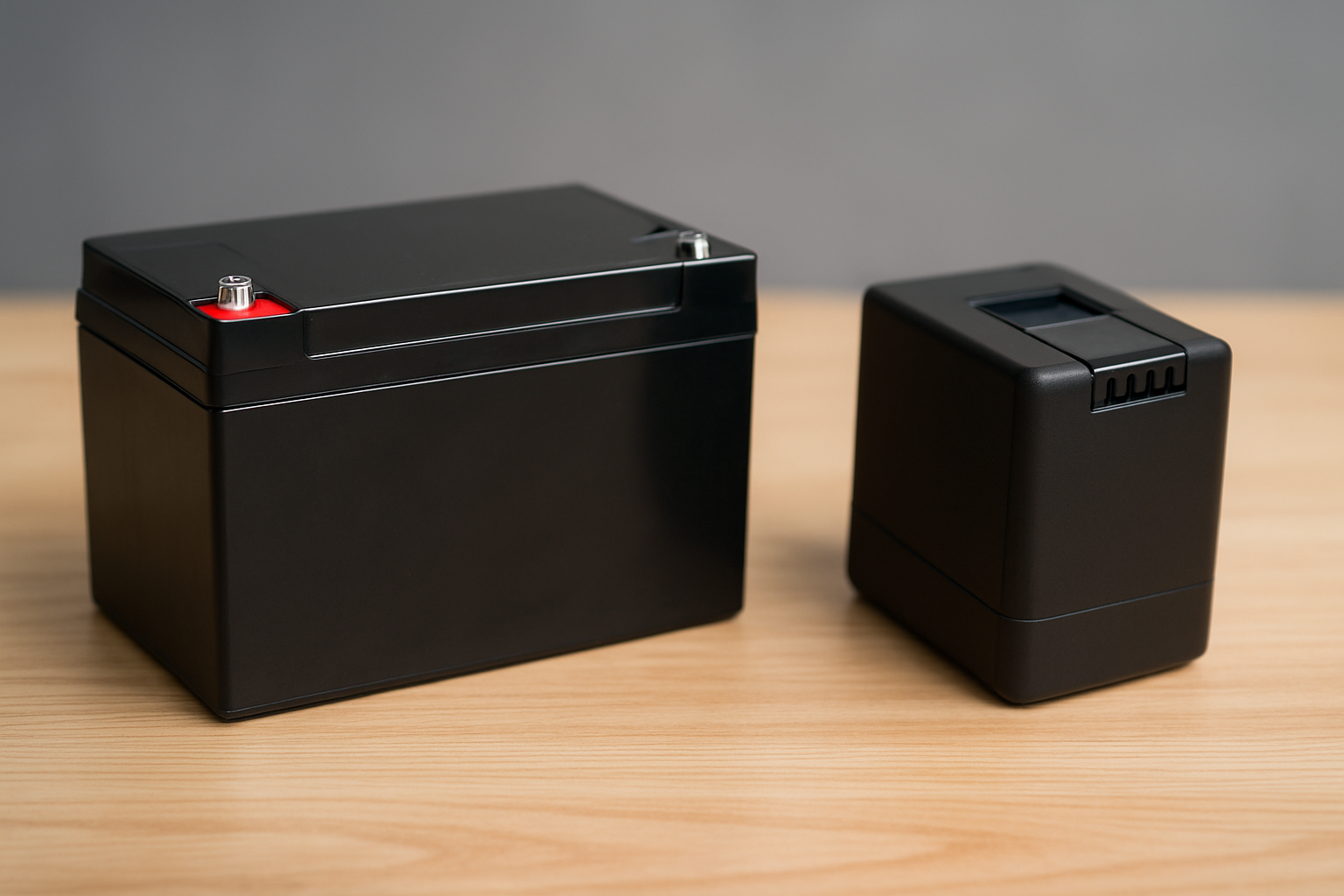
Most power wheelchairs rely on either SLA (sealed lead-acid) or Li-ion (lithium-ion) batteries, and each chemistry shines in different ways. Sealed lead-acid batteries are proven, widely available, and budget friendly, but they are heavier for the energy they store and take longer to charge; they also prefer frequent full charges and do not love deep discharges. Lithium-ion packs deliver higher energy for the weight, which means longer range for the same size chair, faster charging, and longer cycle life when treated well; they also tend to hold voltage more consistently, so performance feels stronger until near the end of the pack. Many travelers choose lithium-ion for portability and quick top-ups, while some heavy-duty users stick with robust lead-acid packs for predictable performance and lower upfront cost.
| Feature | SLA (sealed lead-acid) | Li-ion (lithium-ion) |
|---|---|---|
| Typical Range per Charge (medium chair) | 8 to 15 miles, depends on capacity and terrain | 12 to 25 miles, depends on capacity and terrain |
| Average Charging Time | 8 to 14 hours for a full charge | 3 to 6 hours with a compatible charger |
| Weight for Equivalent Energy | Heavier; can add 10 to 20 pounds to the chair | Lighter; easier to lift and fold |
| Cycle Life (typical) | 200 to 400 full cycles | 600 to 1,000 full cycles |
| Maintenance | Simple; keep charged and avoid deep depletion | Simple; avoid extreme heat and deep depletion |
| Best Fit | Budget-friendly, predictable local travel | Travelers, higher range needs, quick charging |
If you are stuck between the two, think about what you value most during a typical week. For the lightest setup with the fastest morning top-up, lithium-ion is the practical winner, especially on foldable designs that you load into a car trunk. If you rarely need to lift your chair, mostly ride on regular routes, and prefer a lower purchase price, sealed lead-acid can be a solid fit. Go Wheelchairs carries both styles, from compact, lightweight, foldable wheelchair designs to rugged, heavy-duty models, and our specialists can translate your daily routine into watt hours and miles, so you pick the chemistry that matches your life rather than a brochure.
Smart Charging Habits That Extend Battery Life
Charging is not just about plugging in and hoping for green lights; it is about protecting your “fuel tank” so it stays strong for years. The golden rule is routine: charge nightly if you ride daily, and try not to let the level sink below 20 percent except when necessary, because deep depletion stresses the cells. Keep batteries and chargers in a well-ventilated, dry area at normal room temperature, and only use chargers approved by your chair’s manufacturer so the charging profile matches your chemistry. If you will not use the chair for a while, store batteries partially charged, ideally around 50 to 70 percent, and top them up every few weeks.
- Plug in after dinner, unplug before breakfast; that rhythm fits both chemistries.
- Use the charger that shipped with your chair or an approved replacement.
- Avoid charging outdoors in rain or direct hot sun; temperature matters.
- Do not run sealed lead-acid batteries all the way to empty; they dislike it.
- Check that charge ports and cables are clean and firmly seated.
- Carry a travel charger and a short extension cord for days away from home.
| Scenario | When to Charge | Target Level | Notes |
|---|---|---|---|
| Daily commuting | Overnight, each day you ride | 100 percent by morning | Stable routine preserves capacity over time |
| Light weekly use | After each outing | At least 80 percent | Top up before weekend plans |
| Travel days | Before departure and during breaks | Stay above 30 percent | Carry a compact charger for midday boost |
| Seasonal storage | Every 3 to 4 weeks | 50 to 70 percent | Store indoors; avoid extreme heat and cold |
Medicare Coverage and Insurance: How to Navigate Approvals and What Gets Paid
Medicare Part B (Medical Insurance) considers a power wheelchair to be DME (durable medical equipment) when it is medically necessary for in-home mobility, and that phrase is the key. You will need a face-to-face exam and a prescription from your healthcare provider, documentation that a manual wheelchair or scooter does not meet your needs, and a home evaluation to confirm that you can use the device safely in your living space. If approved, Medicare typically covers 80 percent of the allowed amount after the deductible, and you are responsible for the remaining 20 percent, which supplemental insurance may help cover. Batteries, chargers, and some repairs are often covered when they are necessary for the operation of your approved chair, provided you work with a supplier enrolled in Medicare.
- Start with your clinician: secure documentation that outlines medical necessity.
- Use a supplier that accepts Medicare assignment to avoid surprise costs.
- Ask whether replacement batteries and chargers are included when medically necessary.
- Keep records of visits, prescriptions, and prior authorization letters if required.
- Verify coverage differences for lithium-ion versus sealed lead-acid if you have a choice.
| Medicare Step | What You Do | What It Means |
|---|---|---|
| Clinical evaluation | See your provider for a face-to-face mobility assessment | Establishes medical necessity for a power wheelchair |
| Prescription and documentation | Obtain a detailed order and supporting notes | Defines your needs and the type of chair required |
| Supplier selection | Choose an enrolled supplier that accepts assignment | Controls out-of-pocket costs and speeds approvals |
| Home assessment | Confirm you can operate the chair safely at home | Meets the in-home use requirement for coverage |
| Battery and charger coverage | Request medically necessary replacements through your supplier | Often covered for approved chairs when documented |
Go Wheelchairs provides personalized support for these steps, including Medicare and private insurance guidance, so you do not have to learn new acronyms or chase paperwork on your own. We offer free mobility consultations, coverage guidance, help assembling prior-authorization packets and appeals support, request-a-quote and itemized cost estimates, product documentation and setup support, free shipping on eligible orders, customer support phone assistance, and delivery and training coordination. Our team helps translate clinical notes into the correct equipment choice, documents battery needs clearly, and aligns your selection with both lifestyle and coverage. Whether you are choosing a compact folding model for travel or a heavy-duty chair for outdoor independence, we keep an eye on the details that affect approvals and your day-to-day comfort.
Choosing the Right Chair at Go Wheelchairs: Matching Range, Charging Time, and Lifestyle

Picking your chair is about harmonizing three things: how far you need to go, how you want to charge, and what your environment throws at you. If you commute a few miles a day on sidewalks and ramps, a standard power chair with efficient motors and either sealed lead-acid or lithium-ion batteries may be perfect, especially if you are happy charging overnight. If you travel frequently by car or plane, a lightweight, foldable wheelchair design with lithium-ion packs and a compact charger will keep your trunk and your schedule lighter. If you are navigating hills, grass, or long outdoor stretches, a heavy-duty model with higher capacity and a smart charging routine gives you the confidence to say yes to full days.
- Standard power chairs: Balanced range, comfortable seating, and predictable overnight charging.
- Heavy-duty motorized wheelchairs: Higher capacity for hills and grass, with durable frames and wide tires.
- Lightweight, foldable designs: Travel-friendly, quick charging, and easy to lift for car trips.
- Accessories that help: Extra charger for the office, seatback storage for travel cords, and all-weather covers.
- Resources hub: Buying guides, comparison tools, and travel tips to plan smarter routes and charging stops.
| Profile | Typical Battery Type | Expected Range | Charging Approach | Best For |
|---|---|---|---|---|
| Standard daily rider | SLA (sealed lead-acid) or Li-ion (lithium-ion) | 10 to 18 miles in mixed use | Overnight home charging | Routine commutes and errands |
| Heavy-duty adventurer | Larger SLA (sealed lead-acid) or high-capacity Li-ion (lithium-ion) | 15 to 25 miles on smooth paths | Nightly plus midday top-up for long days | Outdoor routes, hills, and longer excursions |
| Frequent traveler | Li-ion (lithium-ion) in a compact form | 8 to 15 miles with quick boosts | Fast top-ups at home or on the go | Car trunks, rideshares, and flights |
Go Wheelchairs exists for people who want dependable mobility without guesswork, and that starts with a conversation about your day rather than a one-size-fits-all spec sheet. We carry a wide range of standard and heavy-duty motorized wheelchairs, plus compact models that fold, and we back that selection with real human guidance on battery choice, charging habits, and insurance steps. With straightforward pricing, Medicare assistance, and a resources hub filled with buying guides and comparison tools, you will feel confident going farther and charging smarter. If you have ever worried about whether you will make it home with battery to spare, we are ready to help you plan for the distance you actually live.
FAQs: Quick Answers to Common Range and Charging Questions
How long do batteries last before replacement, and can I do anything to prolong that clock? Typical sealed lead-acid batteries last 1 to 2 years with daily use, while lithium-ion often stretches to 2 to 4 years, and you can extend lifespan by avoiding deep discharges, charging nightly, and storing at moderate temperatures. What if my advertised range is 18 miles but I never see more than 12 on my routes; is something wrong? Probably not, because mixed indoor and outdoor terrain, hills, and load commonly reduce brochure numbers by 15 to 30 percent, and a tire pressure check or a slower speed setting can often add a few miles back. Do fast chargers harm batteries, and should I buy one? Use only chargers approved for your chair and chemistry because safe fast charging is about a matched profile rather than raw amperage, and a manufacturer-approved quick charger can be a great convenience for travel days when used properly.
Can cold weather ruin my day, and is there a way around it? Cold reduces available capacity temporarily, so pre-warm your chair indoors, avoid storing it in a freezing garage, and plan a midday top-up when temperatures stay low; in very hot weather, allow air flow around the charger. How can Go Wheelchairs help me choose? Our specialists translate your routines and coverage needs into clear recommendations, offer free mobility consultations and request-a-quote options, test-drive choices with you when possible, and support Medicare paperwork so you get a chair that fits your real routes and your real life. And if you love hands-on research, our resources hub includes range calculators, charging checklists, and travel guidance to remove guesswork from everyday mobility.
Here is a visual idea you can imagine as a simple chart: a line graph that shows range shrinking as hills increase and temperature falls, with shaded bands for sealed lead-acid and lithium-ion; it shows how your route and weather shift the final number more than any single spec. If you want help putting your own day on that chart, Go Wheelchairs will sketch it with you and recommend the right chair, battery, and charging routine, then stay in your corner for service and coverage questions. That partnership is how we turn specifications into independence, not just miles on a page.
Key takeaways you can use today: pick the chemistry that suits your routine, plan for a real-world range that is 70 to 85 percent of the brochure number, charge on a predictable schedule, and keep tires and batteries in healthy shape. When coverage matters, start early with documentation and a supplier that accepts Medicare assignment, and ask directly about replacement batteries and chargers. Go Wheelchairs brings these pieces together with a wide product catalog, Medicare assistance, and friendly guidance, so you can move forward with confidence.
Understanding Battery Range and Charging Time for Power Wheelchairs: Your Next Step
Your chair should match your life, not the other way around; now you have what you need to choose for real days, not perfect test tracks. In the next 12 months, expect lighter batteries, smarter chargers, and better range estimates that reflect terrain and temperature, making planning even simpler. What would you do differently tomorrow if you knew your real, dependable battery range and charging time for power wheelchairs?
Additional Resources
Explore these authoritative resources to dive deeper into battery range and charging time for power wheelchairs.
Go Wheelchairs: Elevate Real-World Range and Charging Confidence
Explore our Wide range of standard and heavy-duty motorized wheelchairs, plus guidance on range, charging, and Medicare coverage so you move confidently and independently.