
Are You Making These Wheelchair Battery Charger and Maintenance Mistakes? 9 Fixes to Extend Range & Avoid Costly Replacements
If you rely on a power chair, a little mastery of wheelchair battery charger and maintenance can feel like a superpower. One tiny tweak to your routine might add a mile or two to your day, and one avoided mistake could save hundreds of dollars in replacements. I still remember a neighbor calling at dusk because their chair quit two blocks from home. The culprit was not a bad chair, but a string of avoidable charging habits. The good news: you can fix the most common issues quickly, without fancy tools or engineering degrees.
In this guide, we will walk through nine proven fixes that extend range, cut downtime, and stretch battery life. Along the way, you will learn how to choose the right charger, how temperature and storage affect capacity, and how to set up a simple routine you can actually stick to. And because we know coverage and budgets matter, we will show you how Go Wheelchairs helps you align smart battery care with the right motorized wheelchair and support services.
Why Wheelchair Batteries Lose Range (and What It Costs You)
Power wheelchair batteries fade for predictable reasons: deep discharges, inconsistent charging, heat or cold, and simple aging. Typical mobility industry figures suggest many sealed lead acid batteries last twelve to eighteen months under daily use, while modern lithium-ion batteries often reach three to five years when treated well. Temperature alone can shave capacity fast; cold weeks can reduce available range by twenty to thirty percent, while hot garages accelerate wear. None of this is your fault, but a few small changes can markedly slow the slide.
What is at stake? Range, reliability, and money. A premature battery swap can cost a few hundred dollars per pair for sealed lead acid, and far more for lithium-ion, not counting appointments and downtime. Field data from service teams often finds that a majority of early failures trace back to charging and storage habits, not defective parts. That is why the right pairing of chair, battery chemistry, and charger is so important. And if you are working with Medicare or other insurance, avoiding unnecessary replacements keeps your coverage dollars working where you truly need them.
| Battery Chemistry | Typical Battery Pack Capacity (ampere-hour) | Approximate Cycle Life (charge/discharge cycles) | Notes on Charging |
|---|---|---|---|
| Sealed lead acid (absorbed glass mat) | 35 to 75 | 200 to 400 cycles | Prefers full overnight charges; hates deep discharges; heavier and slower to charge |
| Sealed lead acid (gel) | 35 to 75 | 250 to 500 cycles | Needs charger profile tuned for gel; overvoltage shortens life |
| Lithium-ion | 20 to 60 | 500 to 1,000 cycles | Requires a charger designed for lithium-ion and a built-in battery management system |
Note: the ranges above refer to typical battery pack capacities for common power wheelchair packs; actual battery chemistry and capacity vary by model. For model-specific specs, always check the product page for your chair. For example, the Go Chair® is specified with a 20 Ah battery and an approximate range of ~11.2 miles per charge (product page), and the Jazzy Air® 2 has its own battery and range specifications (seat elevates 12″, drives up to 4 mph while elevated, and is listed with an approximate range of ~19.2 miles on its product page: product page).
The 9 Biggest Wheelchair Battery Charger and Maintenance Mistakes (and Fixes)
Chances are you are not doing everything wrong. Most people have one or two habits that cost them range and lifespan. Spot your pattern below, apply the fix, and watch your chair feel “newer” within a week or two.
Watch This Helpful Video
To help you better understand wheelchair battery charger and maintenance, we’ve included this informative video from Mobility Scooters Direct. It provides valuable insights and visual demonstrations that complement the written content.
-
Running the battery down until it “limps” home. Regularly draining below roughly twenty to thirty percent accelerates wear, especially for sealed lead acid. The chemistry simply ages faster when frequently pushed to near empty. The fix: plan recharges before the battery gets low, and favor multiple moderate cycles over “hero” deep runs. Many riders see a fifteen to twenty-five percent gain in week-to-week range just by avoiding habitual near-empty arrivals.
-
Using a mismatched charger. Not all chargers are created equal. A charger meant for sealed lead acid can damage lithium-ion, and a too-small charger can take forever, tempting you to unplug early. The fix: match chemistry and capacity to the charger output and profile. If your battery is fifty ampere-hour, a good everyday charger might deliver five to eight amperes with a proper absorption and maintenance stage for sealed lead acid, or the correct profile for lithium-ion.
-
“Sip” charging with lots of short top-ups. Constantly plugging in for thirty minutes and unplugging before the absorption stage completes leads to a chronic undercharged state. Over time, sealed lead acid batteries can lose usable capacity when they rarely reach full. The fix: give your chair relaxed, uninterrupted overnight charges whenever possible. If your schedule is hectic, use a smart outlet timer as a backup to ensure enough hours on the charger.
-
Charging in extreme temperatures. A cold shed or a hot trunk is rough on batteries and chargers. Charging while the battery is very cold slows the process and can leave you short the next day; charging in heat speeds chemical aging. The fix: charge in a space roughly ten to twenty-five degrees Celsius, or fifty to seventy-seven degrees Fahrenheit. If you must store in a garage, consider a small, safe indoor spot just for nightly charging.
-
Letting terminals and connectors corrode. White or green fuzz on connectors is a silent range thief because resistance goes up and energy turns to heat. The fix: monthly, power off and gently clean exposed metal with a little baking soda in water on a cotton swab, then dry thoroughly. Keep connections snug, cables untangled, and strain reliefs intact. If you notice warm plugs after charging, have a technician inspect them.
-
Storing the chair unplugged for weeks. All batteries self-discharge. Leave a chair idle and unplugged for a month or two, and you risk deep discharge damage, especially for sealed lead acid. The fix: if storing more than a week, leave it on a maintenance charge or schedule a full charge every two to three weeks. For longer storage, top up to around fifty to sixty percent for lithium-ion if your manufacturer recommends it, then recharge periodically as directed.
-
Mixing old and new batteries in paired systems. Many power chairs use two batteries in series. Pairing a new battery with an old one is like putting a sprinter with a walker; both will suffer. The fix: replace batteries as a matched set and stick to the manufacturer’s recommended specifications. Keep the receipt and label the install date so you can track service life and warranty windows.
-
Expecting full range on day one of a new pack. New batteries often need a break-in period before they deliver their best. Many users report ten to twenty moderate cycles before full capacity appears. The fix: for the first two to three weeks, avoid heavy deep discharges; use normal daily trips and full overnight charges. You will often feel range “unlock” as the chemistry stabilizes.
-
Ignoring early warning signs. Dimming lights under load, sudden drop-offs on the display, or a charger that switches “full” unusually fast are clues. The fix: once a month, do a controlled test route you know well and note distance and post-ride voltage or gauge behavior. If performance drops sharply, test the charger with a technician or your supplier before assuming the battery is done.
| Symptom | Likely Cause | Quick At-Home Check | Next Step |
|---|---|---|---|
| Range suddenly cut in half | Loose connector or failing battery | Inspect cables and plugs for heat or corrosion | Have a pro load-test the battery and inspect harness |
| Charger “full” in minutes | Charger fault or battery not accepting charge | Try a known-good outlet and verify indicator behavior | Contact your dealer or service center for charger testing |
| Hot battery case during charge | Overcharge or high resistance connection | Feel for warmth near the plug; examine for tight fit | Stop charging and seek inspection immediately |
Build a Smarter Charging Routine That Actually Sticks

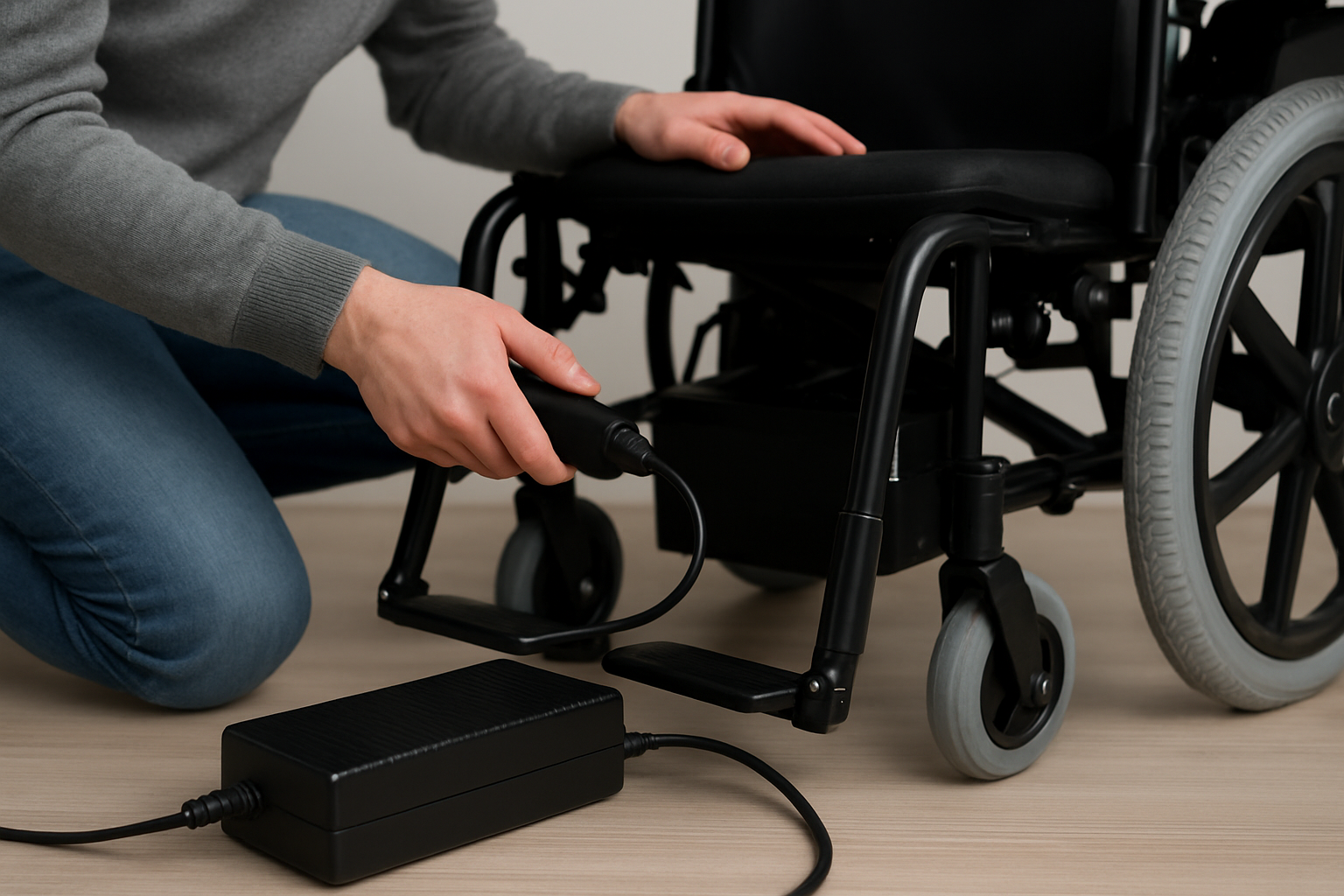
The best routine is the one you will follow even on your busiest days. Think of charging like brushing your teeth: a nightly habit that pays you back every day. Start by picking a stable, indoor spot with a single safe wall outlet and a surface for the charger with airflow. Plug the charger into the wall first, then connect to the chair, and let it run until the indicator shows complete. Resist the urge to unplug early unless you truly need to head out.
If you often arrive home late, set a reminder on your phone or a smart speaker. Many riders love the simple ritual of plugging in while hanging up a jacket, so the habit stacks onto something you already do. If you share outlets with other devices, use a quality surge protector to reduce the risk of power issues, and avoid long, thin extension cords that can cause voltage drop and heat. For lithium-ion, use only the charger provided or approved by your chair’s manufacturer. When in doubt, your wheelchair manual or a trusted supplier can confirm the safe match.
| Battery Pack Capacity (ampere-hour) | Charger Output (amperes) | Approximate Time from Low to Full | Notes |
|---|---|---|---|
| 35 to 40 | 4 to 5 | 8 to 10 hours | Typical compact power chair sealed lead acid pack |
| 45 to 55 | 5 to 8 | 6 to 9 hours | Common mid-size sealed lead acid or lithium-ion |
| 60 to 75 | 8 to 10 | 7 to 10 hours | Heavy-duty chairs; verify heat and ventilation |
These times are ballpark figures. Real-world charging includes absorption and maintenance stages that slow near the top, especially for sealed lead acid. Translation: overnight charging remains your best friend. Picture a simple diagram of a battery filling in three smooth steps; that last step is where patience preserves longevity. Give your battery the time it needs, and it will give you the confidence to do more tomorrow.
Simple Maintenance Calendar and Checklist
Consistency beats intensity. You do not need a toolbox to keep your batteries healthy, just a short checklist and a calendar reminder. Below is a practical schedule many riders find easy to follow. Adjust the details to match your chair model and the guidance in your owner’s manual.
| When | What to Do | Why It Matters |
|---|---|---|
| Daily | Charge overnight; glance at cables and the wall outlet | Ensures full capacity and catches issues early |
| Weekly | Wipe dust from charger vents; confirm indicator behavior | Prevents heat buildup and verifies normal charge cycles |
| Monthly | Inspect connectors for corrosion; test a familiar route and note distance | Maintains low resistance and tracks range trend over time |
| Every 3 months | Clean terminals with mild baking soda solution; tighten fasteners gently | Improves conductivity; avoids cable strain and hot spots |
| Seasonally | Adjust habits for heat or cold; check storage practices | Manages temperature effects that reduce capacity |
- Keep a small notebook or digital note with install dates, cycle estimates, and any unusual behavior.
- If you rely on your chair for work or long commutes, consider a health check with a technician every six months.
- Never cover the charger while operating, and give it space to breathe.
Troubleshooting: When It Is the Charger, the Battery, or the Chair
When range dips, it can be tricky to know what to blame. Before spending money, isolate the variables. First, test the wall outlet with another device to confirm power quality. Next, observe the charger’s indicator sequence; if it jumps to “complete” unusually fast, you might have a battery that is not accepting charge or a charger that is failing. Also listen for the cooling fan if your charger has one; silence when it normally runs is a clue.
If the chair hesitates under load or shuts off on small bumps, look beyond the battery to the harness, joystick module, or motor controllers. Loose connections mimic a dying battery by wasting energy as heat. A careful inspection for warm plugs after a thirty-minute run can reveal hidden resistance. When in doubt, call your supplier or a qualified technician. They can perform a load test and verify open-circuit and under-load voltages safely, then tell you whether a charger replacement, a simple cable repair, or a fresh battery pack will truly solve the problem.
Choosing the Right Charger and Mobility Solution with Go Wheelchairs
Matching your lifestyle to your equipment is where the real wins happen. If you take long outdoor rides or navigate steep neighborhoods, a heavy-duty motorized wheelchair with higher capacity batteries and a suitably powerful charger can protect your daily range while reducing stress on components. If you travel often, a lightweight, foldable design with a manufacturer-approved lithium-ion pack and compact charger simplifies airline policies and hotel charging. Go Wheelchairs brings these choices together and helps you sort them with real-world clarity.
Here is how Go Wheelchairs makes the process easier: a wide range of standard and heavy-duty motorized wheelchairs, personalized support that listens to your daily routes and storage realities, and hands-on guidance with Medicare and other insurance so the chair, battery, and charger pairing align with your coverage. Their resources hub includes buying guides, comparison tools, and travel tips, so you can check compatibility, charging profiles, and airline rules in one place. Many customers share stories like this: Maria, who commutes to volunteer work, moved to a heavy-duty chair with a higher capacity sealed lead acid pack and an eight-ampere smart charger, then saw her weekly range rise while staying within her insurance plan’s parameters.
Meanwhile, if you want a compact setup, Go Wheelchairs offers lightweight, foldable wheelchair designs with lithium-ion packs and approved chargers that reduce charge times and simplify storage. The right charger profile reduces heat, shortens wait time, and preserves cycle life. When your daily living depends on reliable movement, having a supportive partner to calibrate equipment and coverage is invaluable. That is the heart of Go Wheelchairs: ensuring you move forward with confidence and independence.
Safety Notes and Best Practices Professionals Wish Everyone Knew
Always read your wheelchair and charger manuals before changing routines. Use only approved chargers for your battery chemistry, and avoid mixing brands or profiles unless your manufacturer says it is compatible. Do not place a charger under blankets or in enclosed cabinets while it runs; keep it on a stable surface with airflow. If you smell sulfur or notice unusual hissing from sealed lead acid batteries, disconnect safely and call for service. For lithium-ion packs, never use a swollen or damaged battery and seek professional evaluation after impacts.
And here is a little pro tip you can try this week: pick a familiar route and measure how many minutes it takes with a fresh, uninterrupted overnight charge. Write it down. Repeat after you apply one or two fixes from the list above, such as moving your charging station indoors or letting the absorption stage complete nightly. Most riders notice smoother acceleration, fewer warning beeps, and a touch more “reserve” by the end of day three. Small, steady improvements add up to big freedom.
Last, a quick cost saver: label your charger and cables with your name and chair model. Families and caregivers often juggle multiple devices, and the wrong charger on the right chair is a silent killer. Clear labels, a consistent charging spot, and thirty seconds of daily attention keep money in your pocket and energy in your batteries.
Conclusion
Simple habits with your charger and storage can add miles to your day and months to your battery’s life. Imagine the next twelve months with fewer “low battery” alerts, fewer service calls, and more spontaneous trips you can just say yes to. What one change will you make to your wheelchair battery charger and maintenance routine this week?
Additional Resources
Explore these authoritative resources to dive deeper into wheelchair battery charger and maintenance.
Charge Further, Ride Freer With Go Wheelchairs
Discover a wide range of standard and heavy-duty motorized wheelchairs with Medicare and insurance guidance for individuals seeking reliable mobility solutions, so you move forward with confidence and independence.