
Airline regulations for wheelchair batteries: Your flight-day checklist for FAA, TSA & airline compliance
If you have ever tried to decode airline regulations for wheelchair batteries while juggling tickets, transfer times, and gate changes, you are not alone. The rules are real, they are important, and the good news is they are absolutely manageable once you know which details matter for the type of battery in your chair or scooter. This guide translates the alphabet soup, outlines what the FAA [Federal Aviation Administration], TSA [Transportation Security Administration], and individual airlines typically look for, and provides a simple flight-day checklist you can use. Think of it like your travel power plan: short, clear, and designed to help you sail through check-in with confidence rather than guesswork.
Before we dive in, a quick story. A Go Wheelchairs customer named Maya texted me from a check-in line because a gate agent asked for her battery watt-hour [Wh] label. She had it on her phone, along with a quick one-page “Battery and Travel Readiness Letter” we had emailed her, and the conversation went from tense to “have a great flight” in under a minute. That is the goal here. With a little prep and the right documents, your power chair becomes just another piece of carefully handled mobility equipment rather than a mystery box. Along the way, I will point to small habits that make a big difference, like labeling terminals and carrying printed specs, so you can travel smarter and avoid hiccups at the counter.
Airline regulations for wheelchair batteries: What the FAA, TSA & airlines require
Here is the plain-English reality: three parties are involved in your travel day. The FAA [Federal Aviation Administration] sets the safety framework on hazardous materials and batteries. The TSA [Transportation Security Administration] screens you and your equipment at the checkpoint. Your airline applies both sets of rules to its operations and aircraft, and may add carrier-specific procedures. Most issues at the airport happen when a chair’s battery type is unclear, the watt-hour [Wh] rating is missing, or the wheelchair cannot be safely secured upright in the cargo hold. Knowing those three details ahead of time changes everything: your battery type, your watt-hour [Wh] number if it is lithium-ion, and how your chair will be loaded.
As a helpful benchmark, United States Department of Transportation [DOT] data indicates airlines move tens of thousands of mobility devices each year, with thousands reported as mishandled annually across all carriers. That is exactly why the regulations exist: to keep batteries protected from short circuits, pressure changes, and impact. You will see consistent themes in the official guidance, including protecting terminals, disconnecting power, preventing unintentional activation, and packaging any removed batteries in rigid, secure containers. When you can show those boxes are checked, agents typically get you moving quickly. If you are ever unsure, ask for a supervisor and reference your printed documentation. Calm preparation wins the day.
Know your battery: types, limits, and airline rules
The fastest way to avoid confusion is to identify your battery type and record the number the airline will care about. Most motorized wheelchairs use sealed lead-acid (often gel or absorbed glass mat) or lithium-ion batteries. Sealed lead-acid batteries are considered non-spillable when they meet specific test criteria and are generally allowed to remain installed if the chair can be secured upright and the battery is protected and disconnected. Spillable wet batteries require extra packaging steps if the chair cannot remain upright. Lithium-ion batteries are measured by watt-hour [Wh] capacity, which is printed on the pack or in your user manual. For travel, the pivotal limits are typically 300 watt-hour [Wh] for a single installed battery, or up to two batteries at 160 watt-hour [Wh] each. Airlines may allow up to two spare lithium-ion batteries of these sizes in carry-on only, with terminals taped or capped.
Watch This Helpful Video
To help you better understand airline regulations for wheelchair batteries, we’ve included this informative video from 10 Tampa Bay. It provides valuable insights and visual demonstrations that complement the written content.
Not sure what you have? Look at your battery label, your wheelchair manual, or ask your provider. At Go Wheelchairs, we include battery spec sheets with every motorized model we ship and can email a “Battery and Travel Readiness Letter” that summarizes type, capacity, and safe handling steps in one page. That document gives the TSA [Transportation Security Administration] screener and the airline agent exactly what they need. If your battery label is worn, reprint the specs and affix a fresh label before travel. And if you have a removable travel pack, consider placing it in a small, rigid case with foam so you can hand it over neatly instead of improvising at the checkpoint.
| Battery Type | Common Examples | Installed on Chair | Spare Batteries | Key Limits | Prep and Protections | Notes |
|---|---|---|---|---|---|---|
| Non-spillable sealed lead-acid (gel or absorbed glass mat) | AGM and gel packs in many standard power chairs | Usually allowed if chair remains upright; disconnect power and protect terminals | Airline policies vary; generally allowed as carry-on only with terminals protected | No watt-hour [Wh] limit stated like lithium; airline packaging rules apply | Secure battery, insulate terminals, prevent activation, label as non-spillable | Bring documentation stating “non-spillable” test compliance |
| Spillable wet lead-acid | Some older heavy-duty chairs | Allowed if upright; if not upright, battery may need removal and special packaging | Not typically carried as a spare by passengers; airline may package if removal required | N/A for watt-hour [Wh]; packaging and absorbent materials required if removed | Terminals insulated, secure rigid container, absorbent lining, vented as required | Expect additional time at check-in for packaging steps |
| Lithium-ion | Travel scooters, lightweight power chairs | Typically allowed if ≤ 300 watt-hour [Wh]; or two batteries each ≤ 160 watt-hour [Wh] | Usually up to two spares within the same limits, carry-on only | Single pack ≤ 300 watt-hour [Wh]; or two packs ≤ 160 watt-hour [Wh] each | Terminals protected, battery secured; if removable, carry in cabin | Have watt-hour [Wh] clearly labeled or print specs from manual |
| Dry cell (non-spillable) and nickel-metal hydride | Less common in powered wheelchairs today | Generally treated similarly to non-spillable batteries | Policies vary by carrier; carry-on preferred | Limits depend on carrier and size | Protect from short circuit and movement | Bring documentation for clarity |
Your flight-day checklist for zero-stress screening
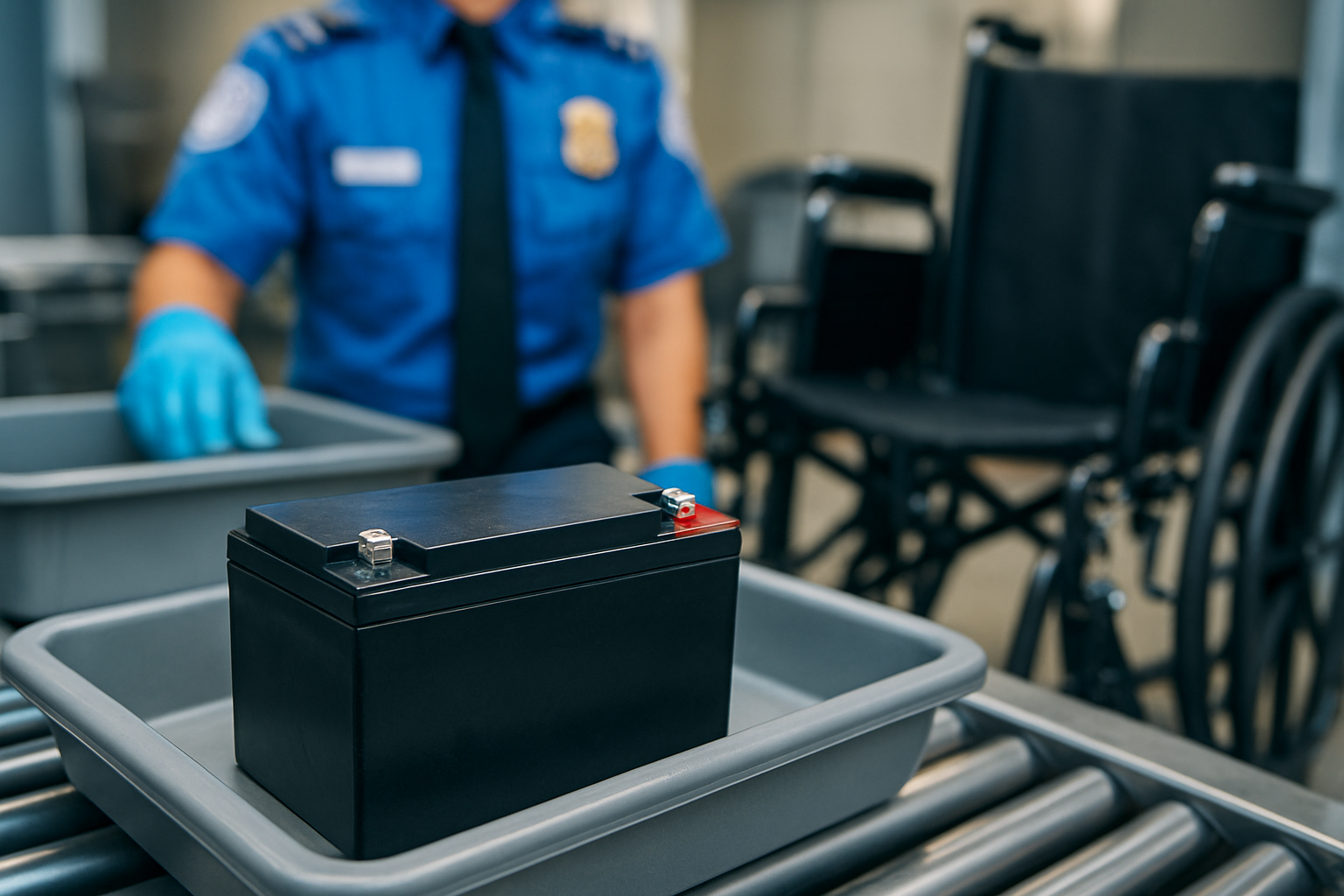
Checklists are where smooth travel begins. I recommend starting 72 hours before departure, because many airlines ask you to notify them about a powered mobility device in advance. Use the list below as your template and add your specific chair steps, like where the freewheel levers are or how to remove the joystick. If you are traveling with companions, decide who does what at the checkpoint and at the gate so you are not negotiating tasks at the last minute. As you plan, remember that the TSA [Transportation Security Administration] runs security screening while the FAA [Federal Aviation Administration] and your airline control battery transportation rules. That means the screener might swab your battery while the agent at the gate confirms your watt-hour [Wh] label or packaging. Both jobs are important, and your prep helps each person help you.
- Notify the airline of your powered wheelchair at booking or 72 hours prior. Mention battery type and watt-hour [Wh] if lithium-ion.
- Print and pack: battery spec sheet, watt-hour [Wh] label, and a one-page “safe handling” letter. Keep digital copies on your phone.
- Inspect and secure: cover or tape terminals, disconnect power, and ensure no loose cables. Add “Do Not Switch On” tag near joystick.
- Practice the quick steps: show how to freewheel, remove the joystick, or remove a travel battery if requested.
- Arrive early: add 30 minutes to your normal schedule to allow for mobility screening and gate-tagging.
- At security: tell the TSA [Transportation Security Administration] officer you have a motorized wheelchair; ask for assistance and a private screening if preferred.
- At the gate: confirm how the chair will be loaded and secured. Ask for upright stowage and to carry the joystick in the cabin if possible.
- Pre-board: show handlers the safest lift points and where the tie-downs attach. Give the battery letter to the lead agent.
| When | Task | Who Leads | Notes |
|---|---|---|---|
| 72 hours pre-flight | Notify airline, record reservation note, request assistance | You, Airline Accessibility Desk | Reference battery type and watt-hour [Wh] |
| 24 hours pre-flight | Print docs, label terminals, prep toolkit | You | Include zip ties, tape, small wrench if needed |
| Airport check-in | Verify mobility device details in record | Airline Agent | Hand over battery letter and spec sheet |
| Security screening | Visual inspection and swab of chair and battery | TSA [Transportation Security Administration] Officer | Ask for medical device accommodation as needed |
| At the gate | Gate-tag, stowage plan, pre-board briefing | Gate Agent, Ramp Crew | Show lift points and freewheel procedure |
Packing, labeling, and protecting your power chair
You can turn a complicated battery conversation into a quick nod by packaging like a pro. The big idea is to remove any risk of short circuit or accidental activation and to make the wheelchair easy to handle without damage. That starts with terminal protection. Use purpose-made terminal covers if you have them; otherwise, electrical tape works in a pinch. Next comes power isolation. Disconnect the battery via your chair’s main switch or connector and place a visible tag by the joystick that says “Power Disconnected.” Finally, immobilize anything loose. A small zip tie around a free cable, a soft wrap over the joystick you carry onboard, or a rigid case around a removable lithium-ion pack sends a strong signal that your device is flight-ready.
Labels matter more than most people realize. Write your name, mobile number, and destination airport code on a card you place on the seat and add a second copy under the cushion. Tape a simple diagram to the frame showing how to put the chair in freewheel mode. If you have a lithium-ion battery, print its watt-hour [Wh] capacity in big, clear type and keep a second copy in your carry-on. If you are traveling with a non-spillable sealed lead-acid battery, bring a statement from the manufacturer that it is non-spillable and compliant with applicable tests, often referred to as UN 38.3 [United Nations Manual of Tests and Criteria section 38.3] for design verification. These are small steps, but they eliminate the two most common delays: unclear battery specs and uncertainty about safe handling.
- Protect terminals with caps or tape to prevent short circuits.
- Disconnect power and add a visible “Do Not Switch On” tag.
- Carry joysticks, cushions, and removable lithium-ion packs in the cabin when allowed.
- Use a rigid, padded case for removable batteries; no metal touching terminals.
- Attach a freewheel diagram and your contact details in two places on the chair.
Real-world scenarios and small airport “gotchas”
Let us talk about what actually happens at the counter. Many airports will ask you to demonstrate freewheel mode or show where to grab the frame for lifting. If you can show those two things in ten seconds, you will see shoulders relax immediately. With lithium-ion batteries, the question is often “What is the watt-hour [Wh]?” Having that number printed on your spec sheet is the difference between a supervisor call and a smooth gate-tag. For non-spillable sealed lead-acid batteries, agents might ask if it is spillable. Your written “non-spillable” confirmation removes doubt. On smaller regional jets, you may be asked to remove the joystick or quickly detach a battery to reduce height; this is exactly where your practice run pays off.
Sometimes the unexpected pops up. Weather or aircraft swaps mean your chair could be moved between holds, so make sure nothing protrudes that could snag. If you are connecting through a tight layover, ask at the first gate whether your chair can meet you plane-side at the connection; if not, request an escort and confirm where you will reunite with your wheelchair at the arrival gate. Remember, the ACAA [Air Carrier Access Act] protects your right to travel with your mobility device and to receive assistance. If something does not feel right, you can ask for the Complaints Resolution Official, a trained airline representative who can resolve accessibility issues. Staying calm, prepared, and assertive is your superpower.
Travel confidently with Go Wheelchairs: gear, paperwork, and support
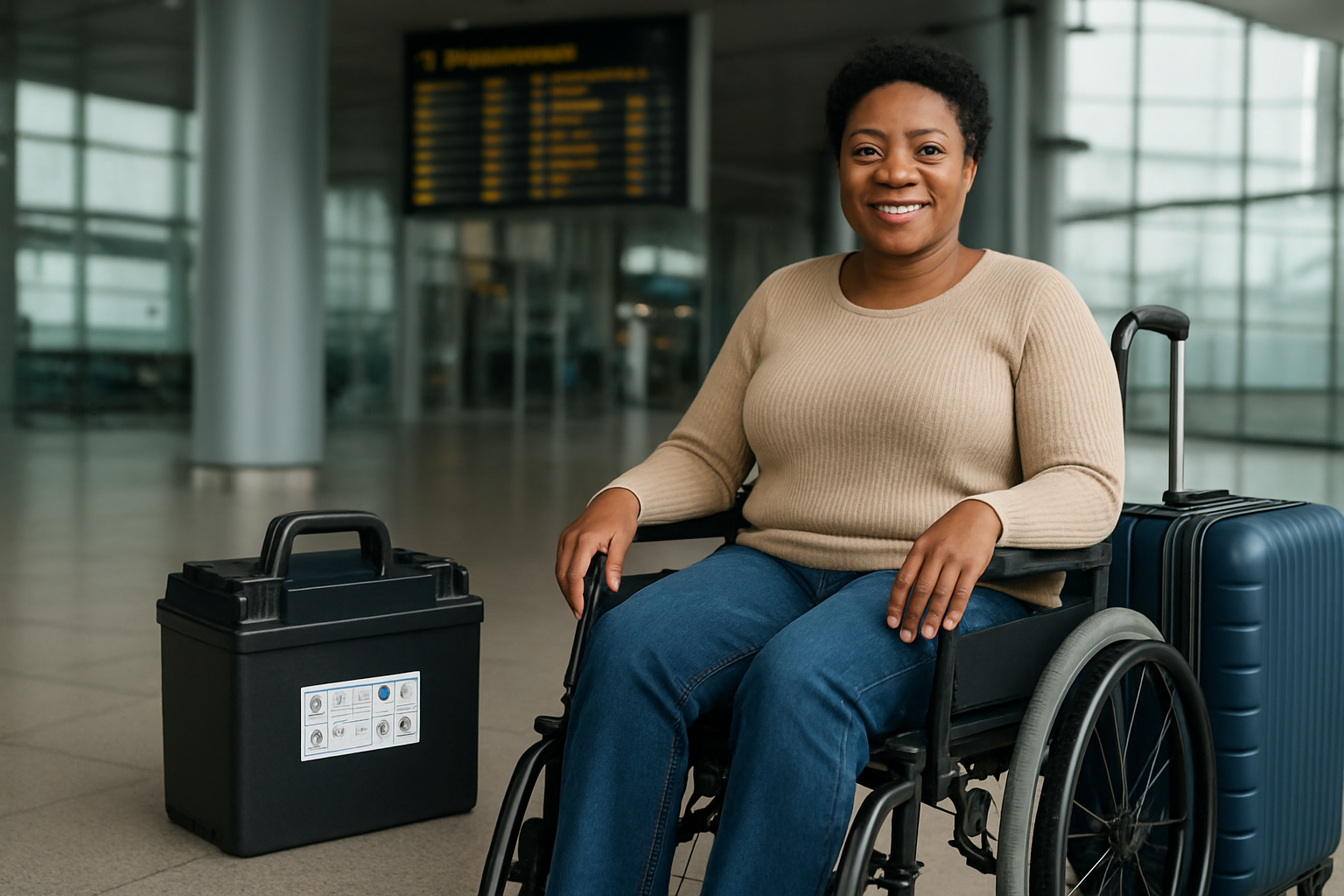
Travel readiness starts with the right equipment, and this is where Go Wheelchairs shines. Our catalog spans a wide range of standard and heavy-duty motorized wheelchairs, plus lightweight, foldable designs built with travel in mind. Every model ships with clear battery specifications, and our team can provide a one-page “Battery and Travel Readiness Letter” that summarizes the battery type, watt-hour [Wh] rating if applicable, and safe-handling steps the airline wants to see. Not sure how to find your watt-hour [Wh] number or test if your pack is non-spillable? We will walk you through it and send you a printable label that mirrors airline expectations, which means fewer questions at the counter and a faster path to boarding.
Just as important, we help you navigate coverage. Individuals with mobility challenges often struggle to find affordable, dependable wheelchair solutions that fit their lifestyle and coverage needs. Go Wheelchairs addresses these challenges by offering a variety of motorized wheelchairs, personalized support, and guidance on insurance and Medicare coverage, ensuring customers can move forward with confidence and independence. Our Resources hub offers buying guides, comparison tools, and travel tips that break down real-world tradeoffs like range versus weight or seat size versus airline cargo door height. You deserve equipment that fits your life and support that answers the phone when a gate agent asks for your battery specs. That is our promise.
| Resource | What It Includes | Why It Helps |
|---|---|---|
| Battery and Travel Readiness Letter | Battery type, watt-hour [Wh], safe handling checklist | Gives TSA [Transportation Security Administration] and airline agents exactly what they need |
| Printable Watt-hour [Wh] Label | Large-format label matching your battery specs | Eliminates delays at the gate when asked for capacity |
| Pre-Flight Call | 15-minute review of your chair’s travel setup | Confidence boost and final checklist before departure |
| Insurance and Medicare Guidance | Coverage options, documentation, and next steps | Aligns your wheelchair choice with your benefits |
Frequently asked, quickly answered
Do I need to remove my lithium-ion battery? If your chair is a foldable travel model with a removable pack, most airlines will ask you to remove it and carry it in the cabin, with terminals protected and watt-hour [Wh] documented. For full-size chairs with installed lithium-ion batteries, limits generally allow up to 300 watt-hour [Wh] for a single pack or two packs at 160 watt-hour [Wh] each. Can I bring spare batteries? Spares must go in carry-on, and most airlines permit up to two within the same watt-hour [Wh] limits. What about sealed lead-acid batteries? If the chair can be loaded upright, these often remain installed with terminals insulated and power disconnected, which simplifies your handoff at the gate.
What if the agent is not sure? Kindly ask for a supervisor and present your printed battery documentation. Can I get help at security? Yes. The TSA [Transportation Security Administration] offers passenger support specialists, and you can request assistance for a private screening or additional time. Will my wheelchair be damaged? Airlines handle thousands of mobility devices monthly. While mishandling does happen, your prep reduces risk by making safe lift points and procedures obvious. Photograph your chair before handoff and request that handlers store it upright. If anything is damaged, report it immediately at baggage services and reference your rights under the ACAA [Air Carrier Access Act].
The fine print, minus the headache
When you see citations like Title 49 of the Code of Federal Regulations [CFR] or references to IATA [International Air Transport Association] handling manuals, remember they all boil down to a few practical actions. Protect terminals, prevent activation, stabilize the battery, and document the type and capacity. Lithium-ion packs list watt-hour [Wh] directly or show voltage and amp-hours you can multiply to calculate watt-hour [Wh]. Non-spillable sealed batteries need a statement of compliance. Spillable batteries call for upright loading or special packaging by the airline if removal is required. You do not need to memorize regulation codes to travel well; you only need to prepare a small set of documents and safeguards that speak the regulators’ language.
Rules can evolve, so build one quick habit: verify your airline’s special assistance page a week before travel and again 48 hours before departure. Most carriers publish a “battery-powered mobility devices” page showing how they apply the FAA [Federal Aviation Administration] and TSA [Transportation Security Administration] framework to their aircraft. Skimming that page and calling the accessibility desk with your battery details takes 10 minutes and prevents most surprises. Keep your checklist in your phone’s notes app and tuck a printed copy into your carry-on. With a well-prepared power chair and a confident handoff at the gate, you can focus on your trip, not your battery.
Bottom line: when you combine clear documentation, properly protected battery terminals, and early communication with your airline, you turn potential points of friction into quick, friendly exchanges. Imagine boarding day where every agent sees your labeled, secured chair and says, “You are good to go.” With a trusted partner like Go Wheelchairs in your corner, from equipment choices to insurance and Medicare support, the path to the plane becomes your routine. Which step will you check off first to master airline regulations for wheelchair batteries?
Additional Resources
Explore these authoritative resources to dive deeper into airline regulations for wheelchair batteries.
Navigate Airline Battery Rules with Go Wheelchairs
Get travel-ready support on airline regulations for wheelchair batteries and choose from a wide range of standard and heavy-duty motorized wheelchairs, with guidance on Medicare and insurance to move confidently.