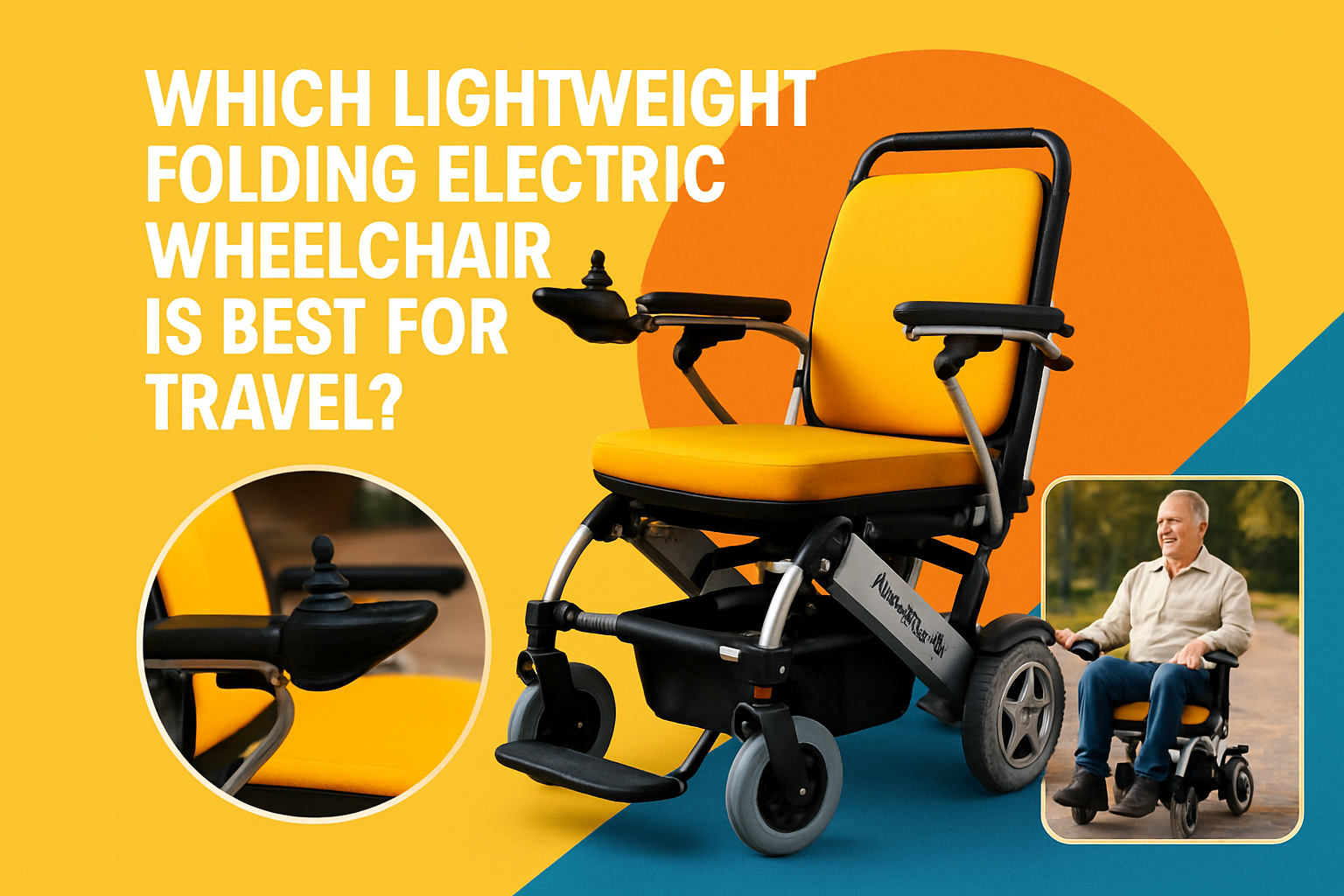
If you are asking which lightweight folding electric wheelchair is best for travel, you are in exactly the right place. The truth is, travel-friendly power chairs live at the intersection of airline battery rules, compact folding frames, tight turning radii, and smart coverage decisions that keep costs reasonable. After helping my uncle navigate a maze of airport gates and narrow hotel hallways, I learned that a two-pound difference and a two-inch turning radius can change a stressful trip into a smooth one. Below, we translate the jargon, outline TSA [Transportation Security Administration]-friendly considerations, and show how Go Wheelchairs can guide you through Medicare [Centers for Medicare & Medicaid Services] and insurance so you can roll forward with confidence.
How to Decide Which Lightweight Folding Electric Wheelchair Is Best for Travel
Before you compare models, anchor your choice to the three realities of travel: lifting, maneuvering, and compliance. Lifting is about total weight in pounds [lb] and how the chair folds or separates into lighter pieces, because a rear trunk lip or hotel steps can turn a 55 lb [pound] frame into a team sport. Maneuvering hinges on the turning radius, overall width, and caster design, because those tight airplane aisles and boutique hotel elevators do not care how comfortable the seat cushion is if you cannot turn. Compliance covers airline battery limits, documentation for lithium-ion packs measured in watt-hours [Wh], and whether your supplier can support Medicare [Centers for Medicare & Medicaid Services] or other insurance. Choose with these pillars in mind, and everything else becomes preference rather than pain.
- Weight and lift strategy: Can you lift 35 to 45 lb [pound], or do you need a model that disassembles into lighter pieces (for example, the Go Chair® disassembles into five pieces) to keep each piece manageable?
- Turning and width: Many travel/lightweight chairs have turning radii commonly in the ~18 to 30 inch range and overall widths around 22 to 24 inches; always check the specific model’s turning radius and footprint for tight cabins and bathrooms.
- Battery compliance: Airline and carrier rules vary. In many cases, installed lithium-ion wheelchair batteries up to about 300 watt-hours [Wh] are accepted for travel, while spare (uninstalled) batteries are typically limited to 160 watt-hours [Wh] each and may require airline approval—always confirm with your carrier in advance.
- Range reality: Ten to twelve miles [mile] per charge is typical for compact frames; bring a spare pack if your airline allows and your itinerary is long.
- Coverage plan: Medicare Part B [Medical Insurance] may cover a power wheelchair as DME [Durable Medical Equipment] when it is medically necessary for home use; a folding travel model can be covered in some scenarios with proper documentation.
- Service and support: Prioritize suppliers like Go Wheelchairs that offer fitting, travel prep checklists, and insurance paperwork help, not just a shipping box.
Which Lightweight Folding Electric Wheelchair Is Best for Travel? TSA [Transportation Security Administration]-Friendly Picks
These travel-ready categories reflect types commonly considered by travelers and mobility specialists. Specs are typical ranges you will see on current folding power chairs; exact numbers vary by configuration, battery, and accessories. Use them as a quick filter to match your lifestyle, then speak with a Go Wheelchairs advisor to confirm measurements, airline compliance, and coverage eligibility for your situation. Go Wheelchairs carries a curated selection of powered wheelchairs (including travel-capable models) and offers buyer guidance, but specific model availability and airline approval should be verified with an advisor.
Watch This Helpful Video
To help you better understand which lightweight folding electric wheelchair is best for travel, we’ve included this informative video from Mobility Scooters Direct. It provides valuable insights and visual demonstrations that complement the written content.
-
Ultra-Light Feather-Fold — Best for Solo Lifting Into Cars
When your top priority is getting the chair into a trunk without a ramp or helper, ultra-light frames shine. Expect total chair weights around 30 to 38 lb [pound] with minimalist armrests, a compact battery of roughly 240 to 288 watt-hours [Wh], and a single-motion fold that locks shut like a suitcase. You give up some cushioning and range, yet you gain serious independence at curbside pickups, rideshares, and hotel drop-offs where elevators or valets are a gamble. Travelers often pair this style with a spare battery if the airline allows, because a second pack doubles your practical day range without adding much bulk. For Medicare [Centers for Medicare & Medicaid Services] conversations, be ready to explain why an ultra-light design is necessary for safe home transfers and daily activities; Go Wheelchairs can help you document that need.
- Typical weight: 30 to 38 lb [pound]
- Turning radius: ~31 to 33 inches
- Battery: 240 to 288 watt-hours [Wh] lithium-ion
- Good fit for: Frequent car transfers, solo travelers, quick city breaks
-
CityTurn Compact — Best for Tight Hallways and Elevators
If airports are fine but boutique hotels and older apartment buildings trip you up, target a chair optimized for nimble turning and narrow doorways. City-centric frames keep width around 22 to 23.5 inches and emphasize caster geometry for a tighter turning radius near 30 to 32 inches, which matters in restrooms and cabins built before generous ADA [Americans with Disabilities Act] updates. Many CityTurn-style chairs offer small, quick-swap batteries to stay within FAA [Federal Aviation Administration] guidelines, plus armrest flip-ups for lateral transfers in cramped spaces. The trade-off is slightly higher weight than the ultra-light category, but maneuverability is king when every inch counts. Go Wheelchairs often recommends this style for travelers who spend more time indoors weaving between furniture than they do cruising boardwalks.
- Typical weight: 40 to 48 lb [pound]
- Width: 22 to 23.5 inches
- Turning radius: ~30 to 32 inches
- Good fit for: Older hotels, small elevators, apartment visits
-
Carbon-Flex CarryOn — Best for Frequent Flyers
Carbon fiber and aerospace-grade alloys can shave five to eight pounds [lb] off a frame without sacrificing strength, and they dampen the rattles that make long days at the terminal exhausting. Carbon-Flex chairs usually fold flat and stand upright on their own, making gate-check handoffs less awkward and baggage claim faster. Look for a battery pack clearly labeled with its watt-hours [Wh] and a manual that shows removal steps; gate agents trained under TSA [Transportation Security Administration] and FAA [Federal Aviation Administration] rules appreciate clarity when time is tight. While price is higher, frequent flyers often recoup the cost in comfort and fewer assists over a year of trips. Go Wheelchairs can verify airline documentation and include a printed battery label card with your purchase.
- Typical weight: 33 to 40 lb [pound]
- Range: 8 to 12 miles [mile]
- Battery: 200 to 300 watt-hours [Wh] single pack
- Good fit for: Weekly flights, quick folds at the gate, business travel
-
All-Day Cruiser — Best Range in a Folding Package
If your itinerary includes long museums, waterfront paths, or conference centers, a long-range folding chair helps you avoid mid-day charging hunts. The All-Day Cruiser class uses efficient motors, slightly larger wheels, and optional second batteries, pushing real-world range to 12 to 18 miles [mile] depending on terrain and user weight. Note that two batteries may mean two lithium-ion packs under 160 watt-hours [Wh] each to satisfy many airline policies, which also makes spares easier to justify. Weight lands closer to 48 to 55 lb [pound], so consider whether you have a helper or vehicle lift. Go Wheelchairs often pairs this pick with a travel charger and a battery policy printout to keep airline counters moving smoothly.
- Typical weight: 48 to 55 lb [pound]
- Range: 12 to 18 miles [mile], terrain dependent
- Battery: Dual 144 to 160 watt-hours [Wh] packs common
- Good fit for: Theme parks, conventions, all-day sightseeing
-
Heavy-Duty Traveler — Best Support Without Bulky Scooters
When you need higher weight capacity or a wider seat but still want a foldable frame, heavy-duty travel chairs bridge the gap. Expect reinforced crossbars, upgraded motors, and capacities in the 300 to 400 lb [pound] range with seat widths up to 20 to 22 inches, all while keeping a fold that fits most trunks. The trade-off is higher chair weight and sometimes a two-piece split to keep each section liftable. Airlines typically treat these like any other powered mobility device under the ACAA [Air Carrier Access Act] and DOT [United States Department of Transportation] rules, but battery documentation remains key. Go Wheelchairs carries a wide range of standard and heavy-duty motorized wheelchairs and can advise on accessories like swing-away leg rests to make transfers more comfortable on the road.
- Typical weight: 55 to 64 lb [pound]
- Capacity: 300 to 400 lb [pound]
- Seat width: 20 to 22 inches
- Good fit for: Larger riders who still need a foldable chair
-
Lean-and-Go Split-Frame — Best for Stairs and Walk-Ups
Split-frame designs detach the battery and sometimes the rear drive module, dropping each lift under 30 to 35 lb [pound]. If you encounter a few steps at a vacation rental or a townhouse walk-up, this category can be a trip-saver. Because the pieces nest together in the trunk, they free space for luggage without playing Tetris at the curb. The folding process takes a minute longer, but the ergonomics of two lighter lifts are kinder on shoulders and backs. For Medicare [Centers for Medicare & Medicaid Services] documentation, your clinician can note safety risks with heavier one-piece lifts; Go Wheelchairs can translate those notes into the right DME [Durable Medical Equipment] codes and supplier forms.
- Piece weights: ~25 to 35 lb [pound] per section
- Total weight: 48 to 58 lb [pound]
- Turning radius: ~31 to 33 inches
- Good fit for: Walk-up rentals, townhomes, small trunks
-
Budget-Friendly FoldGo — Best Value for Occasional Trips
Maybe you fly twice a year and spend most days close to home; a value-focused folding chair keeps costs down while still checking the travel boxes. Expect reliable ranges of 8 to 10 miles [mile], chair weights around 45 to 52 lb [pound], and straightforward folding without advanced latches or carbon fiber price tags. Airlines will still expect battery labels with watt-hours [Wh] and clear removal steps, which reputable suppliers include. Many value chairs are also eligible for financing or partial coverage through Medicare [Centers for Medicare & Medicaid Services] when documented properly. Go Wheelchairs makes this tier approachable by bundling travel prep resources and teaching you the three scripts that speed up check-in, screening, and gate-check handoffs.
- Typical weight: 45 to 52 lb [pound]
- Range: 8 to 10 miles [mile]
- Battery: 240 to 288 watt-hours [Wh]
- Good fit for: Budget-conscious travelers and caregivers
-
Cruise-Cabin QuickFold — Best for Tight Staterooms and Shore Days
Cruising adds two challenges: narrow stateroom doors and long shore excursions with uneven surfaces. This pick focuses on a very compact folded footprint, armrests that flip to squeeze through 22 to 24 inch doorways, and optional puncture-resistant tires. Batteries remain the same lithium-ion chemistry and airline rules for embarkation flights, but you will also want a charger compatible with ship voltage and a plan for shore charging if you roam all day. Many cruisers add a small lap-belt bag for boarding documents and a rain cover for tender boats. Go Wheelchairs can check your ship’s accommodation notes and match you to a chair that will not get stuck the first time you try the bathroom door.
- Typical weight: 44 to 52 lb [pound]
- Folded size: Smallest possible footprint; stands upright
- Battery: 240 to 300 watt-hours [Wh]
- Good fit for: Cruise lines and international shore days
At-a-Glance Comparison: Specs You Can Use on Booking Day
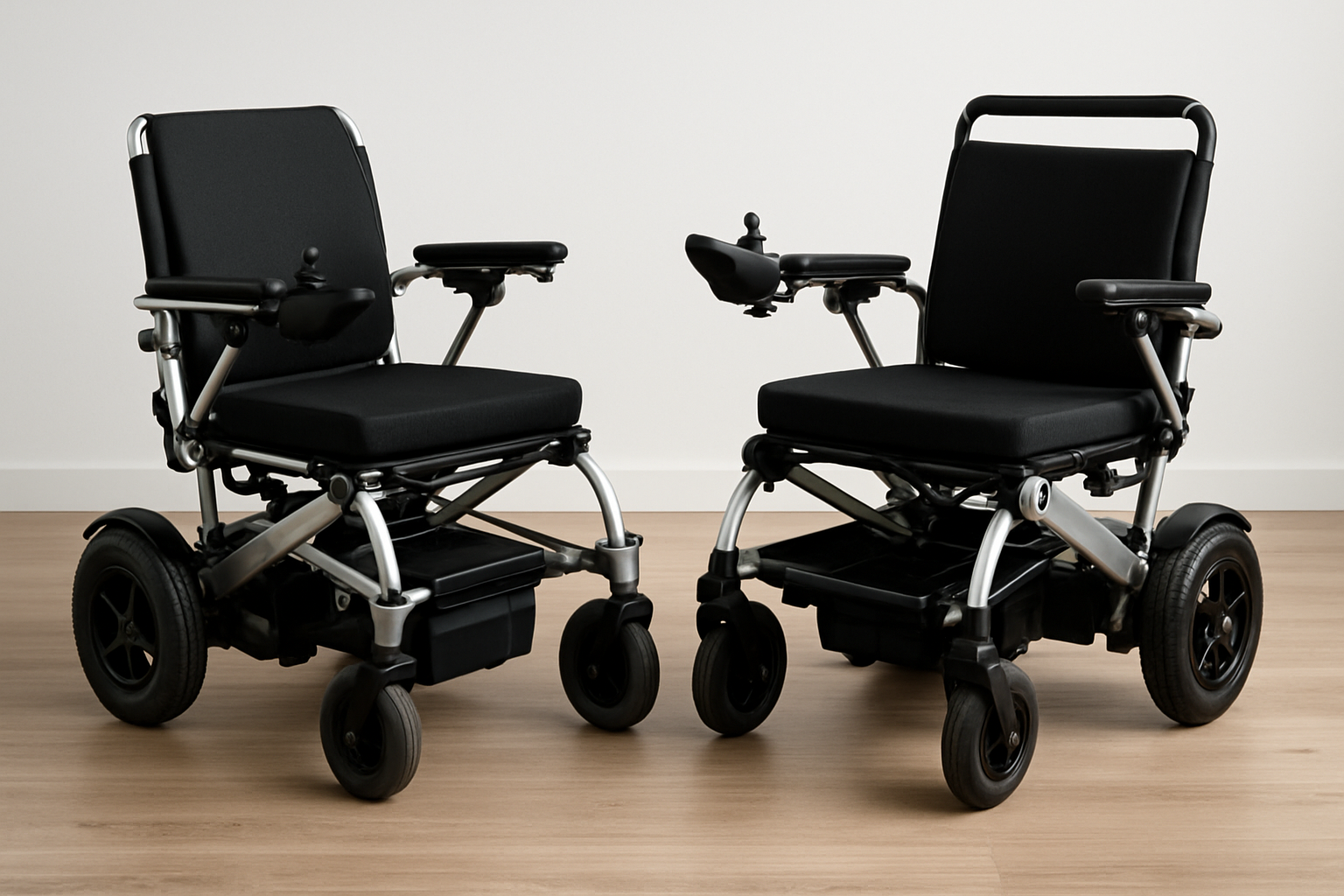
Use this table as a quick filter before you book flights or hotels. Specs are representative ranges for each pick category, not promises from a single manufacturer. Airline acceptance depends on battery labeling, removal steps, and carrier policy. Go Wheelchairs will confirm measurements and provide a written battery summary to carry with your travel documents.
| Pick | Chair Weight | Capacity | Turning Radius | Folded Footprint | Battery Type | Battery Size | Airline Notes |
|---|---|---|---|---|---|---|---|
| Ultra-Light Feather-Fold | 30 to 38 lb [pound] | 220 to 265 lb [pound] | 31 to 33 in | Small suitcase-style | Lithium-ion | 240 to 288 watt-hours [Wh] | Carry battery to cabin when required; label watt-hours [Wh] |
| CityTurn Compact | 40 to 48 lb [pound] | 250 to 300 lb [pound] | 30 to 32 in | Flat-fold, stands upright | Lithium-ion | 200 to 288 watt-hours [Wh] | Confirm joystick removal steps for screening |
| Carbon-Flex CarryOn | 33 to 40 lb [pound] | 220 to 265 lb [pound] | 31 to 33 in | Ultra-flat; light frame | Lithium-ion | 200 to 300 watt-hours [Wh] | Bring printed manual page showing removal sequence |
| All-Day Cruiser | 48 to 55 lb [pound] | 265 to 300 lb [pound] | 31 to 34 in | Flat fold | Lithium-ion | Dual 144 to 160 watt-hours [Wh] packs common | Two small packs often easier for airline approval |
| Heavy-Duty Traveler | 55 to 64 lb [pound] | 300 to 400 lb [pound] | 32 to 35 in | Flat fold or split | Lithium-ion | 240 to 300 watt-hours [Wh] | Ensure battery enclosure is spill-proof and labeled |
| Lean-and-Go Split-Frame | 48 to 58 lb [pound] total | 250 to 300 lb [pound] | 31 to 33 in | Two-piece nest | Lithium-ion | 240 to 288 watt-hours [Wh] | Gate agents appreciate labeled bags for each piece |
| Budget-Friendly FoldGo | 45 to 52 lb [pound] | 220 to 265 lb [pound] | 31 to 33 in | Flat fold | Lithium-ion | 240 to 288 watt-hours [Wh] | Keep charger in carry-on; some airlines ask |
| Cruise-Cabin QuickFold | 44 to 52 lb [pound] | 250 to 300 lb [pound] | 31 to 33 in | Ultra-compact; stands upright | Lithium-ion | 240 to 300 watt-hours [Wh] | Confirm ship and airline policies before sailing |
Flying with Power: TSA [Transportation Security Administration] and FAA [Federal Aviation Administration] Battery Rules Made Simple
Air travel with a powered mobility device is protected by the ACAA [Air Carrier Access Act] and enforced by the DOT [United States Department of Transportation], but practical success comes from preparation. Most folding wheelchairs use lithium-ion packs labeled with watt-hours [Wh]; airlines typically follow the FAA [Federal Aviation Administration] guideline of up to 300 watt-hours [Wh] for many installed wheelchair batteries, while spare (uninstalled) batteries are often limited to 160 watt-hours [Wh] each and may require airline approval. Policies vary, and some carriers request that you remove and carry the battery into the cabin, place terminal covers on exposed contacts, or provide printed documentation. TSA [Transportation Security Administration] officers will swab the chair and may request joystick removal; if the joystick unplug is not obvious, a one-page diagram saves time and nerves.
- Call the airline 48 to 72 hours before travel to add a wheelchair service note and confirm battery handling steps.
- Print a one-page battery card showing chemistry, watt-hours [Wh], and removal instructions; tuck it into a clear pouch on the chair.
- Arrive early and request a gate-check tag; ask staff to load the chair last and unload it first to reduce handling.
- Use a travel cover and remove easily detached parts like cushions and joysticks to your carry-on.
- Know your rights under the ACAA [Air Carrier Access Act]; if damage occurs, document before leaving the gate area.
Will Medicare [Centers for Medicare & Medicaid Services] Help Pay? Your Coverage Roadmap
![Illustration for Will Medicare [Centers for Medicare & Medicaid Services] Help Pay? Your Coverage Roadmap related to which lightweight folding electric wheelchair is best for travel](https://admanager-ai.s3.us-east-1.amazonaws.com/seopro-blog-inline-images/484960c4-3889-4d6a-8907-70375562c4c6.png)
Medicare Part B [Medical Insurance] covers power wheelchairs as DME [Durable Medical Equipment] when they are medically necessary for use in the home and prescribed by a clinician following a face-to-face exam. Folding travel chairs can qualify when the medical record shows that powered mobility is necessary indoors and that a folding design is the safest way for you to access your home environment. You will typically pay 20 percent coinsurance after the annual deductible if the supplier is enrolled and accepts assignment, and secondary insurance may cover some or all of that remainder. Documentation quality drives approvals: clear functional limitations, why a cane or manual chair is insufficient, and why a compact power chair is the right solution for safe activities of daily living.
- Step 1: Clinician visit and detailed written order; include why a folding chair is needed for safe home access.
- Step 2: Supplier coordination; Go Wheelchairs verifies enrollment status, prepares forms, and checks local coverage policies.
- Step 3: Trial and fitting; measurements for seat width, cushion type, and joystick side are recorded.
- Step 4: Submission; allow time for prior authorization when required and keep copies of all paperwork.
- Step 5: Delivery and training; Go Wheelchairs reviews battery safety and travel prep to avoid airport hiccups.
Pro tip: Ask about HCPCS [Healthcare Common Procedure Coding System] coding and any local coverage determination, often called an LCD [Local Coverage Determination], so there are no surprises. Go Wheelchairs offers insurance and Medicare assistance and will tell you upfront if a specific configuration is a poor fit for coverage criteria, then present alternatives that keep you moving.
Why Go Wheelchairs: Range, Expertise, and Real-World Travel Support
Finding a chair that fits your body, your home, your trips, and your budget is hard enough; coordinating airline rules and coverage can feel impossible. Go Wheelchairs solves this by combining a wide range of standard and heavy-duty motorized wheelchairs with lightweight, foldable designs, then wrapping it all in personalized guidance. Our advisors listen to your daily routines, check doorway widths, talk about who lifts the chair, and map your upcoming flights. We prepare documentation, coordinate with your clinician, and pre-check Medicare [Centers for Medicare & Medicaid Services] and other insurance so you are not guessing about cost or eligibility. Finally, our Resources hub offers buying guides, comparison tools, printable battery cards, and travel tips based on real customer trips, because the best test lab is a crowded gate on a Friday afternoon.
- Personalized fittings and measurement checklists so the chair you receive matches the way you live.
- Insurance and Medicare assistance, including prior authorization support and honest cost estimates.
- Travel coaching: packing lists, TSA [Transportation Security Administration] scripts, and airline battery templates.
- Coverage-friendly options across budgets: from value FoldGo builds to heavy-duty travelers.
You started by wondering which lightweight folding electric wheelchair is best for travel, and now you have a roadmap. Picture breezing through security with a clearly labeled battery, pivoting into a tiny elevator, and rolling straight onto your next adventure without drama. In the next 12 months, small gains in battery efficiency and frame materials will make these chairs even lighter and smarter. Which features matter most to your independence, and what will your first trip feel like when every turn is easy and every transfer is safer?
Additional Resources
Explore these authoritative resources to dive deeper into which lightweight folding electric wheelchair is best for travel.
Travel Smarter with Go Wheelchairs
Go Wheelchairs guides travelers with Medicare and insurance support and a wide range of standard and heavy-duty motorized wheelchairs so you move with confidence and independence.