
Ultimate Guide to Power Wheelchair Battery and Charger: Specs, Compatibility, Charging Times, Lifespan & Medicare-Friendly Buying Tips
If you rely on a power chair every day, your power wheelchair battery and charger are the silent teammates that make independence possible. When they work well, you hardly notice them. When they do not, every errand, appointment, and visit becomes a stress test. I have helped dozens of families navigate the maze of specs, compatibility notes, and insurance rules, and I have learned this: once you understand a few fundamentals, smart charging becomes simple, range anxiety fades, and costs drop. In this friendly deep dive, we will translate technical jargon into plain English, map realistic charging times, compare battery chemistries, and share Medicare-friendly buying tips that keep you rolling without surprises.
Along the way, I will sprinkle in real-world examples from the Go Wheelchairs community. Go Wheelchairs is dedicated to reliable, motorized wheelchairs at fair prices with coverage options through Medicare and other health insurance providers, and their team’s guidance has saved people I know countless hours. Whether you are choosing between sealed lead-acid and lithium-ion, troubleshooting a charger light, or lining up documentation for coverage, consider this your roadmap. And if you want tailored help, Go Wheelchairs sells a curated catalog of powered wheelchairs (travel, mid-wheel, and heavy-duty) and maintains a resources hub with buying guides and comparison tools that make next steps feel easy.
Power Wheelchair Battery and Charger Fundamentals
Many power chairs use a twenty-four volt system made from two twelve volt batteries connected in series. However, some models and manufacturers use different voltages or integrated lithium-based packs with different configurations. Think of these like a pair of water tanks feeding one pipe: capacity, measured in ampere hours, tells you how much energy is stored, while voltage is the pressure that moves it. Deep-cycle batteries are designed to deliver steady power over many hours, which is exactly what daily mobility needs. The right charger acts like a smart faucet, delivering just enough flow to refill the tanks without overflowing or stressing the cells. Your best match balances chemistry, capacity, and daily mileage so you get dependable range and reasonable charging times without shortening lifespan.
There are three common battery chemistries in power chairs: sealed lead-acid with absorbed glass mat, sealed lead-acid with gel cell, and lithium-ion including lithium iron phosphate. Each chemistry has strengths. Sealed lead-acid with absorbed glass mat is rugged and budget friendly. Sealed lead-acid with gel cell is stable and low maintenance. Lithium-ion is light, fast to charge, and long lasting. The trade-offs involve cost, weight, charging profiles, and cold-weather performance. Your charger must match your chemistry because the voltage targets and stages differ. A chemistry-matched, automatic, multi-stage charger protects lifespan while minimizing charge time, which means fewer overnight worries and more time living.
| Chemistry | Typical System | Common Capacities | Weight | Strengths | Watch-outs | Great For |
|---|---|---|---|---|---|---|
| Sealed lead-acid with absorbed glass mat | Two twelve volt batteries in series for twenty-four volts | Thirty-three to seventy-five ampere hours | Heavier than lithium-ion | Affordable, widely available, durable | Longer charging times, sensitive to deep discharge | Daily use with predictable charging time and budget focus |
| Sealed lead-acid with gel cell | Two twelve volt batteries in series for twenty-four volts | Thirty-three to sixty-five ampere hours | Heavier than lithium-ion | Stable, spill-proof, low maintenance | Requires gel-specific charging profile, slower charging | Indoor users and moderate range needs |
| Lithium-ion including lithium iron phosphate | Integrated twenty-four volt pack with battery management system | Equivalent to thirty-five to one hundred ampere hours in performance | Lightweight | Fast charging, longer lifespan, consistent power | Higher upfront cost, requires compatible charger and approvals | Travel, heavy-duty terrain, users seeking maximum range |
- Capacity is measured in ampere hours and signals range potential. Higher capacity usually means longer range and longer charging time.
- Voltage is commonly twenty-four volts in many chairs, though some models use different voltages or integrated packs. Do not mix voltages or chemistries in one system.
- Chargers are rated by output current in amperes. Higher current generally means faster charging, as long as it is approved for your battery.
- Smart chargers with three stages cut charge time and protect health: bulk, absorption, and float or storage maintenance.
How It Works: From Plug-in to Full Charge
When you connect your charger, it reads the battery voltage and starts the bulk stage, pushing current to restore most of the charge. Next comes absorption, where the charger holds a steady voltage while the current tapers, topping off without overheat. For sealed lead-acid batteries, many chargers then enter a float or maintenance stage to counter self-discharge during storage. Lithium-ion packs with a battery management system handle balancing differently and do not use a traditional float stage. The chair’s controller, joystick module, and safety circuits coordinate this dance so you can plug in and forget it overnight.
Watch This Helpful Video
To help you better understand power wheelchair battery and charger, we’ve included this informative video from Vive Health. It provides valuable insights and visual demonstrations that complement the written content.
Charging time depends on three variables: battery capacity in ampere hours, charger output in amperes, and the depth of discharge you start from. A fast way to estimate is to multiply capacity by a factor for charging losses, often one point two for sealed lead-acid, and divide by the charger current. For example, a fifty ampere hour sealed lead-acid pack with a five ampere charger takes roughly twelve hours from empty. Lithium-ion is more efficient and often needs less overhead, so the same capacity might charge in eight to ten hours with a similar current. Real-world results vary with temperature, age, and cable condition.
| Battery Capacity | Charger Output | Sealed Lead-Acid Estimate | Lithium-Ion Estimate | Notes |
|---|---|---|---|---|
| Thirty-five ampere hours | Four amperes | About ten to eleven hours | About seven to eight hours | Great for overnight charging |
| Fifty ampere hours | Five amperes | About eleven to twelve hours | About eight to ten hours | Common on mid-range chairs |
| Fifty-five ampere hours | Eight amperes | About eight to nine hours | About six to seven hours | Faster units for heavier users |
| Seventy-five ampere hours | Eight to ten amperes | About ten to twelve hours | About seven to nine hours | Heavy-duty chairs and long-range riders |
What do the little charger lights actually mean? A steady red often signals bulk charge. Amber or yellow usually means absorption top-off. Green commonly indicates full or maintenance mode. If the indicator blinks or shows an error, check the manual for your original equipment manufacturer. Quick tip from the field: if the charger clicks on and off rapidly, you may have a loose connector, a tripped circuit at the wall, or a battery that has dropped too low for automatic detection. In that case, contact a technician or your Go Wheelchairs support team before experimenting, because safety comes first.
Best Practices for Battery Health and Reliable Range
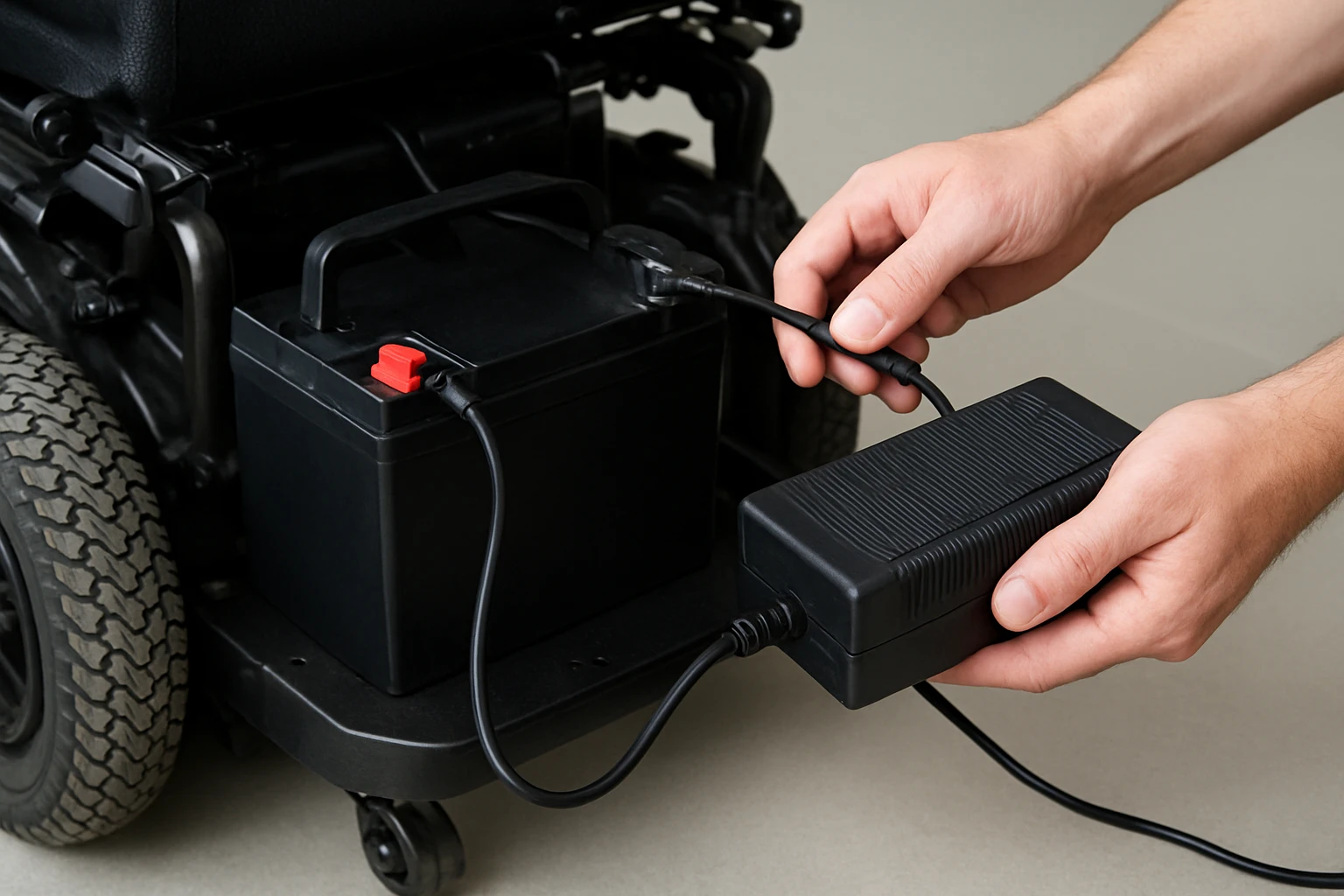
Great battery care is like brushing your teeth: small daily habits prevent big repairs. Start with a routine. Plug in after your day and let the charger finish its cycle. Partial charges are fine for lithium-ion. Sealed lead-acid prefers a full finish to float. Keep the environment moderate, avoiding freezing garages and scorching sunlit car trunks. Once a month, inspect cables and connectors for looseness or corrosion, because tiny resistances can steal miles of range. A few disciplined steps can easily add months, even a year, to your battery’s lifespan and spare you from those inconvenient mid-ride beeps.
From the Go Wheelchairs bench, we consistently see that drivers who match charger output to battery capacity and personal mileage enjoy the smoothest experience. If you travel long distances or ride on grass and gravel, choose a higher capacity battery and a charger with enough current to recover overnight. If you mainly ride indoors or take short trips, a mid-capacity battery with a small, lightweight charger is perfect. For travel or apartments, consider a lightweight, foldable chair with a lithium-ion pack and an airline-compliant option where available. Whatever your setup, document your usage patterns; it helps both your technician and your insurer understand your needs.
- Charge regularly. After daily use, plug in and allow a full cycle. Avoid leaving sealed lead-acid batteries uncharged for days.
- Keep batteries clean and dry. Wipe terminals gently. Moisture and debris can cause slow discharge and heat.
- Match charger to chemistry. A gel cell charger is different from an absorbed glass mat profile, and lithium-ion packs require compatible electronics.
- Store at moderate temperatures. Extreme cold and heat accelerate aging. Lithium-ion prefers partial charge for long storage.
- Plan for replacement. Sealed lead-acid commonly lasts one to three years. Lithium iron phosphate can last five years or more with care.
- Record performance. Note typical range, charging time, and any error codes to catch early signs of decline.
- Use the right outlet. Dedicated household circuits with good ventilation are best. Avoid power strips that may trip.
- Travel smart. Carry your charger, a spare fuse if applicable, and your chair’s documentation for airlines and clinics.
Common Mistakes That Shorten Lifespan or Kill Range
We have all been there: a busy week, late-night plug-ins, then a surprise short ride the next morning. The most common battery killer is deep discharging sealed lead-acid to nearly empty, especially repeated over weeks. That habit can slash cycle life from hundreds of charges to a fraction. Another silent drain is an undersized charger. If your charger cannot replenish what you used in a single evening, you begin the next day partially full, and the deficit compounds. Lithium-ion is more forgiving than sealed lead-acid, but every chemistry benefits from the right charging profile and reasonable depth of discharge.
Compatibility slip-ups also cause headaches. Using a charger that is not approved for your battery chemistry or capacity may overheat cells or trigger safety cutoffs. Swapping one of two batteries in a sealed lead-acid pair without replacing the other can unbalance the system, reducing range and stressing the healthier battery. Finally, skipping simple maintenance, like tightening a slightly wiggly connector, can mimic battery failure. The fix is simple: slow down, check the basics, and when in doubt call a qualified technician. The Go Wheelchairs support team often resolves issues over the phone by walking through a quick checklist before you spend a dollar.
| Symptom | Likely Cause | Action |
|---|---|---|
| Shorter range than usual | Undercharging, aging batteries, cold weather | Allow a full overnight charge, warm to room temp, check capacity |
| Charger light never turns green | Charger mismatch, faulty cell, loose cable | Verify chemistry match, inspect connectors, contact support |
| Chair shuts down on bumps | Loose terminals or connector | Tighten carefully, clean contacts, test again |
| One battery reads lower in a pair | Uneven aging or imbalance | Replace sealed lead-acid batteries as a matched pair |
| Charger very hot to touch | Blocked ventilation or overloading | Move to ventilated area, verify amperes are appropriate |
Tools, Resources, and Medicare-Friendly Buying Tips
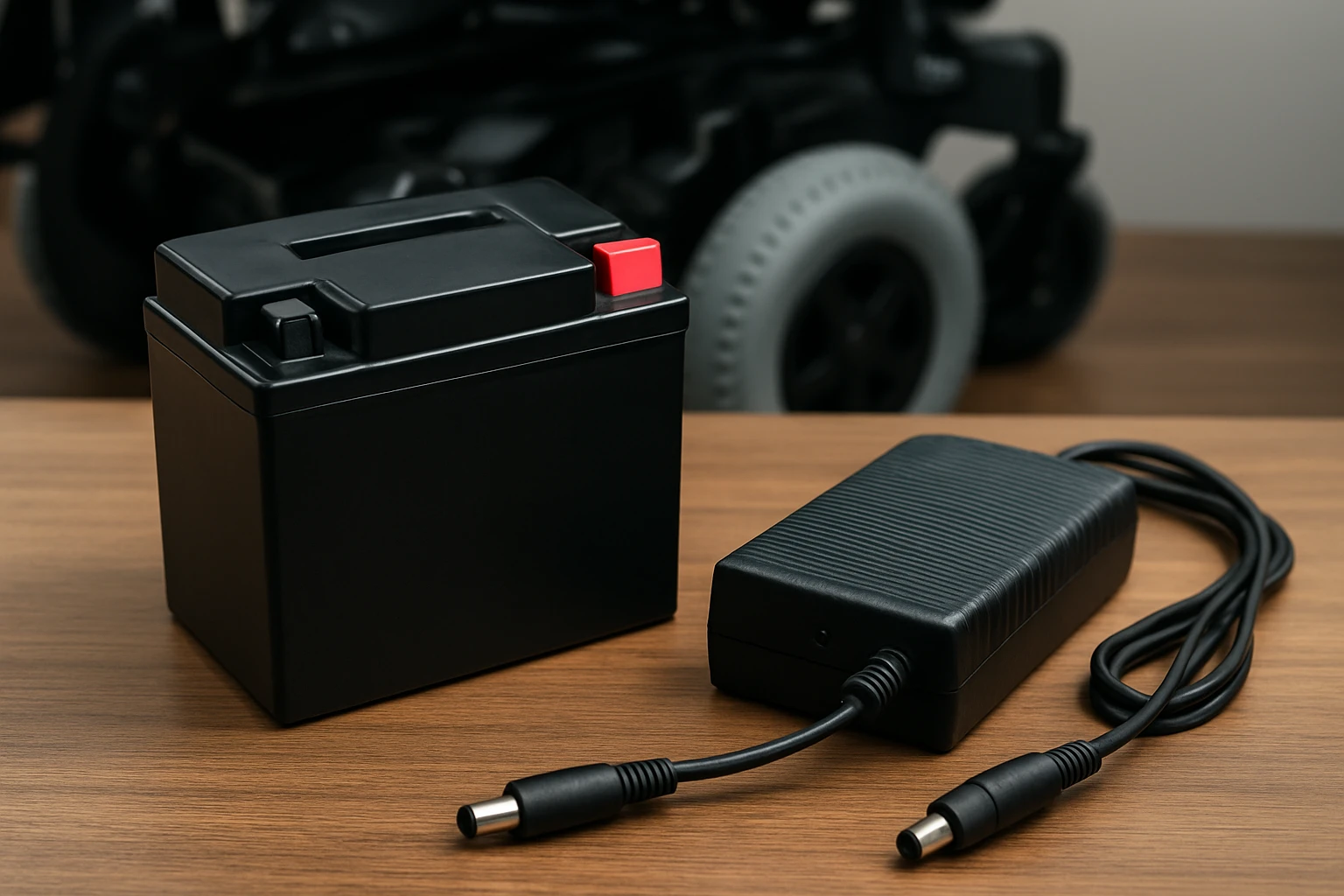
Buying the right setup is not just about volts and ampere hours. It is also about documentation, coverage, and everyday fit. Here is the good news: a little prep smooths the path. For Medicare in the United States, your supplier must be enrolled and compliant, and your healthcare provider’s notes must show medical necessity for a power chair used in the home. Expect to share how mobility limits your daily activities like bathing, dressing, or meal prep. If a power chair is approved, batteries and a standard charger appropriate to the device are typically part of the equipment package when medically necessary. Replacement intervals depend on wear, failure, and documented need.
Go Wheelchairs helps you line up each step with personalized checklists and direct support. Their team coordinates with your provider, explains options in plain English, and matches your profile to the right chair class, battery capacity, and charger current. They also maintain a resources hub with comparison tools and travel guides, which makes tricky calls like absorbed glass mat versus gel or lithium iron phosphate straightforward. Want a quick example? Janelle, a teacher who commutes across campus, moved from a mid-capacity sealed lead-acid pair to a higher-capacity setup with a compatible eight ampere charger, cutting her charge time and boosting range enough to skip mid-day top-offs. Documentation plus data on her daily mileage sealed the coverage question.
| Requirement | What It Means | Tip to Succeed |
|---|---|---|
| Face-to-face evaluation | Your healthcare provider documents in-home mobility needs | Bring notes on daily activities you cannot do safely without a chair |
| Written order prior to delivery | Prescription with chair type and medical necessity | Ask your provider to include battery or charger details if relevant |
| Supplier enrollment | Choose a supplier enrolled with Medicare and compliant | Go Wheelchairs can verify enrollment and handle paperwork |
| Home suitability | Chair can be used inside your home | Measure doorways, turning space, and charging access |
| Reasonable and necessary replacement | Batteries or charger replaced when worn or failed | Keep a log of range, charge times, and any failures |
Compatibility still matters. Even though many chairs use a common three-pin round charging connector, not all chargers are equal. Look at four specs: the system voltage, the battery chemistry, the charger’s output current in amperes, and the connector type approved by your original equipment manufacturer. If your chair uses a built-in charge port at the joystick, confirm the maximum recommended current to avoid overheating. When choosing lithium-ion upgrades, make sure the battery pack and its charger are designed for your exact model and include a certified battery management system and relevant safety certifications from groups such as Underwriters Laboratories and the International Electrotechnical Commission. Safety certifications are peace of mind when you are asleep and the chair is sipping power.
| Your Situation | Recommended Charger Output | Why It Helps | Go Wheelchairs Tip |
|---|---|---|---|
| Light user, mostly indoors | Three to five amperes | Quiet, compact, overnight is enough | Choose a travel-friendly unit and keep a spare at work |
| Daily commuter with hills | Five to eight amperes | Recovers deeper discharges by morning | Pair with mid-to-high capacity sealed lead-acid or lithium iron phosphate |
| Heavy-duty outdoor terrain | Eight to ten amperes if approved | Shortens long charge cycles safely | Confirm the chair’s maximum input current and ventilation space |
| Apartment living with limited outlets | Smart automatic charger | Set-and-forget with protective shutoff | Use a dedicated outlet and avoid daisy-chained power strips |
A quick note on lifespan benchmarks, based on industry data: sealed lead-acid batteries often provide three hundred to five hundred full cycles when treated gently, while lithium iron phosphate can deliver thousands of cycles. Every deep discharge and every degree of excess heat trims those numbers. Keep depth of discharge moderate when possible, maintain good airflow during charging, and replace batteries as a matched pair for sealed lead-acid systems. When choosing your next chair or battery upgrade, the Go Wheelchairs team can run a quick range and charge-time simulation using your actual mileage so you have real expectations before you buy.
Conclusion
Your chair’s confidence starts with a right-sized battery, a chemistry-matched charger, and a simple daily routine you can trust. In the next twelve months, the biggest wins for most riders will come from small upgrades: a properly sized charger, a tidy charging station, and a log that proves your needs for coverage. If you had a magic wand for mobility tomorrow, what would your energy, range, and routine look like when everything just works?
Imagine turning every plug-in into peace of mind, every morning into full power, and every trip into a sure thing because your power wheelchair battery and charger are perfectly dialed.
Charge Ahead Confidently with Go Wheelchairs
Explore Go Wheelchairs’ curated catalog of powered wheelchairs (travel, mid-wheel, and heavy-duty), plus expert help on batteries, chargers, and Medicare coverage so you ride farther with confidence.