
How to Choose Portable Travel Power Chairs: Airline-Ready Specs, Practical At-Home Checks & Medicare Coverage Checklist
If travel is on your calendar, portable travel power chairs can turn long airport days and uneven sidewalks into a smoother, more independent adventure. Yet finding the right fit is not just about a brochure’s range number or a brand name; it is about real-world use, airline rules, and whether your insurance or Medicare Part B (Medicare Part B [Medical Insurance]) can help pay for it. In this guide, I will walk you through airline-ready specifications, practical performance checks you can do at home, and a Medicare coverage checklist that makes paperwork feel much less mysterious. Along the way, I will show you how Go Wheelchairs backs you up with a wide range of standard and heavy-duty motorized wheelchairs, lightweight folding designs, and step-by-step support to help you prepare for gate handling and insurance claims.
Portable Travel Power Chairs 101: What Matters Most on the Move
Before diving into models and accessories, it helps to define your “travel profile.” Do you plan to fly a few times a year and mostly cruise through hotels and museums, or will you be hopping trains, tackling cobblestones, and rolling onto beach boardwalks? The best portable travel power chairs balance four big factors: portability, comfort, stability, and compliance with airline battery rules. Portability covers weight you can realistically lift into a car trunk, an easy fold or quick disassembly, and compact storage footprint; comfort includes seat width, cushioning, and armrest height; stability means a confident feel on ramps and uneven surfaces; and compliance just makes boarding easier, especially with lithium-ion batteries that meet airline guidance.
Think of your chair like a carry-on that you ride: it should fit your body, handle your routes, and cooperate with security and airline staff. If you mostly cruise paved paths, a lighter folding frame with smaller tires could be perfect; if you are a theme park regular or handle higher curbs, you might want chunkier tires, higher ground clearance, and a stabilizing suspension. And if you need higher weight capacity or wider seating, Go Wheelchairs offers heavy-duty models with higher capacities—but note that heavy-duty/all-terrain models are generally not designed to disassemble or fold as compactly or tool-free as ultra-light travel chairs. Go Wheelchairs curates all three types across budgets and coverage paths, and their team helps you trade off features without guessing which spec actually moves the needle for your lifestyle.
| Factor | Why It Matters | Good Target for Frequent Flyers | Pro Tip |
|---|---|---|---|
| Total weight, ready to lift | Easier car-trunk loading, less strain when gate-checking | About 45 to 65 pounds, depending on your lifting help | Check whether batteries remove to shave several pounds for lifting. |
| Folded size | Storage in taxis, hotel rooms, and closets | Compact footprint under typical car trunk width | Measure your actual trunk opening, not just interior space. |
| Battery type and watt-hours | Airline compliance and range per charge | Guidelines vary: many carriers accept batteries ≤100 Wh without approval; batteries between 100–300 Wh often require airline approval and special handling—check your carrier | Ask for printed battery watt-hour info for airline staff. |
| Turning radius | Navigating elevators and tight hotel rooms | Small turning radius for narrow corridors | Test spins in your bathroom doorway and kitchen walkway. |
| Ground clearance | Handling curb cuts and thresholds | Moderate clearance so footplates do not scrape | Check angled ramps and building thresholds near your home. |
| Seat width and adjustability | Comfort and posture on longer days | Fit your hips plus a little extra room for seasonal layers | Try two sizes; a snug but not tight fit reduces fatigue. |
| Range per charge | Confidence for full-day outings | Enough range for your longest planned day plus a buffer | Carry a backup battery if your airline and chair allow it. |
Airline-Ready Specs: Batteries, Weight Limits, and Gate-Check Rituals
Air travel is easier when your chair’s paperwork is as ready as your passport. Most airlines follow guidance based on the International Air Transport Association (International Air Transport Association [IATA]) and the Federal Aviation Administration (Federal Aviation Administration [FAA]) regarding batteries. In practice, many carriers accept mobility devices with securely attached lithium-ion batteries up to about 300 watt-hours per battery, or two spare batteries up to about 160 watt-hours each, as long as terminals are protected and the chair can be deactivated. Always confirm with your airline at booking and again 48 hours before departure, because staff training and rules interpretation vary by carrier and country.
Watch This Helpful Video
To help you better understand portable travel power chairs, we’ve included this informative video from Mobility Scooters Direct. It provides valuable insights and visual demonstrations that complement the written content.
The United States Department of Transportation (United States Department of Transportation [DOT]) requires airlines to accommodate wheelchairs, and the Americans with Disabilities Act (Americans with Disabilities Act [ADA]) reinforces your right to equal access. Still, preparation is your best friend. Print or save a one-page spec sheet with your chair’s battery watt-hours, how to disconnect or remove it, and instructions for freewheeling. Label the chair with your name, mobile number, and handling instructions. At the gate, tell the agent, “This is a mobility device; I will gate-check it” and ask for manual handling. Government data has shown that airlines mishandle thousands of mobility devices annually, so clear instructions, photos of the chair before check-in, and protective padding go a long way.
| Item | Common Allowance | What You Can Do |
|---|---|---|
| Lithium-ion battery watt-hours | Guidelines vary; many airlines accept ≤100 Wh without prior approval. Batteries between 100–300 Wh may require airline approval and special handling; spares are commonly limited and often require cabin approval | Print watt-hour info; use terminal covers; carry spares in cabin if allowed. |
| Gate-check procedure | Permitted for mobility devices | Request manual handling; fold or remove joystick; attach instructions card. |
| Disconnection and freewheel | Required for cargo loading | Learn the freewheel levers; practice once at home with a helper. |
| Advance notice | Helpful, sometimes required | Call 48 hours before; add wheelchair details to your reservation. |
| Protective materials | Allowed if removable quickly | Use bubble wrap on joystick and footplates; remove cushions for the cabin. |
- Airport script to keep handy: “This is my mobility device. The battery is lithium-ion rated at [watt-hours]. It can be deactivated here. Please handle manually and load upright.”
- Security tip for the Transportation Security Administration (Transportation Security Administration [TSA]): arrive early, mention any metal parts, and request a private pat-down if you prefer.
- Backup plan: if an equipment delay happens, ask the airline for a courtesy wheelchair and report any damage before leaving baggage claim.
Practical Test Drive: Hills, Carpets, Curbs, and Tight Hotel Elevators
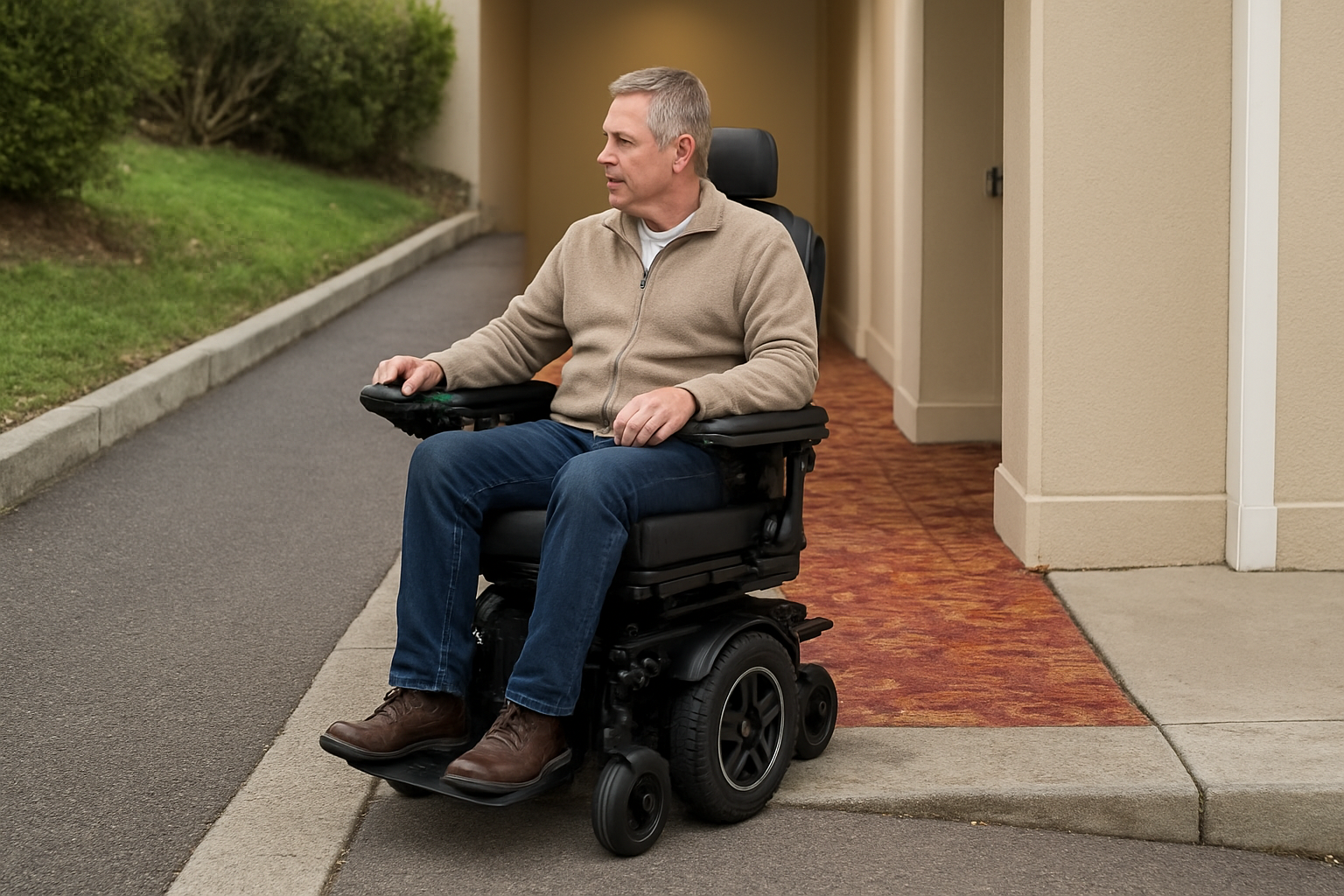
Specs tell a story, but your day tells the truth. I learned this the day my aunt and I rolled into a historic Denver hotel with plush carpet and narrow elevators; her lightweight chair aced the airport but struggled on that dense pile and at the elevator threshold. Since then, I use a five-part test drive for portable travel power chairs: home-course maneuvering, ramp confidence, carpet and threshold push, outdoor curb-cut behavior, and a “long day” battery test with real stops and starts. These tests replicate airports, museums, and city streets better than a showroom spin and uncover tiny issues before they become big headaches away from home.
Set a timer for a one-hour “pretend travel day.” Start with tight turns in your bathroom doorway and kitchen galley, then ride a moderate incline like a neighborhood ramp or garage entry. Roll over a door threshold and a throw rug to feel how the footplate clears and whether anti-tip wheels engage. Outside, try curb cuts and sidewalk cracks at walking pace, and note the comfort of the seat and joystick response during longer glides. Finally, plug in the numbers: how much charge did you use, did the joystick strain your wrist, and did the footplate ever scrape? If the answer to all three feels good, you have a keeper.
| Test | What to Look For | Pass/Adjust |
|---|---|---|
| Tight turns | Clearance in doorways; joystick precision | Adjust armrest height or joystick sensitivity if clipping edges. |
| Ramp and incline | Steady climb without wheel slip | Consider grippier tires if traction breaks on smooth ramps. |
| Carpet and thresholds | No stalling on dense pile; footplate clearance | Look for higher ground clearance or revised footplate angle. |
| Outdoor surfaces | Comfort over seams and cracks | Suspension or pneumatic tires can soften the ride. |
| Battery endurance | Range with frequent stops and starts | Carry a spare battery for museum or theme park days. |
Medicare Coverage Checklist: What to Know Before You Buy
Good news: many power wheelchairs are considered durable medical equipment (durable medical equipment [DME]) under Medicare Part B (Medicare Part B [Medical Insurance]) when medically necessary for use in the home. That means after you meet the annual deductible, Medicare typically pays 80 percent of the Medicare-approved amount while you are responsible for 20 percent, assuming your supplier participates and accepts assignment. The key is documentation: a face-to-face examination by your clinician, a detailed written order, proof that a cane or manual chair will not work for your daily activities inside your home, and sometimes prior authorization before delivery. Rules change and vary by device category, so think of this section as a road map you will personalize with your doctor and supplier.
Go Wheelchairs helps you line everything up. Their team works with you and your clinician to gather the right notes, diagrams, and measurements, and they coordinate with participating suppliers to submit claims correctly the first time. If you are working with a Medicare Advantage plan or another insurer, they help translate the requirements into your plan’s language and confirm network participation. In other words, you are not left to decode acronyms or coverage determinations alone; you get a friendly guide and a clear checklist, so you can focus on trying chairs and planning your first trip instead of shuffling papers.
| Step | What You Need | Who Handles It | Timing Tip |
|---|---|---|---|
| 1. Clinical evaluation | Face-to-face visit notes showing medical necessity for in-home use | You and your clinician | Schedule early; visit must be recent relative to the order. |
| 2. Detailed written order | Exact device type, accessories, and medical justification | Clinician writes; Go Wheelchairs can coordinate details | Double-check the order matches your chosen chair and features. |
| 3. Supplier eligibility | Participating supplier that accepts assignment | Go Wheelchairs verifies participation | Ask for confirmation in writing to avoid surprise bills. |
| 4. Prior authorization | Required for some power wheelchair categories | Supplier submits; you provide signatures | Start this step as soon as your chair choice is finalized. |
| 5. Home environment notes | Doorway widths, turning spaces, ramp needs | You with guidance from Go Wheelchairs | Take photos and basic measurements to support sizing. |
| 6. Delivery and training | Setup, safety training, and operating instructions | Supplier and Go Wheelchairs support | Keep manuals and battery data with your travel documents. |
| 7. Claim and records | Signed delivery ticket and medical documentation copies | Supplier files; you retain copies | Save all paperwork for future repairs or travel letters. |
- If you have a Medicare Advantage plan, verify any network and prior authorization rules specific to your plan.
- Ask whether accessories like elevating leg rests or specialized cushions are covered when medically necessary.
- If your use case is primarily outside the home, talk to your clinician about how your in-home needs are documented.
How Go Wheelchairs Helps You Decide: Fit, Features, and Support
Choosing between folding frames, quick-disassembly designs, and travel-ready heavy-duty builds is easier with a partner who understands both practical use and coverage. Go Wheelchairs combines a curated catalog with hands-on guidance: a wide range of standard and heavy-duty motorized wheelchairs, lightweight foldable designs for easy car-trunk lifting, and a resources hub with buying guides, comparison tools, and travel tips. You get clarity on trade-offs like range versus weight, tire type versus ride comfort, and turning radius versus stability, plus help translating specifications into airline-ready documents. And if you are navigating Medicare Part B (Medicare Part B [Medical Insurance]) or other insurance, their coverage assistance means you can align your dream travel chair with a realistic payment plan.
Below is a simple fit matrix to start a conversation with your advisor. It is not about chasing the highest number on any single spec; it is about how the features work together in your life. If you need a compact footprint and frequent folding, you might prioritize a lighter frame with removable batteries. If terrain and comfort matter most, you may opt for a slightly heavier build with larger tires and suspension. When higher weight capacity or wider seating is a must, heavy-duty options bring sturdiness while you weigh portability trade-offs.
| Category | Typical Rider Capacity | Chair Weight Range | Range per Charge | Best For |
|---|---|---|---|---|
| Ultra-light folding travel | Up to a moderate capacity, check seat width options | Lower weight for easy lifting | Moderate range for city days | Frequent flyers, taxis, hotel rooms, quick storage. |
| Standard travel | Wide range of seating sizes | Balanced weight for comfort and stability | All-day range for sightseeing | Mixed surfaces, museums, parks, and day trips. |
| Heavy-duty travel | Higher weight capacities and wider seats | Sturdier frames while retaining portability | Higher range with larger batteries | Rougher paths, longer outings, and added durability. |
- Personalized support: sizing help, test-drive checklists, and airline-ready spec summaries.
- Insurance guidance: coordination with clinicians and participating suppliers for Medicare and commercial plans.
- Resources hub: buying guides, side-by-side comparisons, and real travel tips you can print and pack.
Pre-Trip Packing List and Safety Tips for Portable Travel Power Chairs
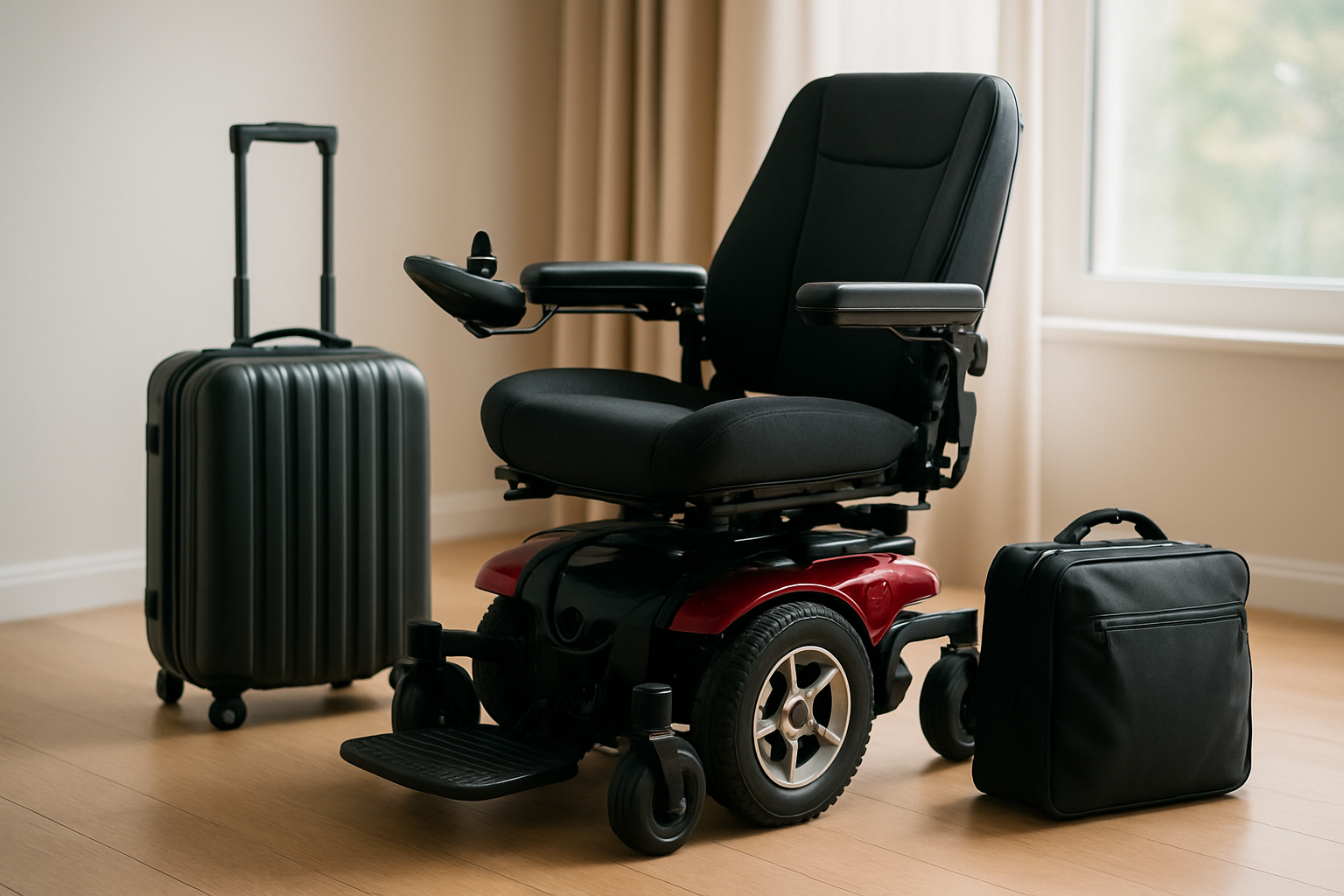
Travel days are easier when your chair toolkit is as ready as your suitcase. Pack a printed one-pager with your chair’s make, model, and battery watt-hours, plus a quick diagram showing how to disconnect power and switch to freewheel. Add terminal covers for lithium-ion batteries and a small roll of bubble wrap to protect your joystick and footrests at the gate. Bring a compact tool for footplate adjustments if your chair allows it, and throw in a labeled bag for the charger and any spare battery you are permitted to carry onboard. A simple luggage tag with handling instructions and your phone number can save time if your chair arrives at a different gate.
- Battery game plan: charge fully the night before; carry the charger in your cabin bag; confirm local voltage if traveling internationally.
- Comfort kit: a thin cushion cover, a light blanket for cooler cabins, and a reusable strap to secure resting footplates in transit.
- Damage prevention: photos of the chair at drop-off, a note taped near the joystick that says “Fragile: Mobility Device, Hand-Load Upright,” and protective padding.
- Airport timing: arrive earlier than usual, ask for an aisle chair if you transfer to a seat, and reconfirm gate-check tags at boarding.
- Hotel setup: request an accessible room with adequate door width and roll-in space; measure once if you are unsure.
If something goes sideways, breathe and document. Ask for a written incident report before you leave baggage claim if any part is damaged. Request a loaner if available, and keep receipts for emergency purchases. The United States Department of Transportation (United States Department of Transportation [DOT]) Air Carrier Access rules give you the right to report mishandling; airlines take these reports seriously when they include times, names, and photos. And if you bought through Go Wheelchairs, call their support team; they will help you triage the issue and coordinate next steps so your trip keeps rolling.
Portable Travel Power Chairs: The Final Checklist
- Comfort and fit: seat width, armrest height, joystick placement, and posture over a full “pretend travel day.”
- Portability: total weight you can lift, folding or disassembly method, and folded dimensions that match your trunk and storage spaces.
- Performance where you go: ramps, carpets, thresholds, curb cuts, and sidewalk seams you actually encounter.
- Airline readiness: lithium-ion battery watt-hours clearly documented, freewheel instructions, and gate-check plan.
- Coverage path: Medicare Part B (Medicare Part B [Medical Insurance]) or other insurance documents ready, supplier participation confirmed, and any prior authorization submitted.
- Support: a responsive partner like Go Wheelchairs for sizing help, claims coordination, and travel know-how.
Your best chair is the one that fits your life like a favorite carry-on: compact when it needs to be, comforting when the day runs long, and confident when plans change. With portable travel power chairs chosen through practical at-home checks and a coverage plan that respects your budget, every trip becomes less about logistics and more about experiences. Ready to try a few contenders and see what freedom feels like on your calendar?
Conclusion
Here is the promise: you can choose a travel-ready power chair that fits your body, your routes, and your coverage—without guesswork.
Imagine the next 12 months filled with smooth flights, easy hotel check-ins, and days that end in stories, not sore shoulders or surprise bills.
Which destination will you roll toward first with portable travel power chairs leading the way?
Additional Resources
Explore these authoritative resources to dive deeper into portable travel power chairs.
Explore Travel-Ready Freedom with Go Wheelchairs
Go Wheelchairs guides Individuals seeking reliable mobility solutions with a wide range of standard and heavy-duty motorized wheelchairs and clear Medicare and insurance support.