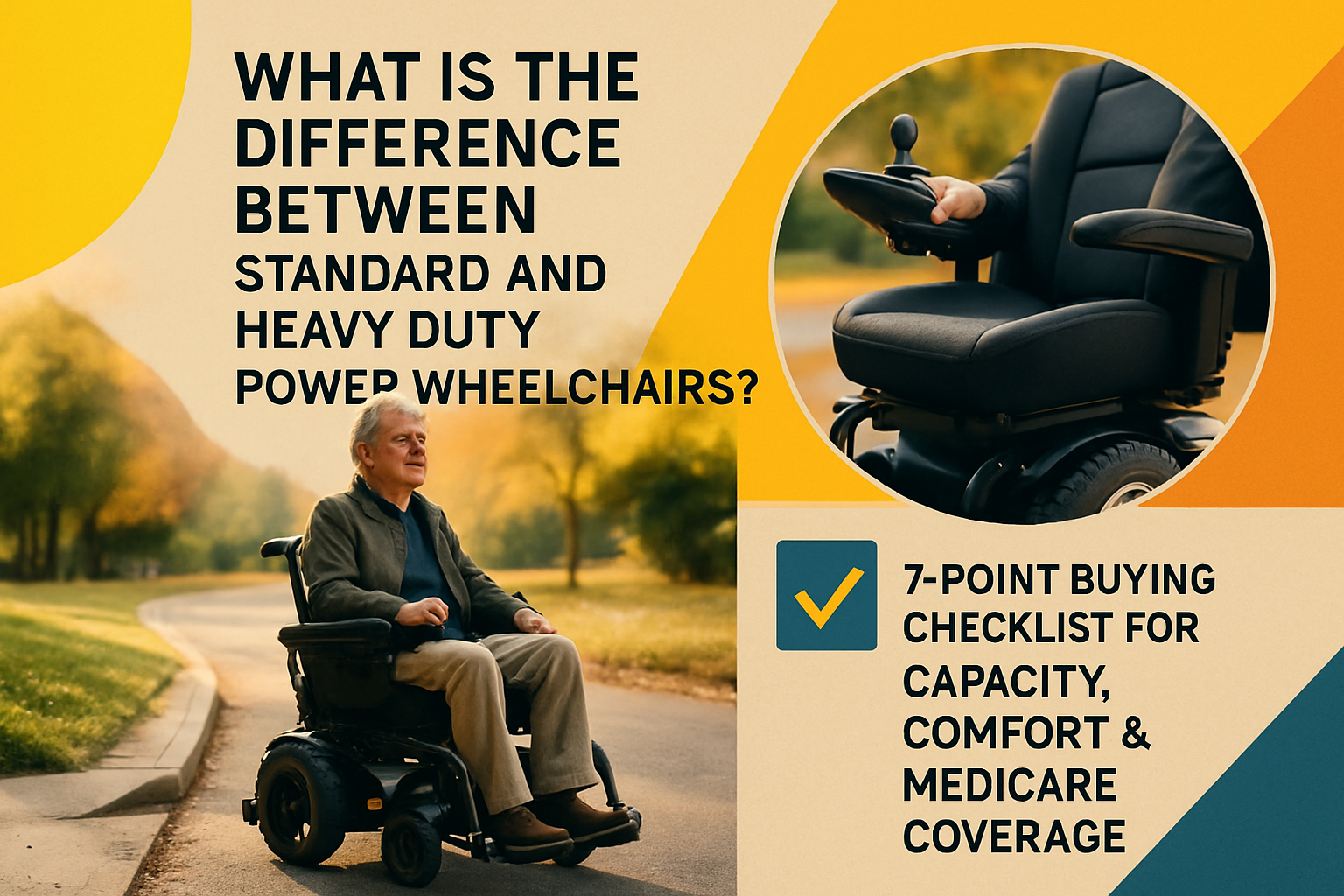
What Is the Difference Between Standard and Heavy Duty Power Wheelchairs? 7-Point Buying Checklist for Capacity, Comfort & Medicare Coverage
If you are weighing your options and asking what is the difference between standard and heavy duty power wheelchairs, you are already doing the smartest first step: getting clear on fit before buying. A power chair is not just a product; it is your daily freedom machine. I remember helping a neighbor test-drive two chairs in her narrow hallway, and the “aha” moment came fast. One chair pivoted like a dancer in her kitchen, the other climbed the cracked sidewalk outside like a mountain goat. Both were great, just for different lives.
In this friendly Q and A guide, you will get a crisp answer, an easy comparison table, and a practical 7-point checklist you can take to a showroom or a virtual consult. We will also walk through Medicare Part B (Medical Insurance) coverage basics, real-world scenarios, and how Go Wheelchairs makes the process less stressful with a wide range of models, lightweight foldable designs, and insurance support. By the end, you will know what to measure, what to ask, and how to choose a chair that feels like it was made for you.
Quick Answer: What is the difference between standard and heavy duty power wheelchairs?
Short version: standard power wheelchairs are built for everyday users who prioritize maneuverability, indoor performance, and transport friendliness, while heavy duty power wheelchairs are engineered for higher weight capacity, rugged durability, and better stability on challenging surfaces. Standard models typically support about two hundred fifty to three hundred pounds, offer tighter turning radiuses, and often disassemble or fold for car travel. Heavy duty models commonly support four hundred to six hundred pounds, feature wider seating, reinforced frames and motors, and larger batteries for longer range, though they are bulkier and usually require a vehicle lift. If your daily life is mostly indoors with occasional smooth outdoor rides, standard is often ideal. If you need higher capacity, extra stability, roomier seating, or frequent outdoor use over grass, gravel, or ramps, heavy duty is often the better fit.
How Do Specs Compare at a Glance?
Numbers make the differences real. Here is a side-by-side view of typical ranges and traits you will encounter when comparing standard versus heavy duty power chairs. Remember that exact specifications vary by brand and model, and your ideal combination depends on your body measurements, terrain, and storage or transport plans.
Watch This Helpful Video
To help you better understand what is the difference between standard and heavy duty power wheelchairs, we’ve included this informative video from Mobility Scooters Direct. It provides valuable insights and visual demonstrations that complement the written content.
| Specification | Standard Power Wheelchair | Heavy Duty Power Wheelchair |
|---|---|---|
| Typical weight capacity | About 250 to 300 pounds | About 400 to 600 pounds (some bariatric models go higher) |
| Seat width options | 16 to 20 inches | 20 to 26 inches (with reinforced seating) |
| Turning radius | Approximately 20 to 26 inches (mid-wheel drive often tightest) | Approximately 22 to 30 inches |
| Overall chair weight | Roughly 150 to 200 pounds | Roughly 200 to 400 pounds |
| Top speed | About 3.5 to 5.5 miles per hour | About 4 to 6 miles per hour |
| Range per charge | About 10 to 18 miles | About 12 to 25 miles |
| Wheel and tire size | Smaller casters and drive wheels, optimized for indoor use | Larger tires for stability and traction outdoors |
| Suspension | Basic to moderate | Enhanced, multi-point suspension common |
| Portability | Often foldable or disassembles for car transport | Rarely foldable; usually needs a vehicle lift or ramp |
| Best suited for | Apartments, tight indoor spaces, smooth sidewalks | Outdoor routes, uneven paths, higher body weight needs |
| Medicare Part B coverage | Covered when medically necessary with proper documentation | Covered when medically necessary with proper documentation |
Specification ranges are typical, not guarantees. Always review the manufacturer’s manual and verify your measurements with a trained specialist before purchase or insurance submission.
What Should I Check Before Buying? Your 7-Point Checklist

Choosing well starts with honest, practical questions about your body, your home, and your routes. Think of this checklist like fitting a suit: the right size, the right fabric, and the right tailoring make all the difference. At Go Wheelchairs, we use these same checkpoints during personalized consults so that you do not just buy a chair, you invest in the right chair. As you read, jot down quick notes or measurements. The more specific your information, the smoother your trial, selection, and potential Medicare Part B process will be later.
- Fit and weight capacity. Confirm your current weight and add a safety buffer for clothing, bags, or growth. Ensure the chair’s rated capacity exceeds that total. Measure seat width, depth, and back height so you get pressure relief and posture support without hip pinch or slouch. A too-small seat creates pressure points, while a too-large seat can reduce control and comfort.
- Home layout and daily terrain. Map your tightest doorway, hallway, and turn. If your bathroom door is 24 inches wide, you will want an overall chair width under that with room to spare. Outdoors, list common surfaces: carpet, tile, ramps, curb cuts, grass, gravel. Standard models shine in tight interiors; heavy duty models handle rougher ground with confidence.
- Battery range and charging routine. Add up a typical day’s miles plus a buffer for errands, weather detours, or skipped charges. If you travel or fly, ask about airline-friendly battery options and how the battery packs disconnect. Consistency matters: a power chair that outlasts your longest day reduces range anxiety and protects battery health.
- Comfort features that truly matter. Do you need elevated leg rests, a headrest, or lateral supports? Would adjustable armrests ease transfers? Consider cushions for pressure relief, tilt-in-space for posture management, and shock absorption. Comfort is not fluff; it impacts skin integrity, fatigue, and how long you enjoy being in the chair.
- Transport and storage. How will the chair leave the house? Some standard models fold or disassemble into lighter pieces for trunk loading, while heavy duty chairs usually pair best with a hitch-mounted lift or van ramp. Measure the weight of the heaviest piece, your vehicle’s capacity, and your storage space at home.
- Service, parts, and support. Ask how fast parts ship, who handles repairs, and what the warranty covers. A great chair is only as good as the support behind it. Go Wheelchairs provides guidance on maintenance, videos from our resources hub, and scheduling help for service so you are not stuck waiting when a simple fix will do.
- Insurance and Medicare details. If you plan to use Medicare Part B or other insurance, line up the documentation early: a face-to-face evaluation, a detailed prescription, and proof that a power wheelchair is necessary for in-home mobility. The right supplier helps you navigate forms, prior authorization if required, and delivery timelines.
Pro tip: bring your checklist to your fitting. Try the chair in motion, not just parked. Practice turning in a bathroom-sized space, rolling over a doorway threshold, and climbing a safe ramp. If the chair keeps up with your real life during a test-drive, it is more likely to serve you well for years.
Will Medicare Pay for My Power Chair? Your Most Asked Questions, Answered
Medicare Part B may cover a power wheelchair when it is medically necessary for in-home mobility, prescribed by your healthcare provider after a face-to-face evaluation, and supplied by a participating durable medical equipment supplier. In plain terms, you must show that a cane, walker, or manual wheelchair will not meet your needs inside your home. The documentation must be precise, and the supplier submits the claim with the details. Both standard and heavy duty power wheelchairs can be covered when the clinical need and specifications match your body size, your home environment, and your physician’s order.
| Coverage Step | What It Means |
|---|---|
| 1. Clinical evaluation | Your healthcare provider documents why you need a power wheelchair for in-home mobility tasks like bathing, dressing, and toileting. |
| 2. Detailed written order | The prescription specifies the type of chair, key features, and any necessary accessories. |
| 3. Supplier coordination | You choose a participating supplier. They verify benefits, gather paperwork, and confirm the model matches medical necessity. |
| 4. Prior authorization (when required) | For certain models or codes, Medicare may require approval before delivery. Timelines vary by region. |
| 5. Delivery and fitting | The supplier delivers the chair, fits it to you, and provides basic training and documentation. |
| 6. Out-of-pocket costs | After the Part B deductible, you typically pay about twenty percent coinsurance if the supplier accepts assignment. |
| 7. Repairs and maintenance | Repairs may be covered when medically necessary; routine maintenance and wear items can vary. |
- Does heavy duty coverage work differently? The process is the same, but the documentation must support the higher weight capacity or specialized features. The supplier will match your measurements to an appropriate model and include that justification.
- How long does approval take? Many approvals complete within a few weeks once paperwork is accurate, but timing depends on benefit checks and whether prior authorization is required.
- What about accessories? Items like elevating leg rests, specialty cushions, or seat belts may be covered when documented as medically necessary. Comfort-only upgrades without medical justification are usually not covered.
- Will Medicare cover a backup chair? Typically no; coverage generally supports one medically necessary power wheelchair at a time.
- Where can I get help? Go Wheelchairs offers insurance and Medicare assistance, clarifies documentation, and coordinates with your provider so the process feels manageable rather than mysterious.
This section is general education, not legal or medical advice. Coverage rules and timelines can change. Confirm details with your healthcare provider and the Centers for Medicare & Medicaid Services (CMS) website or helpline.
Which Chair Fits My Life? Real-World Scenarios You Can Relate To
Specs tell part of the story; your lifestyle fills in the rest. Picture a day in your life from wake-up to bedtime. Where do you turn, transfer, and travel? Who helps you, and when do you fly solo? These quick scenes show how choosing between standard and heavy duty becomes clear when you map choices to real routines, not just features on a page.
- Small-space pro: You live in a compact apartment with tight doorways, elevators, and bus rides. A standard mid-wheel drive chair with a narrow overall width and tight turning radius can glide through hallways, pivot in the kitchen, and disassemble or fold for a rideshare trip or trunk transport.
- Weekend explorer: You visit parks, roll across grass for family games, and navigate bumpy sidewalks. A heavy duty model with larger tires, reinforced suspension, and a wider wheelbase brings stability and confidence, while a higher-capacity battery keeps you out longer without the battery gauge stress.
- Room to breathe: You want a wider seat, taller back, or higher weight capacity for comfort and safety. Heavy duty frames handle those needs without strain, and the ride feels calm and planted, especially on ramps or uneven ground.
- Frequent traveler: Portability is everything. Some standard power wheelchairs fold or break down into lighter modules, making them easier to lift or stow. If you need heavy duty support and still travel often, plan for a vehicle lift or ramp and ask about airline battery guidelines before you book.
When in doubt, test both categories. It is like trying on two pairs of shoes that look similar. The right one tells you in the first fifty feet. Bring your checklist, and ask the fitter to simulate your toughest turns and surfaces. Your confidence should rise, not your heart rate.
How Go Wheelchairs Makes It Easy: Choice, Guidance, and Coverage Help

Finding a chair that fits your body, budget, and benefits is not a do-it-yourself project. That is why Go Wheelchairs pairs selection with personalized support. Our lineup spans a wide range of standard and heavy-duty motorized wheelchairs, including lightweight, foldable designs for travelers and reinforced, high-capacity models for outdoor stability and comfort. Instead of bouncing between random product pages, you get an expert who listens to your story, matches your measurements, and narrows your options to the few that truly fit your life.
Beyond products, our team helps you navigate the steps that matter. We coordinate with your healthcare provider, review documentation for Medicare Part B or private insurance, and guide you through any prior authorization requirements. Our resources hub puts practical tools at your fingertips: buying guides that translate technical jargon into plain English, comparison tools that highlight crucial differences, and travel tips for stress-free charging, packing, and flying. The result is simple: you save time, avoid costly mismatches, and roll away with confidence.
- Wide range of standard and heavy-duty motorized wheelchairs for every lifestyle and budget
- Lightweight, foldable wheelchair designs that simplify travel and storage
- Personalized support from first consult to delivery and adjustments
- Insurance and Medicare assistance so paperwork does not stall your mobility
- Resources hub with buying guides, comparison tools, and travel tips you will actually use
Q and A: Quick Hits You Asked Us in Consults
Q: How do I know if a standard model is strong enough? A: Check your weight against the chair’s rated capacity and add a buffer. If you are near the limit or expect changes, explore heavy duty for longevity and safety.
Q: Which drive wheel setup works best? A: Mid-wheel drive often turns tightest for indoor use. Front-wheel drive handles thresholds and small obstacles smoothly. Rear-wheel drive can feel most stable at higher speeds and on straighter paths. Test them in your real spaces.
Q: How much maintenance should I expect? A: Keep batteries charged, tires inflated to spec if pneumatic, and schedule periodic checks. Heavy duty models tend to be tougher outdoors but can weigh more, making lifts or ramps important planning items.
Q: Can I start with standard and upgrade later? A: Absolutely. Many riders begin with a standard model and later move to heavy duty as needs change. Go Wheelchairs can reassess fit anytime and help with resale or trade-in discussions where available.
Final Thoughts
Now you have the straight answers, a practical checklist, and a clear path to a chair that fits your life today and tomorrow. When fit, terrain, and coverage align, mobility stops being a daily puzzle and starts feeling effortless.
Imagine the next twelve months with smoother mornings, longer afternoons out, and fewer “will it make it?” moments. With the right partner, choosing a chair becomes calm and confident. Which route will you take next, and what would feeling truly supported look like for you?
If you still wonder what is the difference between standard and heavy duty power wheelchairs, you are closer than ever to a confident choice. Let us help you test, compare, and secure the coverage that fits your goals.
Additional Resources
Explore these authoritative resources to dive deeper into what is the difference between standard and heavy duty power wheelchairs.
Choose Your Power Chair Path with Go Wheelchairs
Explore a wide range of standard and heavy-duty motorized wheelchairs with personalized guidance and Medicare or insurance support, so you move confidently and independently.