If you have ever tried to compare power mobility devices (PMD) online and felt overwhelmed, you are not alone. Between scooters, standard power chairs, heavy-duty builds, and advanced rehab options, the labels can blur together fast. Meanwhile, your decision has real-life consequences: how comfortably you move at home, how easily you run errands, and whether Medicare or other health insurance will help. In this friendly guide, we will break the process into clear, doable steps so you can confidently classify options, match them to your needs, and speak the same language as clinicians, insurers, and suppliers.
By the end, you will know how to translate daily activities into precise device categories, interpret specifications without guesswork, and gather exactly the documentation payers ask for. Along the way, I will share what I have seen work in the field, plus practical checklists you can use today. And because practical support matters, I will show how Go Wheelchairs combines a wide range of motorized wheelchairs with personalized guidance and Medicare assistance to make the whole journey easier and more affordable.
Prerequisites and Tools
Before you dive into device categories, give yourself a head start with a few basics. A little preparation now saves time later and dramatically improves your chances of quick coverage approval.
- Daily needs snapshot: jot down typical distances, surfaces, and tasks at home, work, and in the community.
- Measurements: tape measure, a sturdy chair, and a helper to record seat width, seat depth, lower-leg length, doorway widths, and hallway turning spaces.
- Health team contacts: your doctor and, ideally, a PT [Physical Therapist] or OT [Occupational Therapist]; if available, an ATP [Assistive Technology Professional].
- Insurance details: plan name, member ID, and the payer’s DME [durable medical equipment] or DMEPOS [durable medical equipment, prosthetics, orthotics, and supplies] help line.
- Smartphone: for photos of tight spaces and the front steps, and for a simple level app to estimate ramp or driveway slope.
- Notebook or template: a page to track models, specs, and must-have features. Go Wheelchairs offers printable checklists and comparison tools in its Resources Hub.
Step 1: Define Where and How You Move Each Day
Start with your real life, not the catalog. Where do you actually want to go on a typical day, and what slows you down now. List your must-do activities: cooking in a small kitchen, navigating a carpeted hallway, getting to the mailbox on a sloped driveway, visiting friends, or traveling by car. Be specific about flooring, thresholds, curb cuts, and whether elevators or ramps are available. This context drives every classification decision you will make.
Watch This Helpful Video
To help you better understand power mobility devices (PMD), we’ve included this informative video from CMSHHSgov. It provides valuable insights and visual demonstrations that complement the written content.
As you map your day, group environments into indoor-tight, indoor-open, outdoor-smooth, and outdoor-uneven. Tight indoor spaces favor compact, agile devices with short wheelbases and strong turning ability. Outdoor or mixed-use routines may favor devices with bigger tires, better suspension, and longer range. According to federal health surveys, mobility limitations are the most common disability category in the United States, affecting roughly 1 in 7 adults, so designers have diversified models for very different living situations. The clearer you are about your routes, the easier it gets to narrow choices intelligently and avoid paying for features you will not use.
Step 2: Capture Clinical Needs and Fit Measurements
Next, get clinical input and precise measurements. Ask your PT [Physical Therapist] or OT [Occupational Therapist] to evaluate posture, transfer ability, trunk control, and pressure risk. If you have skin breakdown risk or spasticity, you may require tilt, recline, or specialized seating. If fatigue or shoulder pain limits manual propulsion, that points toward a powered solution. Many payers rely on notes from a face-to-face evaluation to justify the equipment, so booking that visit early prevents delays later.
At home, measure seat width by sitting on a firm surface and placing the tape across the widest point of your hips or thighs, then add about 1 inch for comfort. Measure seat depth from your back to about 2 inches behind the knee. For footplate height, measure lower-leg length from the back of knee to the heel while wearing everyday shoes. Note doorway widths and hallway turning spaces. A quick rule of thumb: if your tightest doorway is 28 inches, seek devices with narrow frames and excellent turning ability. Good fit is not a luxury; it is the foundation for safe posture, efficient driving, and all-day comfort.
Step 3: Map Power Mobility Devices (PMD) to Real-World Categories
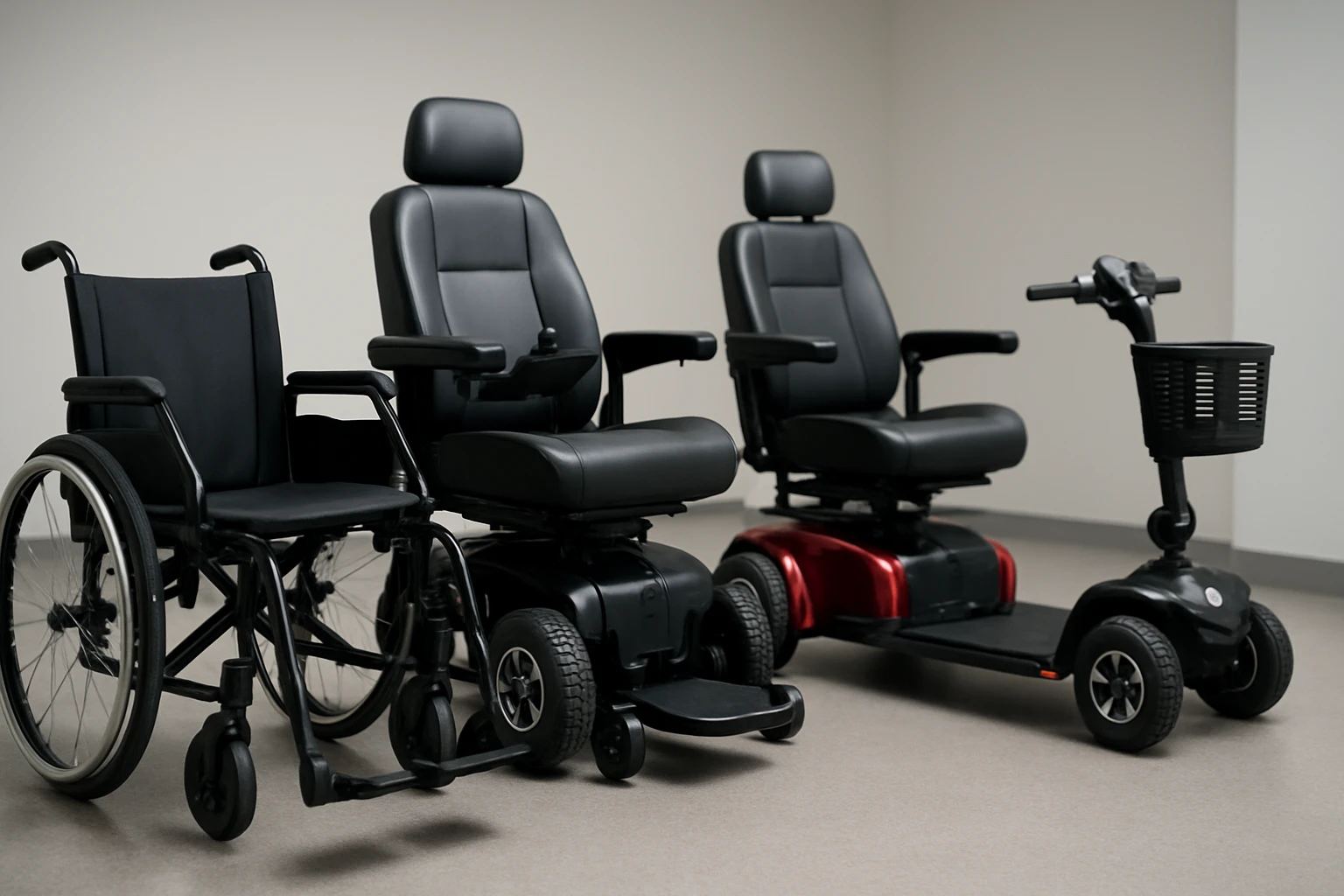
With your environments and clinical needs in hand, it is time to classify device types. Think of this as matching the problem to the tool. You will see four broad categories in most showrooms and policies: scooters, standard power wheelchairs, heavy-duty power wheelchairs, and complex or rehab-configurable power wheelchairs. Each category trades off maneuverability, outdoor performance, seating flexibility, and cost.
| Device Category | Best For | Indoor Maneuverability | Outdoor Capability | Typical Weight Capacity | Key Notes |
|---|---|---|---|---|---|
| Scooter or POV [power-operated vehicle] | Straight corridors, stores, community trips | Moderate to low in tight spaces | Good on smooth to mildly uneven surfaces | Up to 300-400 lb, varies by model | Uses tiller steering; larger turning radius; often disassembles for transport |
| Standard Power Wheelchair | Daily home use, tight indoor spaces | High, especially mid-wheel drive | Fair to good, depends on tires and suspension | Commonly 250-350 lb | Joystick control; compact footprint; many seating and cushion options |
| Heavy-Duty Power Wheelchair | Higher body weight, rugged surfaces | Moderate, larger footprint | Strong, with higher torque and bigger tires | Often 400-600 lb+ | Reinforced frames, upgraded motors; great for inclines and outdoor variance |
| Complex Rehab Power Wheelchair | Advanced seating/positioning, progressive conditions | High, customized | Good to excellent, based on configuration | Varies; built to spec | Power tilt, recline, elevating leg rests; clinician-driven configuration |
A quick note on drive types: front-wheel drive handles obstacles well and is predictable outdoors; mid-wheel drive excels at tight indoor turns; rear-wheel drive is stable at higher speeds and on uneven paths. When you see a model, ask which drive type it uses and test it in a space that feels like your home. Go Wheelchairs can schedule guided trials and talk through how each setup behaves in tight kitchens, crowded stores, or on your driveway.
Step 4: Match Core Specs to Your Body and Terrain
Now that you have a category in mind, fine-tune with specs. Do not let the numbers intimidate you. Focus on a handful that truly affect your day: weight capacity, seat dimensions, turning radius, battery range, ground clearance, and incline rating. If you frequently cross door thresholds or curb cuts, ground clearance matters. If you live on a hill, pay attention to the safe climbing angle. If your hallway is narrow, a strong turning radius and compact wheelbase are essential.
| Need Profile | Suggested Turning Radius | Range Per Charge | Ground Clearance | Incline Rating |
|---|---|---|---|---|
| Apartment, tight hallways | 20-24 inches | 8-12 miles | 1.5-2 inches | 6-8 degrees |
| Suburban errands, mixed indoor-outdoor | 22-26 inches | 10-15 miles | 2-3 inches | 8-10 degrees |
| Hilly neighborhoods, frequent outdoor use | 24-28 inches | 12-20 miles | 3-4 inches | 10-12 degrees |
| Higher body weight or gear payload | 24-28 inches | 10-18 miles | 3-4 inches | 10-12 degrees |
These are ballpark targets to start conversations, not rigid rules. Also consider battery type and replacement cost. Many models use sealed lead-acid batteries that are affordable and proven, typically lasting 12-24 months depending on use and charging habits. Some newer designs use lithium-ion packs that are lighter and recharge faster, though airline travel rules can vary. The Go Wheelchairs team explains these trade-offs plainly and can estimate real-world range for your routes, not just lab numbers on a spec sheet.
Step 5: Align With Medicare and Insurance Requirements
Coverage can be the toughest part, but a bit of structure makes it manageable. Medicare and many private plans follow similar logic: they cover the least costly, medically necessary option that enables safe mobility within your home. That means your clinical notes must show why you cannot use a cane or walker, why a manual chair is insufficient, and why a powered option is required for functional mobility. Your supplier will suggest an HCPCS [Healthcare Common Procedure Coding System] code based on the device class and features, and will reference the payer’s LCD [Local Coverage Determination] if applicable.
| Item | Who Completes It | Why It Matters |
|---|---|---|
| Face-to-face mobility evaluation note | Physician, PT [Physical Therapist], or OT [Occupational Therapist] | Establishes medical necessity and functional limitations |
| Detailed written order | Physician | Specifies device type and key features for billing |
| Home assessment details | Clinician and supplier | Shows device will be used effectively indoors, not just outdoors |
| Trial notes or justification for features | Clinician and supplier | Explains need for items like power tilt or heavy-duty frame |
| Supplier attestation and HCPCS [Healthcare Common Procedure Coding System] coding | Supplier | Aligns order with policy language and billing rules |
If a payer requires prior authorization, submit early and respond quickly to any questions. Many denials happen because a single line in the clinical note is missing or unclear. Ask your clinician to explicitly state why a lesser device will not meet your needs. Go Wheelchairs works directly with Medicare and private plans, translating policy language and helping your care team prepare documentation that satisfies CMS [Centers for Medicare & Medicaid Services] criteria without endless back-and-forth.
Step 6: Plan for Transport, Storage, and Travel
Even a perfectly fitted device can be frustrating if it will not fit in your world. Think about your car, your front door, your storage space, and any travel plans. Do you need something that folds or disassembles into smaller pieces for a trunk. Do you rely on paratransit or a rideshare with a lift. Are you hoping to fly to see family in the next year. These realities can nudge you toward a scooter that breaks down easily, a lightweight folding power chair, or a more robust model that stays assembled and travels on a vehicle lift.
| Scenario | Helpful Feature | Why It Helps |
|---|---|---|
| Small car, no lift | Lightweight folding frame or quick-disassemble design | Fits in trunks without special equipment |
| Apartment with limited storage | Narrow frame and folding backrest | Tucks behind a door or in a closet |
| Frequent air travel | Airline-friendly batteries and removable joystick | Smoother gate check and compliance with battery rules |
| Daily neighborhood errands | Reliable suspension and 10-15 mile range | Comfort on sidewalks and less frequent charging |
| Hilly driveways or ramps | Higher torque motors and 10-12 degree incline rating | Confident climbing and safer descents |
If you are unsure, try a mock run. Fold a borrowed unit into the trunk, or measure your hallway with painter’s tape to simulate turning space. This is where Go Wheelchairs’ lightweight, foldable designs shine, especially for folks juggling apartment living and weekend travel. Their team can also advise on vehicle lifts and travel tips, including how to notify airlines and protect joysticks during transit.
Step 7: Test-Drive, Fit, and Fine-Tune

Numbers and checklists are helpful, but your body’s feedback matters most. When you test-drive, mimic real maneuvers: U-turn in a narrow kitchen, transition from tile to carpet, and approach a ramp or threshold. Adjust armrests, joystick position, and back angle. During a 15-minute drive, notice shoulder and wrist comfort, whether you feel secure through turns, and whether the seat and cushion support pressure points evenly. If you transfer regularly, practice sliding from your favorite chair and back again to confirm footplate height and stability feel right.
- Fit check: do the two-finger test at the hips and thighs to ensure comfortable seat width without slumping.
- Posture: confirm you can reach controls without shrugging shoulders or leaning forward.
- Vision and safety: ensure you can see over the tiller or joystick mount, and that mirrors or lights are available if you go out at dusk.
- Noise and feel: listen for motor strain on inclines and note any vibrations that could become fatiguing over time.
When possible, involve an ATP [Assistive Technology Professional] or a PT [Physical Therapist]/OT [Occupational Therapist] with seating expertise. Their small adjustments often transform drive comfort. Go Wheelchairs can coordinate clinician-supported fittings and provide cushions or backs to trial so you are not guessing about long-term comfort.
Step 8: Confirm Ownership Costs and Vendor Support
Classifying a device also means planning for years of use. Ask about warranty length for frame, motors, and electronics, typical battery replacement intervals, and tire types. Foam-filled or flat-free tires reduce maintenance but ride a little firmer on rough paths. Air-filled tires cushion better but need pressure checks. Clarify how service happens under your plan: in-home repair, loaner availability, and average turnaround times for common parts. Budget a small annual allowance for consumables like armrest pads and, if you are outdoors often, an occasional tire swap.
Your vendor relationship is part of the classification decision. Do they help with paperwork, set up and train you on day one, and remain reachable when you have questions. Go Wheelchairs is built around that kind of partnership: a wide range of standard and heavy-duty motorized wheelchairs, lightweight foldable designs for travel, and real human guidance on everything from Medicare to day-to-day maintenance. Their Resource Hub packs buying guides, comparison tools, and travel checklists, which means fewer surprises and more confident mobility from week one.
Common Mistakes When Classifying Devices
Before you finalize your choice, learn from common pitfalls I see again and again. They are easy to avoid once you know them, and avoiding them saves time, money, and frustration. Keep these in your back pocket as a last-minute checklist before ordering.
- Choosing by brand name alone instead of environment fit. A great outdoor machine can feel clumsy in a narrow hallway.
- Underestimating turning radius. Even an inch or two can be the difference between effortless U-turns and three-point frustration.
- Skipping the clinical note specifics. Payers want explicit reasons a cane, walker, or manual chair will not work in your home.
- Ignoring transport reality. If it will not fit the trunk or elevator, you will use it less than you think.
- Overlooking seat and cushion choices. Proper seating prevents aches now and pressure injuries later.
- Assuming batteries are all the same. Ask about weight, charge time, lifespan, and airline rules if you travel.
- Not planning service. Know who you will call, how fast parts arrive, and whether loaners are available during repairs.
Bringing It All Together
You now have a step-by-step way to classify options, align them with your body and environments, and navigate coverage without guesswork. Imagine taking the shortest path from evaluation to a device that fits your life, not the other way around. In the next 12 months, small choices you make today could add hundreds of comfortable miles to your independence. Which streets, rooms, and experiences do you want your next set of wheels to unlock.
With the right plan, the maze of power mobility devices (PMD) turns into a clear map, and every turn leads to more confident, independent movement.
Move Forward with Go Wheelchairs
Explore a wide range of standard and heavy-duty motorized wheelchairs, plus guidance on Medicare and insurance, so you gain dependable mobility and confident independence.